Odisha CMO hails Centre's nod for Rs 8,300 cr coastal highway
Synopsis
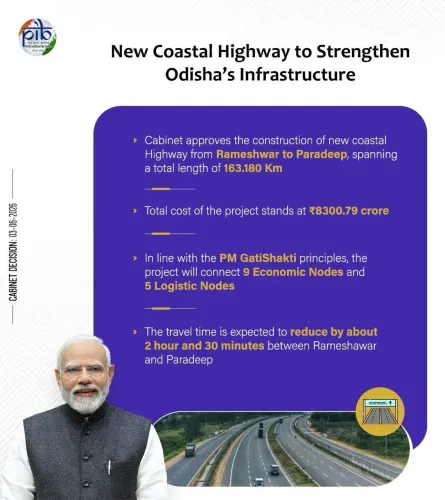
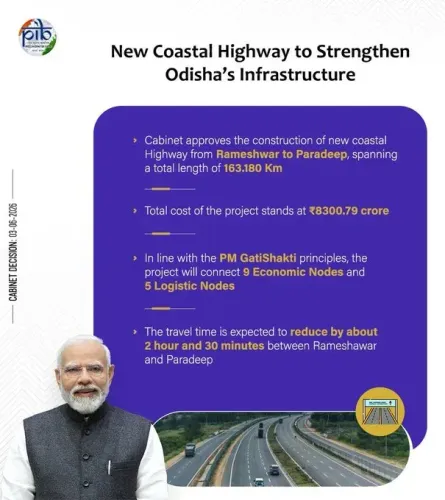
The Chief Minister's Office of Odisha hailed the Union Cabinet's approval of a 163.18 km coastal highway from Rameshwar to Paradip, to be built at Rs 8,300 crore under PM Gati Shakti. The corridor will link nine economic and five logistics nodes and cut travel time by about 2 hours 30 minutes.
Key Takeaways
Union Cabinet has approved a 163.18 km coastal highway between Rameshwar and Paradip .
The project carries an estimated outlay of Rs 8,300 crore .
It will be developed in alignment with the PM Gati Shakti national master plan.
The corridor will connect 9 major economic nodes and 5 logistics nodes .
Travel time between Rameshwar and Paradip is expected to fall by about 2 hours 30 minutes .
The CMO said the project opens 'a new chapter' for Odisha's trade and tourism sector.
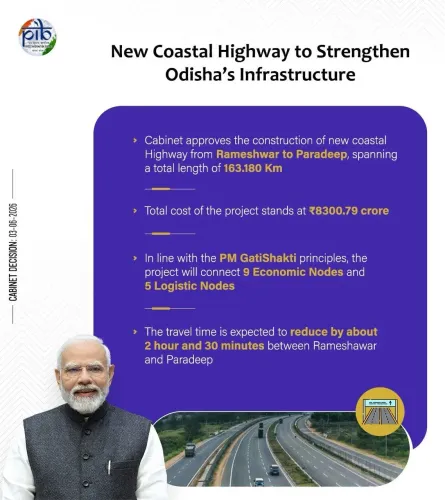
The Chief Minister's Office of Odisha on 3 June 2026 welcomed the Union Cabinet's approval for a new 163.18-kilometre coastal highway connecting Rameshwar to Paradip, calling it the opening of 'a new chapter' in the state's trade and tourism landscape. The mega project, estimated at Rs 8,300 crore, is to be developed in alignment with the PM Gati Shakti national master plan. The CMO said the corridor would link nine major economic nodes and five logistics nodes along Odisha's coastline.
Context
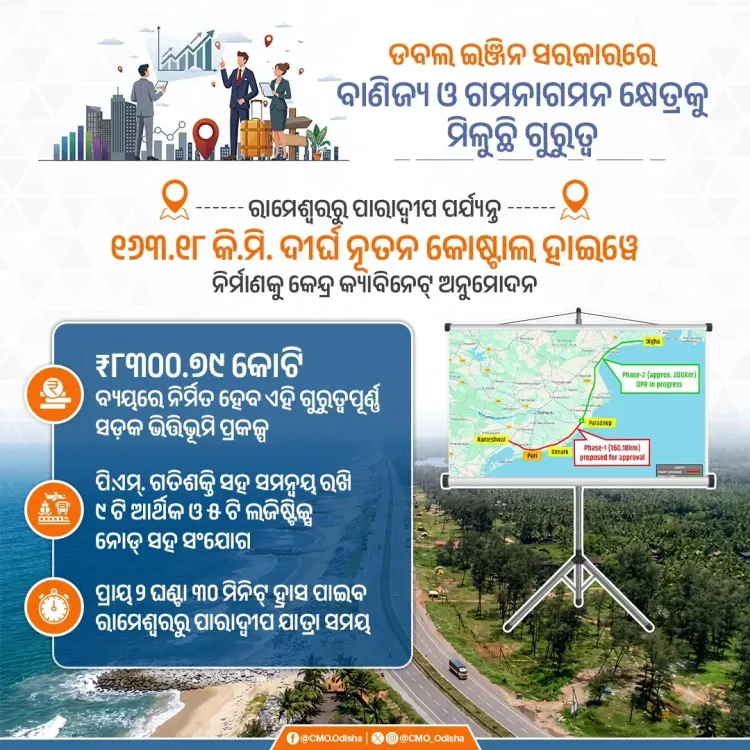
In its post, the CMO stated that the Union Cabinet's clearance for the Rameshwar-to-Paradip corridor 'has added a new chapter to the state's trade and tourism sector'. It added that, once built, the alignment would cut travel time between Rameshwar and Paradip by approximately 2 hours 30 minutes, easing transport and energising economic activity along the Bay of Bengal coast.
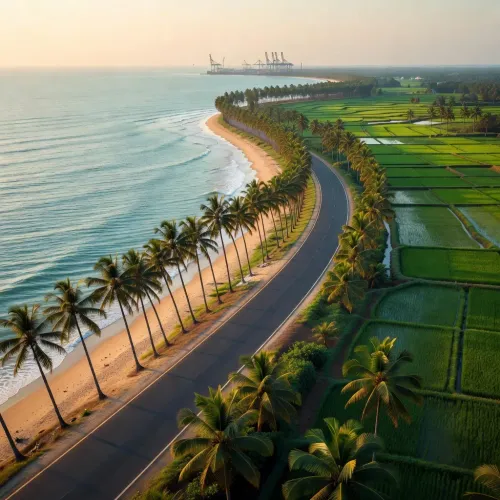
The original message, posted in Odia, reads in translation: 'The Union Cabinet's approval for the construction of a new 163.18 km long coastal highway from Rameshwar to Paradip has added a new chapter to the state's trade and tourism sector.' The CMO framed the corridor as both a logistics upgrade and a tourism enabler, given the temple towns, beaches and heritage sites that dot the Odisha coast.
Policy backdrop
The project is being positioned within the PM Gati Shakti National Master Plan, launched in October 2021 to integrate multimodal infrastructure planning across central ministries through a GIS-based coordination platform. By mapping the new highway to nine economic and five logistics nodes, the alignment leans on Gati Shakti's principle of synchronising road, rail and port investments rather than building them in silos.
The corridor also sits within a longer policy arc. The Bharatmala Pariyojana, approved in 2017, set out to optimise national freight movement through new economic corridors and coastal connectivity. The Sagarmala initiative, cleared in 2015, focused on port-led development. Odisha's coastline, anchored by the deep-water port at Paradip in Jagatsinghpur district, has been a recurring focus area under both programmes for linking emerging industrial clusters with maritime gateways.
Stakeholders and impact
For coastal traders and logistics operators, a shorter, dedicated corridor to Paradip Port — which handles bulk cargo, petroleum and container traffic — promises lower turnaround times and reduced freight costs. The CMO's emphasis on a 2 hour 30 minute reduction in journey time signals a sharper integration of hinterland producers with the port's export pipeline.
Tourism operators stand to gain from easier access to coastal destinations between the two end points, while fishing communities along the alignment will be watching land acquisition contours closely. The five logistics nodes flagged in the post suggest space for warehousing, cold chains and multimodal transfer points — typical components of Gati Shakti-aligned highway projects.
State officials have framed the corridor as a structural shift rather than a routine road upgrade, citing the scale of the Rs 8,300 crore outlay. The investment is among the larger single-stretch highway sanctions for Odisha in recent years.
What's next
Attention now turns to the operational rollout: detailed project reports, tender notices and land acquisition notifications from the Union Ministry of Road Transport and Highways, along with environmental clearances for the coastal stretch. Subsequent allocations in the state budget for land compensation and rehabilitation will indicate the pace at which the corridor moves from sanction to spade-work.
If executed on schedule, the Rameshwar-Paradip coastal highway could become a template for how state governments package coastal infrastructure proposals through the Gati Shakti platform — potentially accelerating similar corridors along India's eastern seaboard and reshaping the economic geography of Odisha's coast.
Point of View
And this sanction extends that trajectory by hardwiring nine economic nodes into a single coastal spine. The political subtext is cooperative federalism in action — a state government publicly crediting a central clearance for a high-value project. The real test will be land acquisition speed and environmental compliance, which historically determine whether such corridors meet their headline timelines.
NationPress
19 Sept 2026
Frequently Asked Questions
What is the Rameshwar to Paradip coastal highway project?
It is a new 163.18 km coastal highway approved by the Union Cabinet to connect Rameshwar with Paradip in Odisha. The project will be built at an estimated cost of Rs 8,300 crore in alignment with the PM Gati Shakti master plan.
How much will the Rameshwar-Paradip coastal highway cost?
The project is estimated at Rs 8,300 crore, according to the Chief Minister's Office of Odisha. The outlay is among the larger single-stretch highway sanctions for the state in recent years.
How much travel time will the new Odisha coastal highway save?
The corridor is expected to reduce travel time between Rameshwar and Paradip by approximately 2 hours 30 minutes. The CMO said this will ease transport and boost economic activity along the coast.
How is the project linked to PM Gati Shakti?
The highway has been planned in coordination with the PM Gati Shakti National Master Plan, launched in October 2021. It will connect nine major economic nodes and five logistics nodes identified under the integrated infrastructure framework.
Why is Paradip important for Odisha's economy?
Paradip hosts a major deep-water seaport in Jagatsinghpur district that handles bulk cargo, petroleum and container traffic. Better road connectivity to the port is expected to lower logistics costs for coastal traders and exporters.