CM Majhi hails 12 years of central farm schemes, cites Odisha gains
Synopsis
Odisha CM Mohan Charan Majhi marked 12 years of central farm schemes on 11 June 2026, crediting PM-KISAN, Fasal Bima Yojana, e-NAM and PM-KUSUM for farmer welfare, while highlighting state measures including Rs 3,100 per quintal paddy procurement and a cold storage expansion drive.
Key Takeaways
Odisha Chief Minister Mohan Charan Majhi posted on 11 June 2026 marking 12 years of central agricultural welfare under PM Narendra Modi .
He credited four central schemes — PM-KISAN , PM Fasal Bima Yojana , PM-KUSUM and e-NAM — with providing financial and social security to farmers.
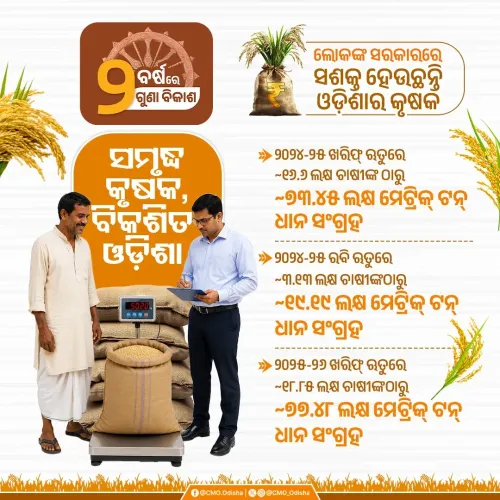
Odisha's Samruddha Krushak Yojana is procuring paddy at Rs 3,100 per quintal to ensure remunerative returns for growers.
The state's CM-Kisan scheme supplements central income transfers, while the Shri Anna Abhiyan promotes millets cultivation.
A state-wide cold storage construction policy has been cited as a new direction for Odisha's agricultural economy.
The post was framed around the theme 'Krushak Samruddhiru Rashtra Samruddhi' — farmer prosperity as the foundation of national prosperity.
Odisha Chief Minister Mohan Charan Majhi on Thursday, 11 June 2026 lauded the agricultural welfare record of the Narendra Modi-led central government, saying that the past 12 years had opened a new chapter of dignity, security and prosperity for farmers across India. In the same post, he outlined complementary state-level measures his government has pursued to deepen those gains for Odisha's farming communities.
Context
Writing in Odia, the Chief Minister described Prime Minister Modi's tenure as having brought 'samman, suraksha o samruddhi' (honour, security and prosperity) to the country's 'annadaata' — the food-provider farmers. He specifically credited central programmes such as PM-KISAN, the Pradhan Mantri Fasal Bima Yojana, PM-KUSUM and e-NAM with delivering financial and social protection to cultivators. The post was tagged with the hashtag #12YearsOfKisanSamriddhi, signalling it as part of a coordinated BJP communication drive marking a decade-plus of central farm policy.
Majhi also invoked the hashtags #2YearsofLokankaSarakar and #2YearsofKrushakSamruddhi, situating the message within his own government's two-year anniversary in office. The BJP came to power in Odisha in 2024, ending a long stretch of BJD governance, and has since sought to align state agricultural policy with central schemes.
Policy Backdrop
PM-KISAN, launched in February 2019, provides eligible farmer families an annual direct income transfer of Rs 6,000 in three instalments. The Pradhan Mantri Fasal Bima Yojana, introduced in 2016, replaced earlier crop-insurance frameworks with a restructured premium-subsidy model aimed at broader coverage. e-NAM, also rolled out in 2016, created a national digital marketplace integrating state mandis to improve price discovery for farmers.
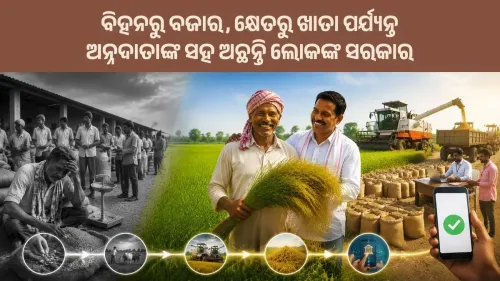
PM-KUSUM (Pradhan Mantri Kisan Urja Suraksha evam Utthaan Mahabhiyan) focuses on solar energy for irrigation, reducing farmers' dependence on grid power and diesel pumps. Together, these four schemes represent the central government's 'seed-to-market' architecture — a phrase Majhi echoed when he described policies designed 'bihana ru bajaar' (from seed to market) with farmer welfare at the centre.
Odisha's State-Level Measures
The Chief Minister highlighted the state's Samruddha Krushak Yojana, under which paddy is being procured at Rs 3,100 per quintal, as a key instrument for ensuring remunerative prices for paddy growers. He also cited the CM-Kisan scheme as an additional income-support layer for Odisha farmers, running in parallel to the central PM-KISAN transfers.
Majhi further mentioned the Shri Anna Abhiyan — a millets promotion drive — and a state-wide cold storage construction policy as measures designed to diversify cropping patterns and reduce post-harvest losses. He framed these initiatives as expressions of 'Odishara swabhimana o sankalpa' (Odisha's self-respect and resolve), positioning state policy as a proud complement to central efforts rather than a substitute.
Stakeholders and Impact
Odisha has a large agrarian base, with paddy cultivation dominant across its districts. Paddy growers stand to benefit directly from the enhanced procurement price under the Samruddha Krushak Yojana, while the millets push under the Shri Anna Abhiyan targets farmers in rain-fed and tribal belt areas where coarse cereals are traditionally grown. Cold storage infrastructure, if rolled out at scale, could reduce distress selling by giving farmers the ability to hold produce for better prices.
The Chief Minister closed his post with the phrase 'Krushak Samruddhiru Rashtra Samruddhi' — 'From Farmer Prosperity, National Prosperity' — framing agricultural welfare as the foundation of broader national development. This mirrors the BJP's consistent messaging that farm income growth is inseparable from India's economic trajectory.
What's Next
Attention will now turn to state budget allocations for paddy procurement operations and the pace of cold storage infrastructure deployment across Odisha's districts. The release of verifiable impact data on farmer income levels — combining central and state transfers — will be a key metric for assessing whether the policy architecture is translating into measurable on-ground change. The two-year anniversary framing suggests the Odisha government intends to make farmer welfare a central plank heading into future electoral cycles.
Point of View
Majhi is performing a dual political task: legitimising the central record and staking a claim for state-level credit. The emphasis on a procurement price of Rs 3,100 per quintal — above the central MSP — signals competitive federalism on farm support, a pattern seen in other BJP-ruled states. Whether the cold storage and millets diversification measures translate into structural income gains for small and marginal farmers will determine if this narrative holds beyond the anniversary cycle.
NationPress
24 Sept 2026
Frequently Asked Questions
What is the Samruddha Krushak Yojana in Odisha?
The Samruddha Krushak Yojana is an Odisha state scheme under which the government procures paddy at Rs 3,100 per quintal, providing farmers a price above the central minimum support price to ensure more remunerative returns.
What is PM-KISAN and how does it benefit Odisha farmers?
PM-KISAN is a central government scheme launched in February 2019 that provides eligible farmer families a direct income transfer of Rs 6,000 per year in three instalments. Odisha farmers enrolled in the scheme receive these transfers directly into their bank accounts.
What is the Shri Anna Abhiyan mentioned by CM Majhi?
The Shri Anna Abhiyan is an Odisha government initiative to promote millets cultivation, particularly ragi (finger millet), targeting farmers in rain-fed and tribal belt regions where coarse cereals are traditionally grown.
Why did Odisha CM Majhi post about farm schemes on 11 June 2026?
The post was part of a BJP communication drive marked by the hashtag #12YearsOfKisanSamriddhi, celebrating 12 years of central agricultural welfare under Prime Minister Modi, coinciding also with the two-year anniversary of Majhi's own government in Odisha.
What is e-NAM and how does it help farmers?
e-NAM, or the Electronic National Agriculture Market, is a central government platform launched in 2016 that links state agricultural mandis into a single national digital marketplace, improving price transparency and market access for farmers selling their produce.