CM Majhi hails India's first Hydrogen Train inauguration

Synopsis
Odisha Chief Minister Mohan Charan Majhi praised the inauguration of India's first Hydrogen Train on 17 July 2026, linking the milestone to PM Modi's Viksit Bharat vision and Indian Railways' net-zero 2030 target. The launch builds on the 2023 National Green Hydrogen Mission and India's Paris Agreement commitments.
Key Takeaways
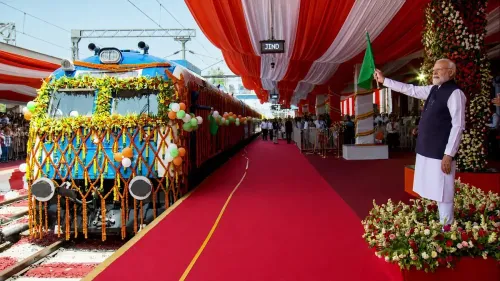
India's first Hydrogen Train was inaugurated on 17 July 2026 , marking a new chapter in zero-emission rail mobility.
Odisha CM Mohan Charan Majhi publicly welcomed the development, connecting it to PM Narendra Modi's Viksit Bharat vision.
Indian Railways committed to a net-zero carbon target by 2030 at COP26 in November 2021, underpinning the hydrogen push.
The National Green Hydrogen Mission , approved in January 2023 , specifically earmarked railway pilot projects for hydrogen technology.
The hydrogen train produces only water vapour, eliminating local air pollutants and advancing India's 2070 net-zero pledge .
Rollout of additional hydrogen rakes and state-level refuelling infrastructure — including in Odisha — is the immediate next step.
Odisha Chief Minister Mohan Charan Majhi on Friday, 17 July 2026 welcomed the inauguration of India's first Hydrogen Train, calling it a historic leap in the transformation of Indian Railways and a reflection of the country's growing leadership in clean, sustainable transportation.
Context
In his post, CM Majhi described the development as 'a testament to India's unwavering commitment to innovation, green growth and technological self-reliance.' He credited the achievement to the 'visionary leadership' of Prime Minister Narendra Modi, framing it within the broader Viksit Bharat vision — the government's roadmap for a developed India by 2047.
The Hydrogen Train represents a significant pivot in Indian Railways' propulsion strategy, moving beyond diesel and conventional electric traction toward zero-emission hydrogen fuel-cell technology. CM Majhi underscored its role in 'reducing carbon emissions, strengthening energy security and shaping a cleaner, more resilient future for generations to come.'
Policy Backdrop
Indian Railways — the world's fourth-largest rail network — declared a net-zero carbon emissions target by 2030 at the COP26 climate summit in November 2021. That commitment set in motion a series of policy moves, including Budget 2021-22 announcements of memoranda of understanding for hydrogen fuel-cell train prototypes, with heritage and hill routes identified as early candidates.
The National Green Hydrogen Mission, approved in January 2023, provided the institutional backbone for scaling hydrogen use across transport, industry and power. Pilot projects for railways were specifically earmarked under the mission, making today's inauguration a direct outcome of that multi-year policy architecture.
The initiative also dovetails with India's 2070 net-zero pledge and its Paris Agreement commitments, positioning hydrogen alongside expanded electrification and solar-powered traction as pillars of decarbonised rail mobility.
Stakeholders and Impact
Railway passengers stand to benefit from quieter, cleaner train operations as hydrogen fuel-cell rakes produce only water vapour as a by-product, eliminating local air pollutants associated with diesel traction. For the clean energy industry, the inauguration signals a large, captive market for domestically produced green hydrogen, consistent with the Atmanirbhar Bharat push for indigenous technology development.
States like Odisha, which host significant rail freight corridors and industrial hubs, have a direct stake in the rollout of refuelling infrastructure. CM Majhi's public endorsement signals state-level readiness to coordinate on hydrogen supply chains alongside the central government's push.
What's Next
Attention will now turn to the phased rollout of additional hydrogen train rakes on designated routes and the development of refuelling stations at key railway yards. State governments, including Odisha, are expected to play a role in facilitating land and logistics support for this infrastructure buildout.
As Indian Railways moves to set new global benchmarks in sustainable mobility, the pace of hydrogen fleet expansion and the cost trajectory of green hydrogen production will determine how quickly the technology scales from a pioneering showcase to mainstream operations across the network.
Point of View
The launch tests whether India can translate its ambitious hydrogen policy architecture — the 2023 National Green Hydrogen Mission, the Railways net-zero pledge — into operational scale, or whether it remains a showcase project. The speed of refuelling infrastructure rollout across states like Odisha will be the real measure of political commitment behind the rhetoric.
NationPress
17 Jul 2026
Frequently Asked Questions
What is India's first Hydrogen Train?
India's first Hydrogen Train is a fuel-cell-powered rail prototype developed under Indian Railways' decarbonisation programme, producing only water vapour instead of carbon emissions. It was inaugurated in July 2026 as part of the National Green Hydrogen Mission's railway pilot projects.
What did Odisha CM Mohan Charan Majhi say about the Hydrogen Train?
CM Majhi called the inauguration 'a historic leap' in Indian Railways' transformation and praised it as a testament to India's commitment to innovation and green growth, crediting PM Narendra Modi's leadership for the achievement.
What is the National Green Hydrogen Mission?
The National Green Hydrogen Mission is a central government scheme approved in January 2023 to scale up green hydrogen production and deployment across transport, industry and power sectors, with specific pilot projects earmarked for Indian Railways.
What is Indian Railways' net-zero target?
Indian Railways pledged to achieve net-zero carbon emissions by 2030, a commitment announced at the COP26 climate summit in November 2021. The hydrogen train programme is one of several technologies being deployed to meet that target.
How does the Hydrogen Train relate to Viksit Bharat?
Viksit Bharat is the government's vision for a developed India by 2047, emphasising technological self-reliance and sustainable infrastructure. The Hydrogen Train is cited by leaders including CM Majhi as a concrete example of next-generation technology advancing that vision.