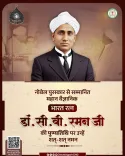
CM Majhi pays tribute to C.V. Raman on death anniversary
Synopsis
Odisha Chief Minister Mohan Charan Majhi honoured physicist C.V. Raman on his death anniversary on 21 November 2026. Raman, who won the Nobel Prize in Physics in 1930 and received the Bharat Ratna in 1954, remains a defining figure in India's scientific heritage.
Key Takeaways
Odisha CM Mohan Charan Majhi posted a tribute to C.V.
Raman on his death anniversary, 21 November 2026 .
Raman won the Nobel Prize in Physics in 1930 for discovering the Raman Effect, the first Asian scientist to receive the honour.
He was awarded the Bharat Ratna in 1954 and passed away on 21 November 1970 in Bengaluru.
National Science Day is observed every year on 28 February — the date Raman announced his discovery in 1928 — since 1987 .
Indian political leaders routinely mark the death anniversaries of national scientific figures as part of civic and institutional remembrance.
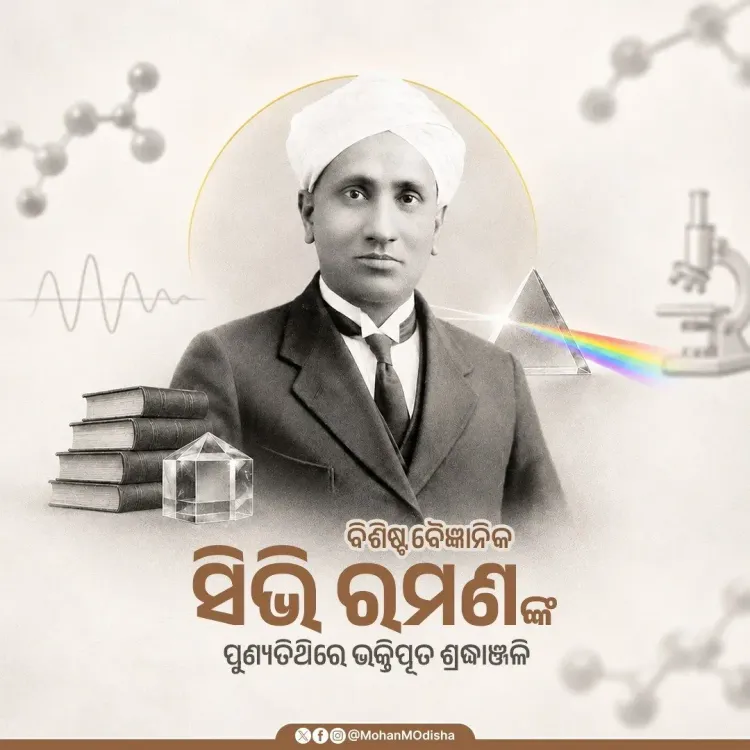
Fifty-six years after Sir C.V. Raman passed away, his legacy still commands the attention of India's highest offices — including, on 21 November 2026, the Chief Minister of Odisha. Odisha Chief Minister Mohan Charan Majhi posted a heartfelt tribute on X, honouring the Nobel laureate and Bharat Ratna on his death anniversary.
Writing in Odia, CM Majhi offered his shraddhaanjali (reverential homage) to the 'distinguished scientist and Nobel Prize winner, Bharat Ratna C.V. Raman' on his punyatithi — the sacred anniversary of his passing.
The man behind the light: C.V. Raman's enduring legacy
Chandrasekhara Venkata Raman remains one of the most towering figures in the history of Indian science. In 1930, he became the first Asian scientist to win the Nobel Prize in Physics, recognised for his discovery of the Raman Effect — the phenomenon describing how light scatters when it passes through a transparent material, shifting in wavelength and revealing the material's molecular fingerprint. The discovery opened an entirely new field of spectroscopy and continues to power modern analytical science, from pharmaceutical labs to space telescopes.
In 1954, the Government of India honoured him with the Bharat Ratna, the country's highest civilian award. He died on 21 November 1970 in Bengaluru, aged 82. His birthday, 28 February — the date he announced the Raman Effect in 1928 — is observed as National Science Day across India every year since 1987.
A ritual of remembrance in Indian political life
Tributes of this kind from state chief ministers on the death anniversaries of national scientific icons are a consistent feature of Indian public life. They serve as a moment of collective reaffirmation — a signal to citizens, especially students, that the state values its intellectual heritage. For Odisha, a state with a growing emphasis on science and technology education, such gestures carry quiet institutional weight.
C.V. Raman's story — a government servant who did Nobel-winning science on a shoestring, in Calcutta, decades before India's independence — is precisely the kind of narrative that state governments invoke when building the case for investment in homegrown research and curiosity-driven education.
The real tribute to Raman, as scientists and educators have long argued, is not the annual post — it is the policy that follows. Odisha's science promotion calendar, particularly around National Science Day in February, will be the next measure of how that sentiment translates into action.
Point of View
The gesture also fits a broader BJP-led emphasis on celebrating India's pre-independence intellectual achievers as part of civilisational pride. The real policy test, however, comes in February: whether Odisha's National Science Day observances translate into concrete investments in research infrastructure or student science programmes. A tribute without a follow-through budget line is, ultimately, just a post.
NationPress
21 Nov 2026
Frequently Asked Questions
Why did CM Mohan Charan Majhi pay tribute to C.V. Raman on 21 November?
21 November is the death anniversary of C.V. Raman , who passed away on this date in 1970 . CM Majhi posted a tribute on X to mark the occasion and honour Raman's scientific legacy.
What did C.V. Raman win the Nobel Prize for?
C.V. Raman won the Nobel Prize in Physics in 1930 for discovering the Raman Effect — the scattering of light as it passes through a transparent medium, which reveals the molecular composition of materials.
What is the Bharat Ratna and when did C.V. Raman receive it?
The Bharat Ratna is India's highest civilian honour. C.V. Raman received it in 1954 , making him one of the earliest recipients of the award.
What is National Science Day and how is it connected to C.V. Raman?
National Science Day is observed on 28 February every year since 1987 to mark the date in 1928 when C.V. Raman announced his discovery of the Raman Effect.
Who was C.V. Raman and why is he significant for India?
Chandrasekhara Venkata Raman was an Indian physicist who became the first Asian to win a Nobel Prize in Physics in 1930 . His discovery of the Raman Effect remains foundational to modern spectroscopy and molecular science.