Punjab Police Arrests 85,598 in 10-Month Gangster Crackdown

Synopsis
The Chief Minister's Office of Punjab reports that the 'Gangsteran Te Vaar' campaign has completed 10 months with 85,598 arrests, 1.67 lakh raids, and the recovery of 1,497 weapons and 21 hand grenades across the state.
Key Takeaways
85,598 individuals arrested — including gangsters and their associates — in 10 months of the 'Gangsteran Te Vaar' campaign.
Punjab Police conducted 1.67 lakh raids across the state since the campaign's launch.
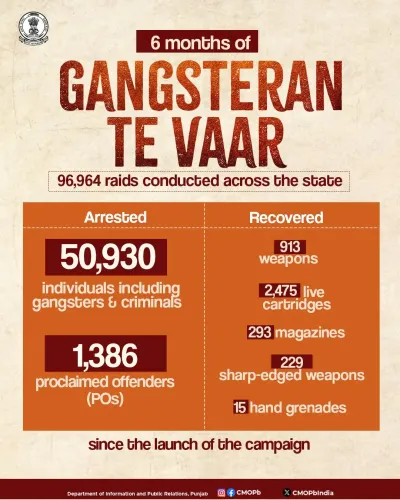
Recovered 1,497 weapons , 4,561 live cartridges , 487 magazines , 296 sharp-edged weapons , and 21 hand grenades .
The campaign is a flagship law-and-order initiative of the Aam Aadmi Party government under Chief Minister Bhagwant Mann , who took office in March 2022 .
Punjab has historically faced organised crime networks intertwined with narcotics trafficking and cross-border linkages.
Sustained prosecution rates and legislative support will determine whether the campaign's gains prove durable beyond the arrest numbers.
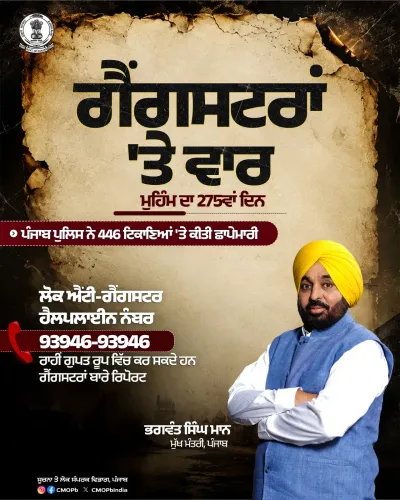
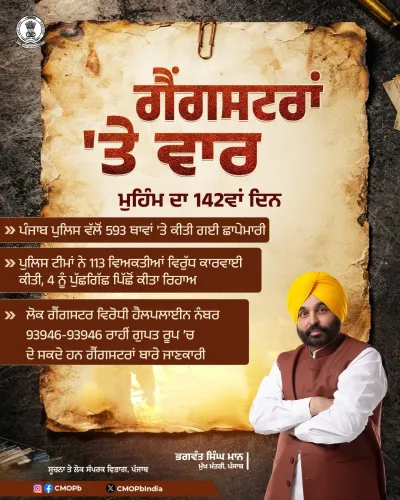
Ten months into one of Punjab's most sweeping law-enforcement offensives, the numbers are staggering — and the Chief Minister's Office of Punjab says they are still climbing. The CMO Punjab announced on Saturday, 21 November 2026 that the 'Gangsteran Te Vaar' campaign has resulted in the arrest of 85,598 individuals, including gangsters and their associates, following 1.67 lakh raids conducted across the state since the campaign's launch.
What 1.67 Lakh Raids Pulled Off Punjab's Streets
The sheer scale of the operation is hard to overstate. Police teams recovered 1,497 weapons, 4,561 live cartridges, and 487 magazines from arrested individuals — alongside 296 sharp-edged weapons and, most alarmingly, 21 hand grenades. Each grenade recovered is a reminder of just how heavily armed Punjab's criminal networks had become.
The campaign's Punjabi name — Gangsteran Te Vaar (roughly, 'Strike Against Gangsters') — signals its intent with deliberate bluntness. It is not a policing review or a task force review; it is framed as an offensive, and the operational tempo reflects that framing.
The Long Shadow of Organised Crime in Punjab
Punjab's struggle with organised crime is not new. The state has for years faced gangs operating at the intersection of narcotics trafficking, extortion, and cross-border networks — a combination that has made disrupting them structurally difficult for successive governments. The Aam Aadmi Party, which came to power under Chief Minister Bhagwant Mann in March 2022, made a decisive crackdown on gangsters and the drug mafia a centrepiece of its election manifesto and, subsequently, its governance agenda.
'Gangsteran Te Vaar' is the operational expression of that political commitment — a sustained, state-wide enforcement drive rather than a periodic spike in policing activity.
21 Hand Grenades and What They Signal About the Threat Level
The recovery of 21 hand grenades is the detail that cuts through the aggregate statistics. Grenades in civilian criminal hands point to supply chains that extend well beyond routine domestic crime — raising questions about cross-border smuggling routes and the depth of the networks Punjab Police is working to dismantle. The volume of live ammunition — more than 4,500 cartridges — compounds that picture.
Analysts watching Punjab's security environment will note that sustained enforcement pressure of this scale, if maintained, does more than rack up arrest numbers: it degrades the operational capacity of networks that depend on freedom of movement, access to weapons, and the ability to recruit.
What Comes After the Arrests
The campaign's next test is less about raids and more about what follows them. Prosecution rates, conviction timelines, and whether recovered weapons are systematically traced to their sources will determine whether the offensive translates into durable safety gains. The Punjab government has not yet announced dedicated budgetary or legislative support to sustain the campaign's pace — a gap that observers say will matter as the operation moves into its second year.
For now, the milestone is clear: ten months, 85,598 arrests, and enough seized firepower to equip a small army. Punjab Police has served notice that the campaign is not winding down.
Point of View
Which staked considerable credibility on law-and-order reform as a differentiator from predecessor administrations. The scale of the operation — arrests in the tens of thousands and grenade recoveries — signals genuine operational intensity, not merely optics. However, the true test of the campaign's policy legacy will lie in conviction rates and whether dismantled networks are replaced by new ones, a cycle Punjab has seen before. For AAP, sustaining this momentum heading into the next electoral cycle is as much a political imperative as a governance one.
NationPress
21 Nov 2026
Frequently Asked Questions
What is the 'Gangsteran Te Vaar' campaign in Punjab?
'Gangsteran Te Vaar' — meaning 'Strike Against Gangsters' — is a statewide anti-crime offensive launched by the Punjab government under Chief Minister Bhagwant Mann, targeting gangsters, their associates, and related criminal networks through large-scale raids and arrests.
How many people have been arrested in Punjab's anti-gangster campaign?
As of the campaign's 10-month milestone, Punjab Police has arrested 85,598 individuals , including gangsters and their criminal associates, following 1.67 lakh raids across the state.
What weapons were recovered during the Gangsteran Te Vaar campaign?
Punjab Police recovered 1,497 weapons , 4,561 live cartridges , 487 magazines , 296 sharp-edged weapons , and 21 hand grenades from individuals arrested during the campaign.
Who launched the Gangsteran Te Vaar campaign in Punjab?
The campaign was launched by the Aam Aadmi Party government in Punjab under Chief Minister Bhagwant Mann , who came to power in March 2022 with a manifesto pledge to crack down on gangsters and the drug mafia.
Why does Punjab have a problem with organised crime and gangsters?
Punjab has historically faced organised criminal gangs operating at the intersection of narcotics trafficking, extortion, and cross-border smuggling networks, making them structurally difficult to dismantle and a persistent challenge for successive state governments.