Chhattisgarh CMO pays tribute to Dr. C.V. Raman on death anniversary
Synopsis
The Chief Minister's Office of Chhattisgarh marked the death anniversary of Dr. C.V. Raman — Nobel Prize winner and Bharat Ratna recipient — paying tribute to the physicist whose 1928 discovery of the Raman Effect transformed global science and earned India its first Nobel in the sciences.
Key Takeaways
Raman's death anniversary was observed on 21 November 2026 with a tribute from the Chhattisgarh Chief Minister's Office .
Raman discovered the Raman Effect on 28 February 1928 , earning him the Nobel Prize in Physics in 1930 .
He was the first Asian and first non-white scientist to win a Nobel Prize in the sciences.
The Government of India awarded him the Bharat Ratna in 1954 .
28 February is observed as National Science Day in India to commemorate the Raman Effect discovery.
The Raman Effect has modern applications in pharmaceuticals, materials science, and space exploration, including NASA's Mars missions.
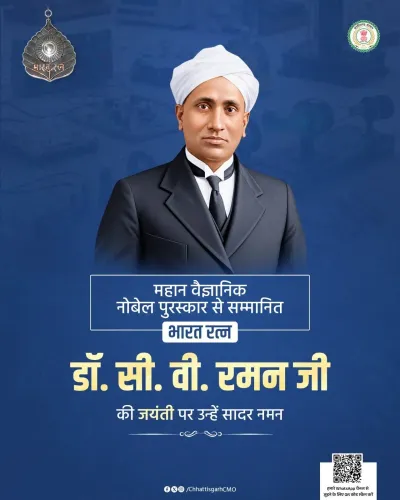
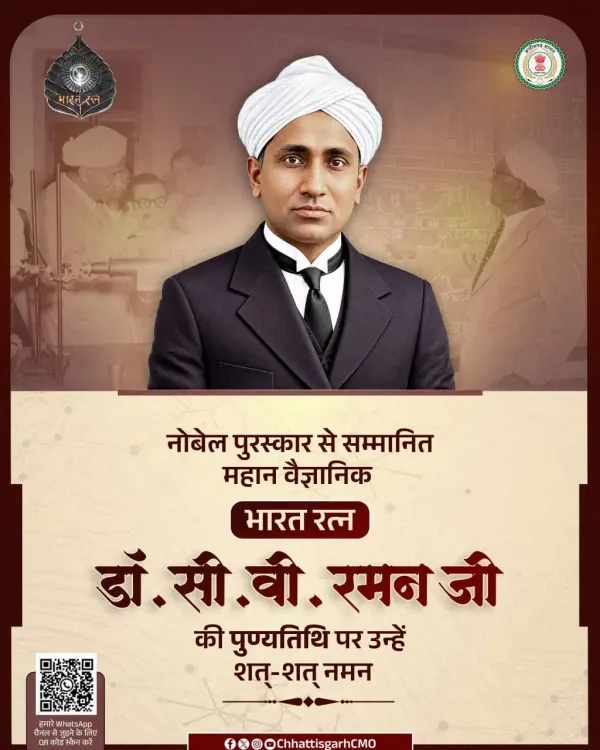
A century after he bent light into legend, Dr. Chandrasekhara Venkata Raman is remembered today by the Chief Minister's Office of Chhattisgarh, which offered a solemn tribute on his death anniversary, 21 November 2026.
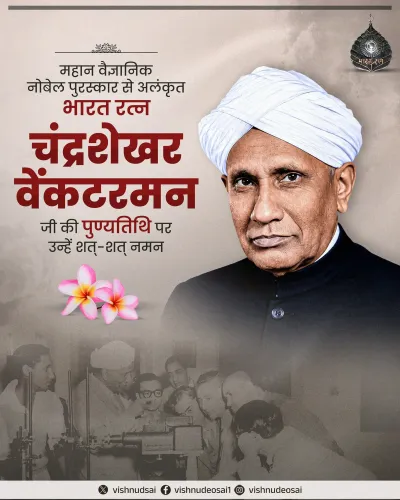
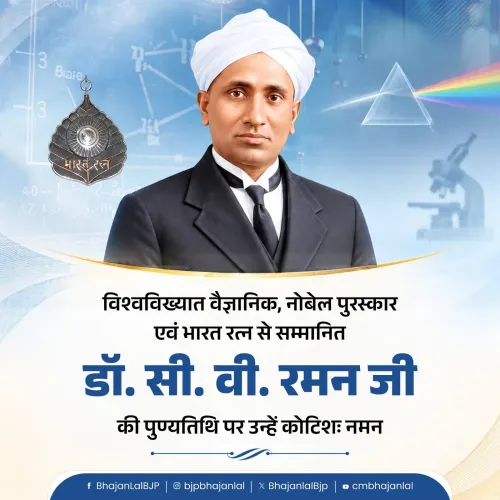
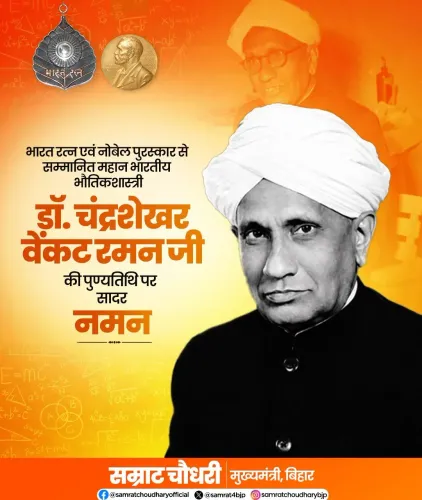
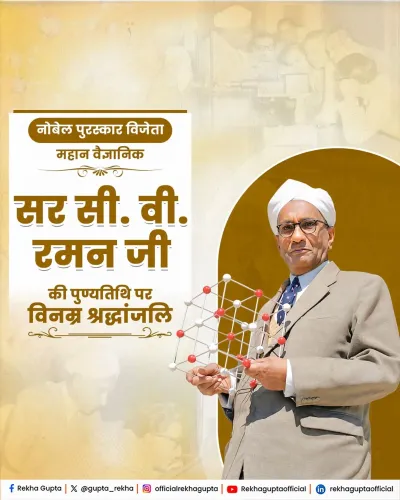
The post, shared on X, reads: 'Mahan bhautik shastri, prasiddh vaigyanik, Nobel Puraskar aur Bharat Ratna se alankrit Dr. C.V. Raman ji ki punyatithi par unhe shat-shat naman.' — 'Heartfelt salutations to the great physicist, renowned scientist, and recipient of the Nobel Prize and Bharat Ratna, Dr. C.V. Raman, on his death anniversary.'
The discovery that changed how science sees light
Dr. C.V. Raman discovered the Raman Effect on 28 February 1928 — demonstrating that when light passes through a transparent material, a portion of it scatters at a different wavelength, revealing the material's molecular fingerprint. The find was so consequential it earned him the Nobel Prize in Physics in 1930, making him the first Asian and first non-white scientist to win a Nobel in the sciences. India now marks 28 February as National Science Day every year in his honour.
In 1954, the Government of India conferred upon him the Bharat Ratna, the nation's highest civilian honour — a recognition that placed him in the same pantheon as statesmen and artists, a rare distinction for a working scientist.
State offices and the ritual of scientific memory
The Chhattisgarh CMO's tribute is part of a broader, consistent practice among Indian state governments: using official social-media channels to publicly acknowledge the birth and death anniversaries of national icons, particularly those who carried India's name to a global stage. For scientists like Raman — whose work lives in spectrometers, cancer diagnostics, and materials research worldwide — these moments of institutional memory serve as a quiet signal that the state values its intellectual heritage.
Raman's legacy is not merely archival. The Raman Effect underpins modern analytical chemistry, pharmaceutical quality control, and even planetary science — NASA has used Raman spectroscopy on Mars rovers. A tribute posted in Raipur connects, in its own small way, to a discovery that now operates on another planet.
Point of View
A state building its identity around mineral wealth and infrastructure, invoking Raman's legacy subtly broadens the state's cultural narrative. These moments, however ceremonial, keep the public conversation about scientific heritage alive between the bigger policy announcements.
NationPress
21 Nov 2026
Frequently Asked Questions
When did Dr. C.V. Raman die?
Dr. C.V. Raman passed away on 21 November 1970 in Bangalore, India, at the age of 82.
What is the Raman Effect?
The Raman Effect, discovered on 28 February 1928 , is the phenomenon by which light scatters at a different wavelength when it passes through a transparent material, revealing the material's molecular structure. It is the basis of Raman spectroscopy used widely in science and industry.
Why did C.V. Raman win the Nobel Prize?
Dr. C.V. Raman was awarded the Nobel Prize in Physics in 1930 for his discovery of the Raman Effect, which demonstrated inelastic scattering of photons and provided a new tool for studying molecular composition.
What is National Science Day in India?
National Science Day is observed every year on 28 February to commemorate the day Dr. C.V. Raman announced the discovery of the Raman Effect in 1928. It aims to promote scientific awareness among citizens.
Was C.V. Raman awarded the Bharat Ratna?
Yes. Dr. C.V. Raman received the Bharat Ratna , India's highest civilian honour, in 1954 , making him one of the earliest recipients of the award.