Kishan Reddy Pays Tribute to C.V. Raman on Birth Anniversary
Synopsis
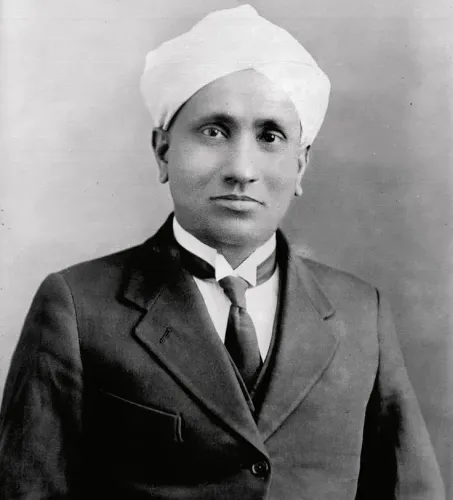
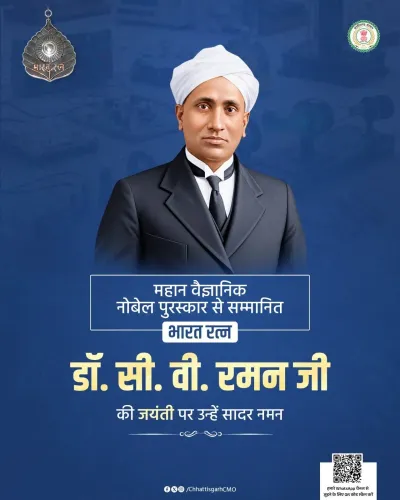
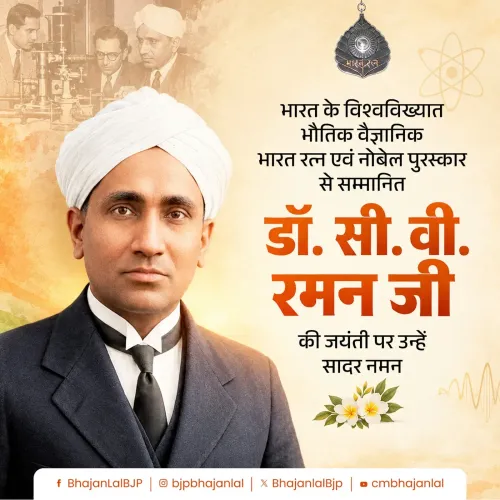
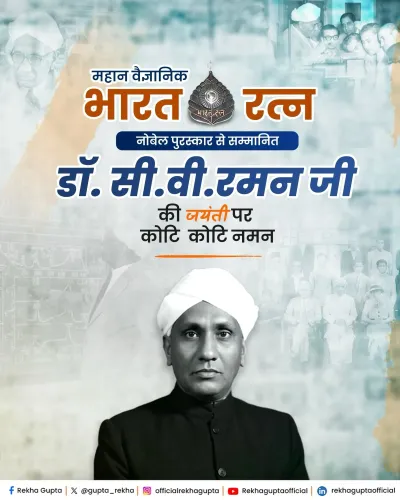
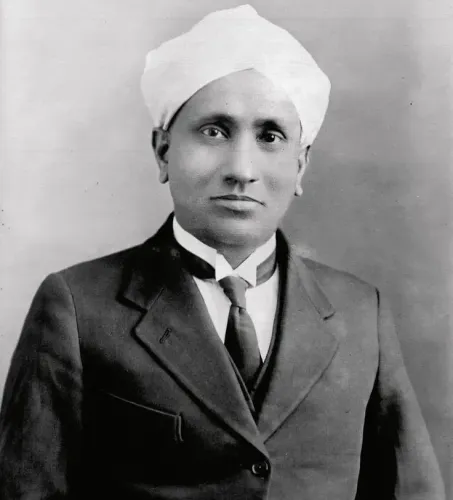
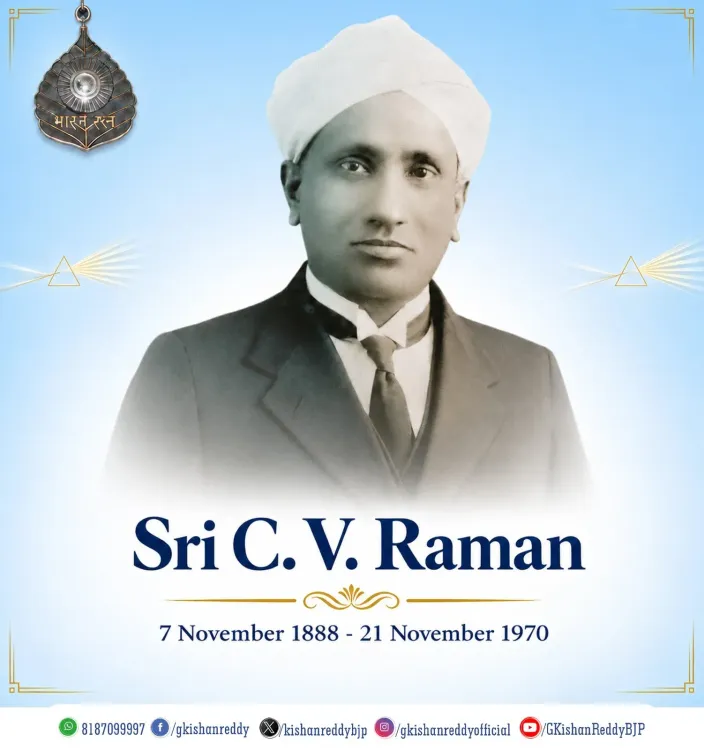
Union Coal and Mines Minister G. Kishan Reddy paid tribute to Bharat Ratna Sir C.V. Raman on his birth anniversary, noting the physicist's 1930 Nobel Prize for the Raman Effect — a discovery that made him the first Asian to win science's highest honour.
Key Takeaways
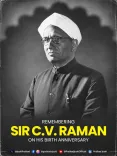
Kishan Reddy posted a tribute to Sir C.
Raman on his birth anniversary on 7 November 2026 .
Raman discovered the Raman Effect in 1928 , explaining the inelastic scattering of light through transparent materials.
He was awarded the Nobel Prize in Physics in 1930 , becoming the first Asian to receive the honour in the sciences.
The Government of India conferred the Bharat Ratna on Raman in 1954 .
National Science Day is observed on 28 February every year since 1986 to commemorate the discovery of the Raman Effect.
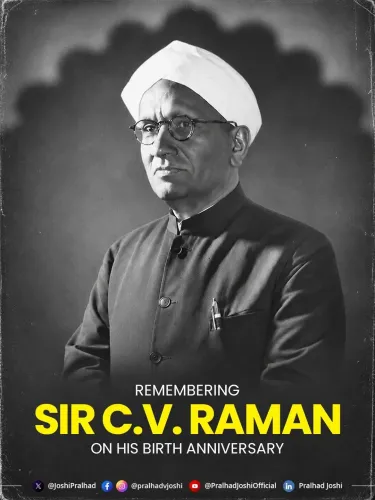
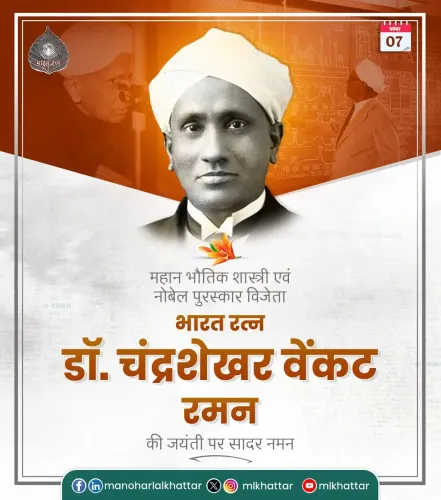
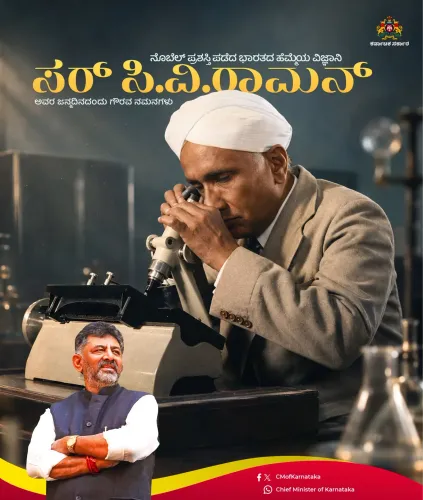
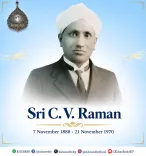
A Nobel laureate who bent light and changed science forever — Union Coal and Mines Minister G. Kishan Reddy marked the birth anniversary of Bharat Ratna Sir C. V. Raman on Saturday, 7 November 2026, with a heartfelt tribute on X, honouring the physicist whose discovery reshaped humanity's understanding of matter.
Reddy wrote: 'Humble tributes to Bharat Ratna Sir C. V. Raman Ji on his birth anniversary. A distinguished physicist, his discovery of the Raman Effect earned him the Nobel Prize in Physics in 1930, making him the first Asian to receive this honour. His seminal contribution received international acclaim, bringing honour to the nation. May his legacy continues to inspire generations to pursue scientific research and innovation.'
The discovery that made history
Sir Chandrasekhara Venkata Raman made his landmark observation in 1928: when light passes through a transparent material, a small fraction of it scatters at a different wavelength — a phenomenon now universally known as the Raman Effect. The finding was elegant in its simplicity and staggering in its implications. Two years later, in 1930, it earned him the Nobel Prize in Physics, making him not only the first Indian but the first Asian to claim that honour in the sciences. The global scientific community took notice — and so did India.From Nobel to Bharat Ratna
The recognition did not stop at Stockholm. In 1954, the Government of India conferred upon Raman the Bharat Ratna, the country's highest civilian honour — a full acknowledgement that his achievement belonged not just to physics, but to the national story. Decades later, in 1986, India institutionalised his legacy by designating 28 February — the date of the original 1928 discovery — as National Science Day, observed annually across research institutions, universities, and schools.Why India's leaders keep returning to Raman
Tributes to C.V. Raman from ministers and senior officials have become a consistent thread in Indian public life, particularly around his birth and discovery anniversaries. The gesture carries a dual purpose: honouring a giant of twentieth-century science while reinforcing a broader national narrative — that India's intellectual heritage is deep, its scientific contributions globally consequential, and its future researchers have towering shoulders to stand on. For a nation that has made science and technology investment a centrepiece of its development agenda, invoking Raman is never purely ceremonial. It is a reminder of what original inquiry can achieve — and a quiet challenge to the next generation to match it.Point of View
Used consistently across party lines to anchor the national identity to scientific achievement. For BJP leaders like Kishan Reddy — who simultaneously holds the BJP Telangana state presidency — invoking a towering South Indian scientist carries an additional resonance in a state where BJP is working to consolidate its footprint. More broadly, these tributes track India's official effort to link its ambitious present-day science and technology investments to a proven, Nobel-calibre intellectual heritage — a narrative that serves both domestic pride and international positioning.
NationPress
7 Nov 2026
Frequently Asked Questions
Why is C.V. Raman's birth anniversary celebrated?
C.V. Raman's birth anniversary is marked by scientists, institutions, and public figures to honour his extraordinary contribution to physics — particularly the discovery of the Raman Effect in 1928 , which earned him the Nobel Prize in Physics in 1930 . He remains the first Asian to have won a Nobel Prize in the sciences.
What is the Raman Effect?
The Raman Effect is the phenomenon by which light changes wavelength when it scatters through a transparent material. Discovered by Sir C.V. Raman in 1928 , it has become a fundamental tool in chemistry, materials science, and medical diagnostics.
What is National Science Day and when is it observed?
National Science Day is observed on 28 February every year in India to commemorate the discovery of the Raman Effect on that date in 1928 . The Government of India established the observance in 1986 .
What awards did C.V. Raman receive?
Sir C.V. Raman was awarded the Nobel Prize in Physics in 1930 for the discovery of the Raman Effect, making him the first Asian to receive the honour. In 1954 , the Government of India awarded him the Bharat Ratna , the country's highest civilian distinction.
Who is G. Kishan Reddy?
G. Kishan Reddy is the Union Minister of Coal and Mines in the Government of India and serves as the BJP Telangana state president . He posted the tribute to C.V. Raman on 7 November 2026 via his official X account.