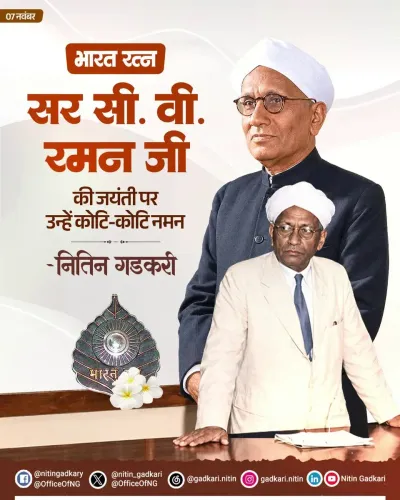
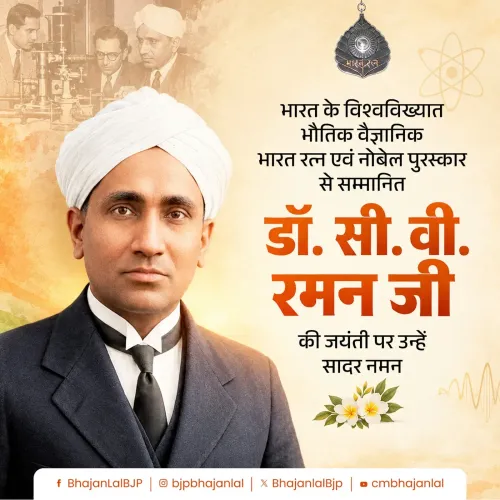
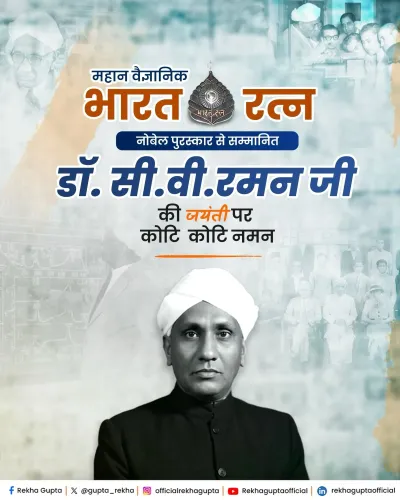
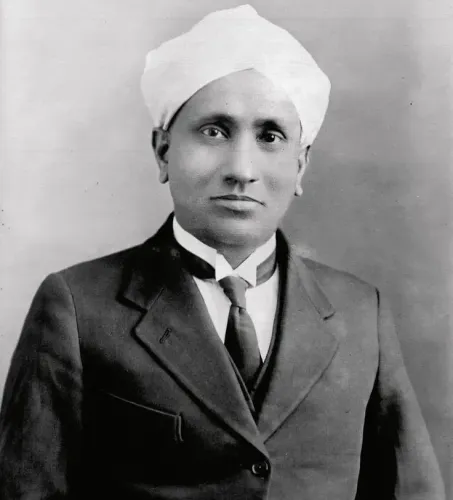
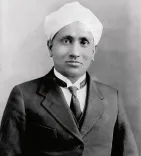
Khattar pays tribute to Nobel laureate Dr. C.V. Raman on birth anniversary
Synopsis
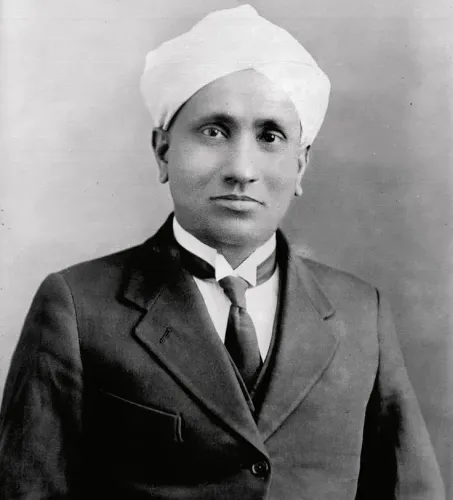
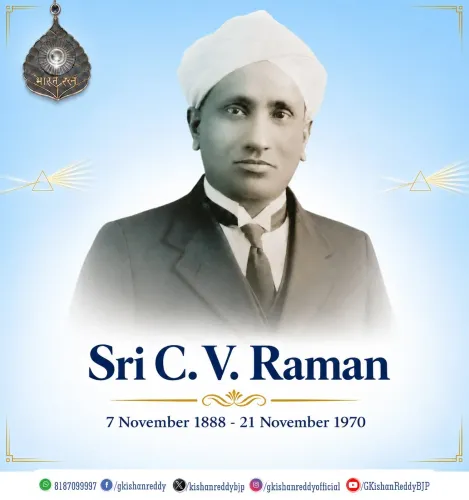
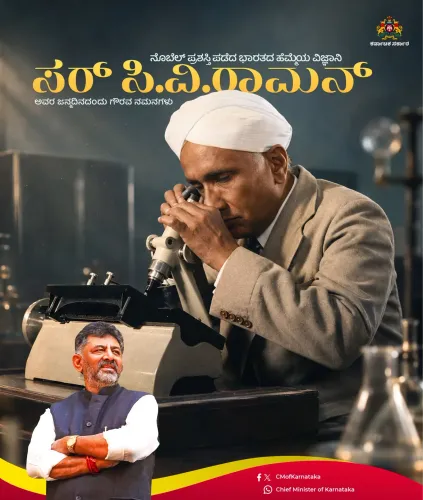
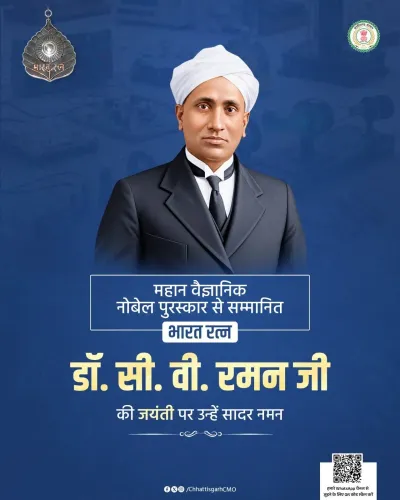
Union Power Minister Manohar Lal Khattar paid tribute to Dr. C.V. Raman on his birth anniversary, honouring the Nobel Prize-winning physicist whose discovery of the Raman Effect in 1928 made him the first Asian to win a Nobel in science.
Key Takeaways
Union Power Minister Manohar Lal Khattar paid tribute to Dr.
Raman on his birth anniversary on 7 November 2026 .
Raman discovered the Raman Effect on 28 February 1928 , revealing inelastic scattering of light through transparent materials.
He was awarded the Nobel Prize in Physics in 1930 — the first Asian and first non-white scientist to win a Nobel in science.
India conferred on him the Bharat Ratna in 1954 , the country's highest civilian honour.
28 February , the date of the Raman Effect discovery, is observed as National Science Day across India each year.
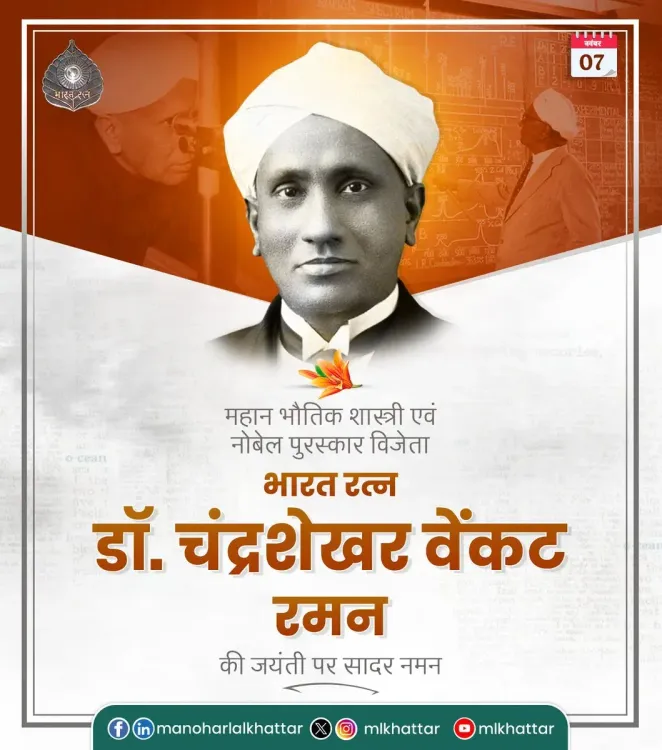
A Nobel Prize and a Bharat Ratna — and yet, nearly seven decades after his passing, Dr. Chandrasekhara Venkata Raman continues to inspire every generation of Indian scientists. On Saturday, 7 November 2026, Union Power Minister Manohar Lal Khattar marked the birth anniversary of the legendary physicist with a respectful tribute on X, honouring the man whose single discovery changed how the world understood light.
Posting in Hindi, Minister Khattar wrote: 'रमन प्रभाव की खोज करने वाले भारत रत्न और नोबेल पुरस्कार विजेता डॉ. सी.वी. रमन जी की जयंती पर उन्हें आदरपूर्वक नमन!' — 'Respectful salutations to Bharat Ratna and Nobel laureate Dr. C.V. Raman on his birth anniversary, discoverer of the Raman Effect!' He added that Raman's 'invaluable contribution to enriching and empowering India's journey of scientific research will always remain unforgettable and unparalleled.'
The discovery that put India on the global science map
Dr. C.V. Raman made his landmark discovery — the Raman Effect — on 28 February 1928, demonstrating that when light passes through a transparent material, a fraction of that light is scattered at a different wavelength. It was a finding of profound consequence: it gave scientists a new non-destructive tool to probe the molecular structure of matter, with applications ranging from chemistry and pharmaceuticals to materials science and astrophysics. The discovery earned him the Nobel Prize in Physics in 1930, making him the first Asian and the first non-white scientist to win a Nobel in science. India later honoured him with the Bharat Ratna in 1954, the country's highest civilian distinction.
A tribute pattern rooted in national scientific pride
Senior Indian leaders and ministers regularly mark the birth anniversaries of the country's scientific icons through official channels — a tradition that keeps foundational figures visible in public discourse. Raman's birthday on 7 November is observed annually, while 28 February — the date of the Raman Effect discovery — is celebrated across India as National Science Day, a reminder that the legacy he built is not archived history but active inspiration.
Point of View
Invoking Raman's legacy serves as a reminder that the country's scientific ambition has deep historical roots. The gesture also subtly connects the present government's science-and-technology policy aspirations to a lineage that predates independence. It is ceremonial in form, but the symbolism carries weight in an era of competitive global science diplomacy.
NationPress
7 Nov 2026
Frequently Asked Questions
Why is 7 November significant for C.V. Raman?
7 November is the birth anniversary of Dr. C.V. Raman , the Indian physicist who discovered the Raman Effect and won the Nobel Prize in Physics in 1930.
What is the Raman Effect?
The Raman Effect is the phenomenon by which a fraction of light passing through a transparent material is scattered at a wavelength different from the incident light, discovered by Dr. C.V. Raman on 28 February 1928 .
What awards did C.V. Raman receive?
Dr. Raman was awarded the Nobel Prize in Physics in 1930 and India's highest civilian honour, the Bharat Ratna, in 1954 .
What is National Science Day in India?
National Science Day is observed on 28 February every year to commemorate the date in 1928 when Dr. C.V. Raman announced the discovery of the Raman Effect.
Who was the first Asian to win a Nobel Prize in science?
Dr. C.V. Raman was the first Asian and the first non-white scientist to win a Nobel Prize in science, receiving the Nobel Prize in Physics in 1930 .