CM Majhi Hails BJP Govt's Strides in Defence, Semiconductors
Synopsis
Odisha Chief Minister Mohan Charan Majhi marked two years of BJP rule in Odisha by crediting the central government's 'visionary leadership' for new benchmarks in defence and semiconductor development, framing the progress as a step toward the Viksit Bharat 2047 vision.
Key Takeaways
Odisha CM Mohan Charan Majhi posted on X on 9 June 2026 marking two years of the BJP government in Odisha.
He credited BJP's 'visionary leadership' with setting new records in defence and semiconductor development .
The post invokes Atmanirbhar Bharat (self-reliance) and the Viksit Bharat vision for a developed India by 2047.
The India Semiconductor Mission (approved 2021) and Make in India (launched 2014) form the policy backbone behind the claims.
Key sectors highlighted — defence and semiconductors — involve both central incentive schemes and growing state-level industrial partnerships.
Progress on approved semiconductor fabrication projects and defence indigenisation targets will be the metrics to watch going forward.
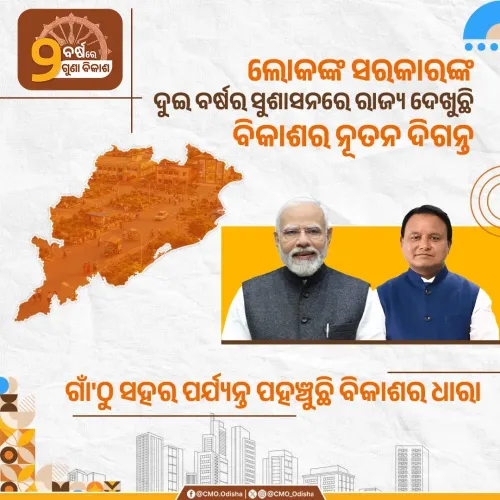
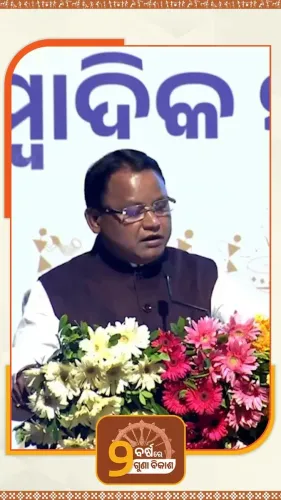
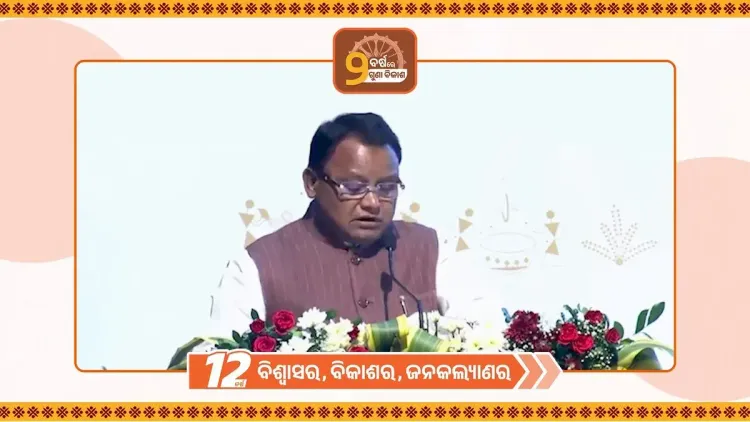
Odisha Chief Minister Mohan Charan Majhi on Tuesday, 9 June 2026, credited the BJP-led central government with setting new benchmarks across sectors — from defence to semiconductor development — as his party marked two years of governance in Odisha. The post, shared on X under the hashtags #2YearsofLokankaSarakar and #BikasharaDharaOdishaSara, frames India's recent strides as proof of the ruling party's 'visionary leadership.'
Context
Majhi's post, originally in Odia, states: 'ପ୍ରତିରକ୍ଷା ଠାରୁ ଆରମ୍ଭ କରି ସେମିକଣ୍ଡକ୍ଟର ବିକାଶ ପର୍ଯ୍ୟନ୍ତ' — 'From defence to semiconductor development' — India under the BJP government has set 'new records of success in every sector.' He adds that this 'unprecedented progress' has given the country a 'glorious identity on the world stage' and become a symbol of self-reliance. The post also invokes the phrase 'ବିକଶିତ ଭାରତ' ('Viksit Bharat'), calling the nation's advances a 'firm step' toward realising that vision.
The timing coincides with the second anniversary of the BJP government in Odisha, which came to power after the 2024 state assembly elections, ending over two decades of Biju Janata Dal rule in the state.
Policy Backdrop
The twin pillars Majhi highlights — defence and semiconductors — reflect long-running central government initiatives. The Atmanirbhar Bharat initiative, launched in May 2020, set out to boost domestic manufacturing and reduce import dependence across strategic sectors, with defence indigenisation as a flagship goal. Revised foreign direct investment norms and production-linked incentive schemes followed, aimed at drawing global manufacturers to India.
On the semiconductor front, the India Semiconductor Mission, approved in 2021, introduced incentives for chip fabrication units and design firms. The broader Make in India programme, launched in 2014, provided the original policy scaffolding that subsequent schemes have built upon. Together, these efforts represent a sustained attempt to reduce strategic vulnerabilities and improve India's positioning in global supply chains.
Stakeholders and Impact
The sectors Majhi references touch a wide range of actors. Defence manufacturers — both public sector undertakings and private firms — have been the primary beneficiaries of indigenisation mandates and positive indigenisation lists that restrict imports of hundreds of defence items. Domestic procurement targets and export ambitions have risen steadily over the past decade.
Semiconductor firms, meanwhile, stand to benefit from approved fabrication and assembly projects backed by central incentives. State governments, including Odisha, have increasingly positioned themselves as partners in attracting manufacturing investment, leveraging land, power, and skilled-workforce advantages to compete for high-value projects.
What's Next
Attention will turn to the rollout timelines of approved semiconductor projects and the pace of defence indigenisation as measured against stated export and domestic-procurement targets. Union Budget announcements in the coming cycle are expected to signal whether fresh incentive tranches will be released for both sectors. At the state level, the Odisha government's own industrial policy moves — particularly around defence manufacturing clusters and electronics parks — will determine how closely state ambitions align with the central policy framework Majhi is championing.
As India pushes toward the Viksit Bharat 2047 goal, the degree to which semiconductor self-sufficiency and defence export targets are met will serve as key indicators of whether the policy architecture translates into durable economic transformation.
Point of View
Sectors with tangible policy lineage dating to 2014 and 2020, the post grounds its claims in real initiatives even as it avoids specific metrics. The Viksit Bharat 2047 anchor is a recurring rhetorical device among BJP leaders that links routine governance milestones to a long-horizon national aspiration, making accountability harder to pin to any single term. The dual hashtag strategy — one Odia, one Hindi-transliterated — signals an attempt to reach both a local Odisha audience and a wider national BJP ecosystem simultaneously.
NationPress
23 Oct 2026
Frequently Asked Questions
Why did Odisha CM Mohan Majhi post about defence and semiconductors?
CM Majhi posted to mark two years of the BJP government in Odisha, using the occasion to highlight the central government's progress in defence indigenisation and semiconductor development as part of the Atmanirbhar Bharat and Viksit Bharat policy agenda.
What is the India Semiconductor Mission?
The India Semiconductor Mission was approved by the central government in 2021 to provide financial incentives for chip fabrication units and semiconductor design firms, aiming to build a domestic semiconductor ecosystem and reduce India's dependence on imports.
What does Viksit Bharat mean?
Viksit Bharat, meaning 'Developed India,' is a government vision to transform India into a fully developed nation by the year 2047, the centenary of independence, across economic, technological, and social dimensions.
When did the BJP come to power in Odisha?
The BJP came to power in Odisha following the 2024 state assembly elections, ending more than two decades of Biju Janata Dal rule, with Mohan Charan Majhi becoming Chief Minister.
What is Atmanirbhar Bharat?
Atmanirbhar Bharat, or 'Self-Reliant India,' is an initiative launched in May 2020 to promote domestic manufacturing, reduce import dependence, and strengthen strategic sectors including defence, pharmaceuticals, and electronics.