CM Majhi Pays Tribute at Deendayal Upadhyay's 111th Birth Anniversary
Synopsis
Odisha CM Mohan Charan Majhi attended the 111th birth anniversary of Pandit Deendayal Upadhyay at Bhubaneswar's Jayadev Bhawan, linking the ideologue's Antyodaya and Integral Humanism philosophy to four active state welfare schemes and a 2036 self-reliance target for Odisha.
Key Takeaways
CM Mohan Charan Majhi attended the 111th birth anniversary of Pandit Deendayal Upadhyay at Jayadev Bhawan, Bhubaneswar on September 25, 2026 .
Majhi cited Upadhyay's Ekatma Manavavad (Integral Humanism) and Antyodaya (uplifting the last person) as the guiding philosophy of his government.
Four welfare schemes — Antyodaya Griha Yojana , Deendayal Karmachari Nivas , Subhadra Yojana , and Samruddha Krushak — were presented as operational expressions of that philosophy.
Upadhyay's slogan 'Har haath ko kaam, har khet ko paani' was quoted as the administration's core governance mantra.
Majhi set 2036 as the target year for building a self-reliant, prosperous Odisha, aligning the state's vision with the BJP's broader Antyodaya-framed development narrative.
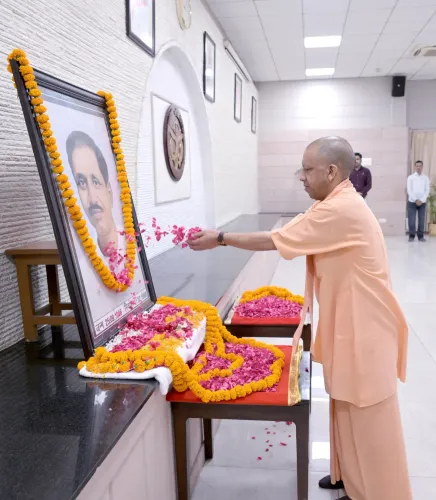
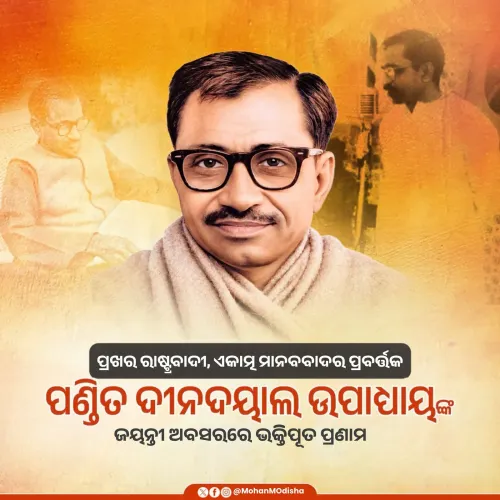
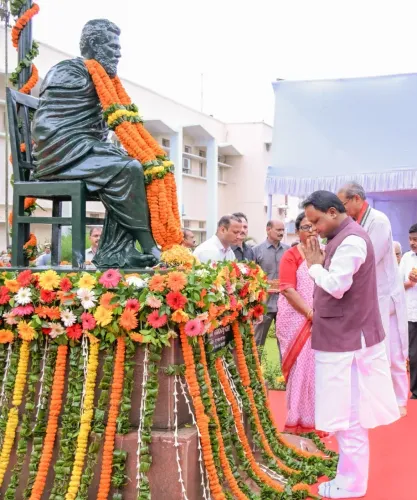
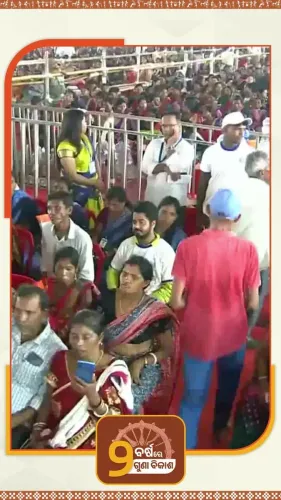
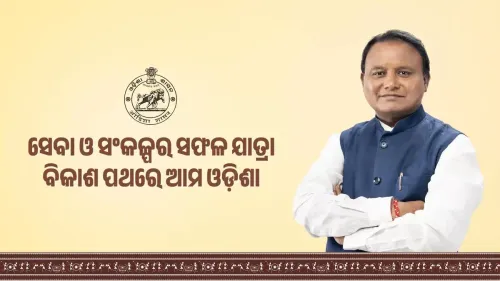
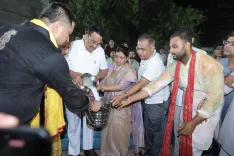
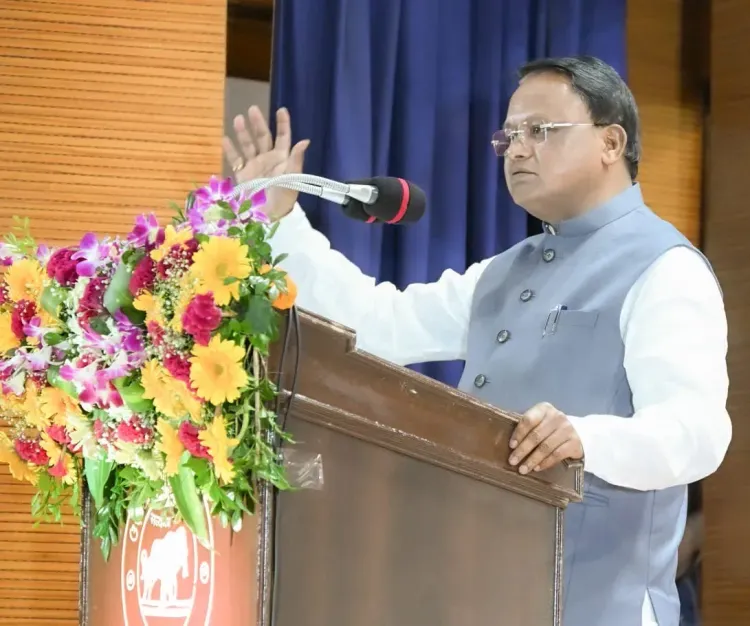
At Jayadev Bhawan in Bhubaneswar on Friday, September 25, 2026, Odisha Chief Minister Mohan Charan Majhi paid tribute to Pandit Deendayal Upadhyay at the state-level celebration of the ideologue's 111th birth anniversary — pledging that his philosophy of serving 'the last person in the queue' would drive Odisha's governance through 2036.
The philosophy Majhi invoked — and why it matters to Odisha today
Pandit Deendayal Upadhyay delivered his landmark lectures on Ekatma Manavavad (Integral Humanism) in 1965, articulating a governance vision rooted in India's civilisational values, swadeshi economics, and decentralised power — explicitly rejecting what he saw as the mimicry of Western political models. Paired with his Antyodaya principle — the idea that true progress is measured by the uplift of the poorest — these ideas became the ideological bedrock of the BJP's welfare architecture. CM Majhi quoted Upadhyay's call of 'Har haath ko kaam, har khet ko paani' ('Work for every hand, water for every field') as the governing mantra his administration has adopted.
That is not merely rhetoric on an anniversary stage. Since the BJP formed the Odisha government in 2024, state schemes have been deliberately framed around the Antyodaya vocabulary. The Chief Minister named four specific programmes as the living expression of that philosophy: Antyodaya Griha Yojana (housing for the poorest households), Deendayal Karmachari Nivas in industrial clusters (worker housing), Subhadra Yojana (welfare for women and girls), and Samruddha Krushak (farm income support for rural cultivators).
From 1965 philosophy to a 2036 development deadline
The Chief Minister's message went beyond commemoration. He framed 2036 as Odisha's self-reliance horizon — a 'self-sustaining, proud, and prosperous Odisha' — tying a long-range state vision document to the anniversary moment. It is a pattern familiar across BJP-ruled states: anniversary events become policy pledges, and the philosopher's birth year becomes a governance calendar. The goal is to 'empower every individual at the last rung of society,' Majhi said, echoing Upadhyay's own insistence that development which does not reach the margins is no development at all.
Whether the four named schemes have yet reached the scale their ambitions imply — the beneficiary counts, budget lines, and rollout timelines — will be tested in the coming Odisha budget sessions. For now, the Chief Minister has staked the government's identity to a philosopher born more than a century ago, and to a deadline a decade away.
Point of View
Majhi is converting a commemorative occasion into a governance accountability moment. This mirrors a broader BJP strategy in states it has newly won, where Deendayal Upadhyay's anniversary serves as an annual audit of how far the administration has advanced a philosophy it claims to operationalise. The real test will come at budget time, when scheme allocations either validate or hollow out the anniversary rhetoric.
NationPress
26 Sept 2026
Frequently Asked Questions
Who was Pandit Deendayal Upadhyay and why is he important to the BJP?
Pandit Deendayal Upadhyay was an RSS pracharak and BJP ideologue who formulated Integral Humanism (Ekatma Manavavad) and the Antyodaya principle in the 1960s, arguing for governance rooted in Indian civilisational values, decentralised power, and the uplift of the poorest citizen. His philosophy remains the stated ideological foundation of the BJP.
What is Antyodaya and how does it relate to Odisha government schemes?
Antyodaya, coined by Upadhyay, means prioritising 'the last person' — ensuring the most marginalised benefit first from development. The Odisha government has named a housing scheme 'Antyodaya Griha Yojana' directly after this principle, alongside other welfare schemes for women and farmers.
What are the four welfare schemes CM Majhi linked to Deendayal Upadhyay's philosophy?
CM Majhi cited Antyodaya Griha Yojana (housing for the poorest), Deendayal Karmachari Nivas in industrial areas (worker housing), Subhadra Yojana (welfare for women and girls), and Samruddha Krushak (farmer income support) as the four schemes embodying Upadhyay's Antyodaya vision.
What is Odisha's 2036 development target mentioned by CM Majhi?
CM Majhi has set 2036 as the year by which his government aims to build a self-reliant, proud, and prosperous Odisha, empowering every individual at the last rung of society through its welfare and economic programmes.
What is Jayadev Bhawan in Bhubaneswar?
Jayadev Bhawan is a cultural auditorium in Bhubaneswar used by the Odisha government for state-level commemorative and official events, including annual birth anniversary celebrations of national figures.