CM Majhi Marks World Blood Donor Day, Urges Voluntary Donation

Synopsis
Odisha Chief Minister Mohan Charan Majhi marked World Blood Donor Day on 14 June 2026 by thanking voluntary blood donors and urging continued promotion of regular donation, aligning with WHO goals and India's National Blood Policy.
Key Takeaways
World Blood Donor Day is observed on 14 June every year, established by the WHO in 2004 .
Odisha CM Mohan Charan Majhi expressed gratitude to voluntary donors and called for sustained promotion of blood donation.
India's National Blood Policy (2002) aims to achieve 100 per cent voluntary, non-remunerated blood donation nationwide.
The National Blood Transfusion Council , set up in 1996 , oversees blood transfusion services across Indian states.
Odisha's rural and tribal regions face particular challenges in blood supply access, making voluntary donation drives critical.
State health departments are expected to follow such appeals with blood donation camps and infrastructure investments.
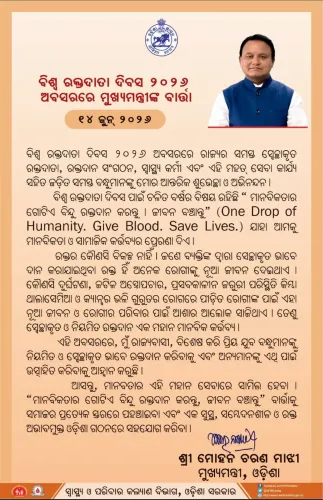
Odisha Chief Minister Mohan Charan Majhi on Sunday, 14 June 2026 marked World Blood Donor Day by extending gratitude to voluntary blood donors across the country, calling their selfless contributions a source of hope for countless families.
Context
World Blood Donor Day is observed every year on 14 June, a date established by the World Health Organization (WHO) in 2004 to recognise voluntary, non-remunerated blood donors and raise awareness about the need for safe blood supplies. Chief Minister Majhi's message, posted on his official X account, called on citizens to 'continue to promote regular blood donation and strengthen the spirit of service and humanity in our society.'
The appeal reflects a broader pattern among Indian state leaders of using global health observances to reinforce public health messaging and align local governance with international standards set by the WHO.
Policy Backdrop
India's push for voluntary blood donation has a formal policy foundation. The country adopted its National Blood Policy in 2002, which aimed to phase out replacement and paid donations in favour of a fully voluntary system. The National Blood Transfusion Council, established in 1996 under the Union Ministry of Health, continues to regulate and strengthen blood transfusion services across all states.
Odisha, an eastern Indian state with large tribal and rural populations, has historically faced challenges in ensuring equitable access to blood transfusion services in remote areas. Central funding channelled through the National Health Mission has supported blood bank upgrades in such states, making voluntary donation campaigns particularly significant for regions where access remains uneven.
Stakeholders and Impact
The primary beneficiaries of voluntary blood donation drives are patients requiring transfusions — including those undergoing surgery, cancer treatment, or managing conditions such as thalassaemia and sickle cell anaemia, both of which are prevalent in Odisha's tribal belt. State blood banks and district hospitals depend heavily on sustained voluntary donor pools to maintain adequate stocks.
For voluntary donors themselves, public acknowledgement from senior political leaders serves as social reinforcement, encouraging repeat donation and broadening community participation. Statements of this nature from chief ministers also signal to health department officials that voluntary donation remains a governance priority.
What's Next
Attention will now turn to whether the Odisha state health department follows the Chief Minister's message with concrete action — including blood donation camps, targets for voluntary collection volumes, or budget provisions for new blood storage facilities in the state's upcoming legislative session. The WHO recommends that countries aim for 100 per cent voluntary non-remunerated blood donation, a goal India continues to work toward at both the central and state levels.
Point of View
Such signals carry practical weight beyond ceremony. The statement also fits a pattern of BJP-led state governments reinforcing national health targets — particularly the push toward fully voluntary blood collection — through high-visibility political endorsement. Whether the message translates into measurable health department action will be the more consequential test.
NationPress
13 Sept 2026
Frequently Asked Questions
Why is World Blood Donor Day celebrated on 14 June?
World Blood Donor Day falls on 14 June because it marks the birth anniversary of Karl Landsteiner , the scientist who discovered the ABO blood group system. The WHO established the observance in 2004 to honour voluntary donors and promote safe blood supplies globally.
What did Odisha CM Mohan Majhi say on World Blood Donor Day 2026?
CM Mohan Charan Majhi extended gratitude to voluntary blood donors, describing their contributions as life-saving and a source of hope for countless families, and urged citizens to promote regular blood donation and the spirit of service in society.
What is India's National Blood Policy?
India adopted its National Blood Policy in 2002 to promote voluntary, non-remunerated blood donation and phase out replacement and paid donations. It is implemented through the National Blood Transfusion Council set up under the Union Ministry of Health .
How does Odisha manage blood supply for rural and tribal areas?
Odisha relies on state blood banks and district hospitals supported by central funding under the National Health Mission . Voluntary donation campaigns are especially critical given the state's large rural and tribal population, where access to transfusion services has historically been limited.
What is the WHO target for blood donation?
The WHO recommends that all countries achieve 100 per cent voluntary non-remunerated blood donation to ensure a safe and adequate national blood supply, a goal India continues to work toward through policy and public awareness campaigns.