CM Majhi: Odisha leads AMRUT 2.0, targets 24x7 tap water
Synopsis
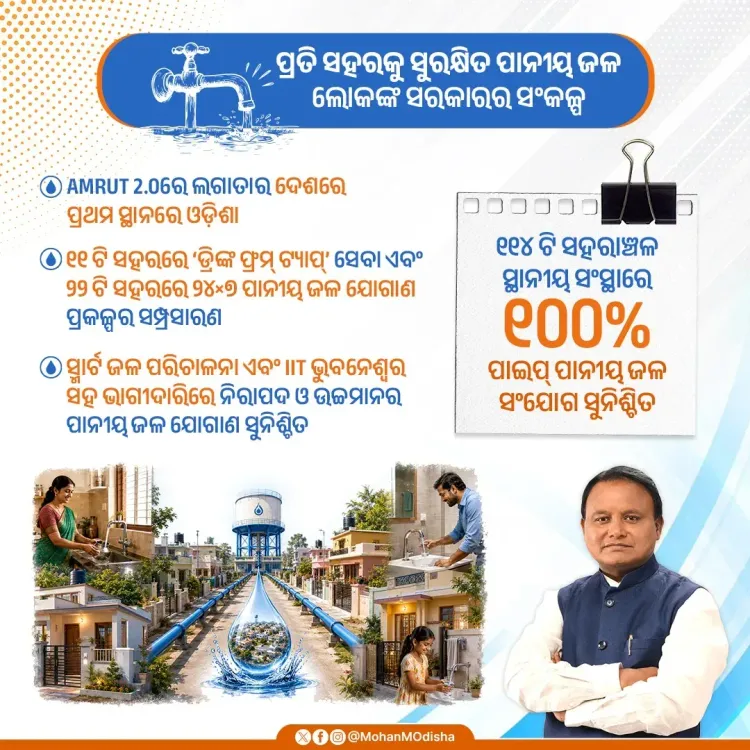
Odisha Chief Minister Mohan Charan Majhi says the state leads India in AMRUT 2.0 with 100% piped water connections, 'Drink from Tap' services, and 24x7 supply, backed by a smart water management partnership with IIT Bhubaneswar.
Key Takeaways
CM Mohan Charan Majhi announced on 22 July 2026 that Odisha ranks first in India under the AMRUT 2.0 urban water mission.
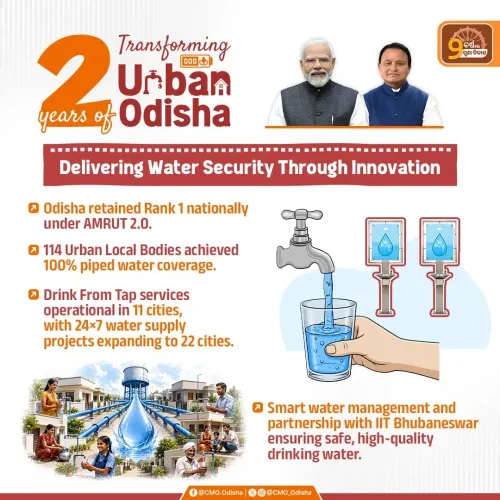
The state claims 100% piped drinking water connections in urban areas alongside a 'Drink from Tap' service.
24x7 drinking water supply projects have been cited as a key qualitative improvement for urban residents.
A partnership with IIT Bhubaneswar is being used to deploy smart water management systems for quality monitoring.
AMRUT 2.0 was approved in 2021 with an outlay of Rs 2.77 lakh crore targeting universal urban tap connections across India.
The BJP government in Odisha, in power since June 2024 , has positioned water delivery as a core welfare and governance priority.
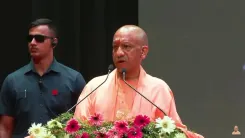
Odisha Chief Minister Mohan Charan Majhi on Wednesday, 22 July 2026 highlighted the state's progress under the central AMRUT 2.0 urban water mission, asserting that Odisha has consistently ranked first in the country and achieved 100% piped drinking water connections across urban areas.
Context
Posting in Odia, CM Majhi stated: 'ପ୍ରତ୍ୟେକ ଅଞ୍ଚଳକୁ ସୁରକ୍ଷିତ ଓ ବିଶୁଦ୍ଧ ପାନୀୟ ଜଳ ପହଞ୍ଚାଇବା ହିଁ ଲୋକଙ୍କ ସରକାରର ସଂକଳ୍ପ' ('Delivering safe and pure drinking water to every region is the resolve of the people's government'). He credited the state's performance in AMRUT 2.0 for bringing a qualitative change in the lives of citizens through 'Drink from Tap' services and 24x7 drinking water supply projects.
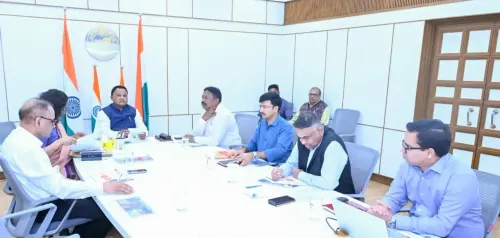
The Chief Minister also pointed to a partnership with IIT Bhubaneswar to strengthen high-quality drinking water supply through smart water management systems, framing these as pillars of his government's vision of a 'safe, healthy, smart and prosperous Odisha.'
Policy Backdrop
The Atal Mission for Rejuvenation and Urban Transformation (AMRUT) was first launched in 2015 to modernise urban water supply and sewerage infrastructure across 500 cities in India. Its successor, AMRUT 2.0, was approved in 2021 with an outlay of Rs 2.77 lakh crore, targeting universal tap connections and round-the-clock supply in urban households nationwide.
States are ranked by the Ministry of Housing and Urban Affairs on metrics including tap coverage, water quality, and service continuity. Odisha, under the BJP government that came to power in June 2024, has positioned urban water delivery as a flagship welfare priority. The collaboration with IIT Bhubaneswar reflects a broader national trend of integrating technical institutions into public infrastructure governance.
Stakeholders and Impact
The primary beneficiaries of AMRUT 2.0 gains are urban households across Odisha's cities and towns, many of which previously relied on intermittent or untreated water sources. Municipal bodies are the implementing agencies, responsible for laying pipelines, installing smart meters, and maintaining supply networks.
The 'Drink from Tap' model — where tap water meets potable standards without additional treatment — represents a significant public health upgrade for residents. Consistent 24x7 supply also reduces the burden on households, particularly women and children, who often manage water storage under irregular supply conditions.
What's Next
Updated AMRUT 2.0 coverage statistics from the Ministry of Housing and Urban Affairs will be closely watched to verify state-level rankings and tap connection figures. Any allocations for water infrastructure in Odisha's upcoming assembly budget sessions will indicate the state government's fiscal commitment to sustaining and expanding these gains. The IIT Bhubaneswar partnership's outcomes on smart water management are also expected to inform future policy decisions at both state and national levels.
Point of View
Tying Odisha's AMRUT 2.0 performance to the BJP's 'people's government' narrative ahead of future electoral cycles. By invoking a national ranking, a central scheme, and a technical institution in a single message, the communication is designed to signal both delivery competence and centre-state alignment. The IIT Bhubaneswar partnership adds a modernisation layer that appeals to urban and aspirational voters. Sustaining these claims will depend on independently verified coverage data from the Ministry of Housing and Urban Affairs, which remains the critical accountability checkpoint.
NationPress
22 Jul 2026
Frequently Asked Questions
What is AMRUT 2.0 and why is Odisha's ranking significant?
AMRUT 2.0 is the Union government's urban water mission approved in 2021 with a Rs 2.77 lakh crore outlay to provide universal tap connections. Odisha's claimed first-place ranking signals strong implementation of piped water and 24x7 supply targets among all participating states.
What does 'Drink from Tap' mean in the context of Odisha?
'Drink from Tap' means that water supplied through household taps meets potable quality standards and can be consumed directly without boiling or additional filtration, representing a higher service benchmark than conventional urban water supply.
How is IIT Bhubaneswar involved in Odisha's water supply?
IIT Bhubaneswar has partnered with the Odisha government on smart water management, contributing technical expertise in quality monitoring and supply optimisation to strengthen the state's urban drinking water infrastructure.
When did Mohan Charan Majhi become Chief Minister of Odisha?
Mohan Charan Majhi became Chief Minister of Odisha in June 2024 after the BJP won the state assembly elections, ending the previous government's long tenure.
What is the total outlay of AMRUT 2.0?
The Union government approved AMRUT 2.0 in 2021 with a total outlay of Rs 2.77 lakh crore, targeting universal piped water connections and 24x7 supply across urban areas in India.