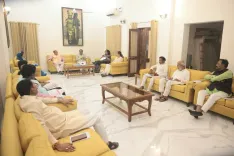
PM Modi Chairs Secretaries Meeting on Rural, Farm and Welfare Reforms
Synopsis
Prime Minister Narendra Modi chaired a meeting of Secretaries to the Government of India on 22 July 2026, reviewing progress in rural development, agriculture, and social welfare sectors. He highlighted the need to strengthen people-centric reforms, continuing his practice of top-level bureaucratic reviews to drive scheme implementation.
Key Takeaways
PM Narendra Modi chaired a meeting of Secretaries to the Government of India on 22 July 2026 .
Discussions covered progress in rural development, agriculture, and social welfare sectors.
Modi highlighted the need to strengthen reforms that further the welfare of the people.
Such high-level reviews have been a consistent feature of Modi's governance approach since 2014 , focused on tracking scheme delivery.
Key programmes in scope include PM-KISAN (launched 2019) and the MGNREGA framework, both centred on direct benefit transfers to rural beneficiaries.
Follow-up ministerial directives and any references in upcoming parliamentary or budget sessions will indicate concrete next steps.
Prime Minister Narendra Modi on Wednesday, 22 July 2026 chaired a high-level meeting of Secretaries to the Government of India, where discussions spanned progress in rural development, agriculture, and social welfare sectors, along with the need to deepen ongoing reforms for public welfare.
Context
The meeting brought together senior civil servants who head key ministries and are responsible for translating policy into on-ground outcomes. Modi stressed the importance of strengthening reforms that 'further the welfare of the people,' signalling a continued focus on implementation quality over mere scheme launches.
Such periodic reviews with secretaries have become a hallmark of Modi's administrative approach since 2014, designed to cut through bureaucratic inertia and track delivery of flagship programmes directly from the top.
Policy Backdrop
The sectors discussed — rural development, agriculture, and social welfare — sit at the heart of several landmark central government initiatives. The Pradhan Mantri Kisan Samman Nidhi (PM-KISAN) scheme, launched in 2019, provides direct income support to farmers and has been a key pillar of agricultural welfare policy.
The Mahatma Gandhi National Rural Employment Guarantee Act (MGNREGA) framework, operational since 2005, continues to serve as a primary rural employment safety net and has seen periodic updates to improve targeting and delivery. Both programmes rely heavily on direct benefit transfers and robust grievance redressal mechanisms — areas that top-level reviews like this one are designed to monitor.
Stakeholders and Impact
Rural farmers and welfare beneficiaries across India stand as the primary stakeholders in the outcomes of this meeting. Effective scheme convergence — where multiple programmes are aligned to serve the same household — remains a persistent implementation challenge that such high-level reviews aim to address.
The emphasis on 'strengthening reforms' suggests the agenda was not limited to status updates but extended to identifying structural gaps in how welfare reaches its intended recipients. Secretaries from ministries covering agriculture, rural development, and social justice are likely to carry forward specific directives to their departments.
What's Next
Follow-up instructions issued to individual ministries will be closely watched, particularly any moves toward greater scheme convergence or revised delivery timelines. References to the outcomes of this meeting could surface in the next parliamentary session or in upcoming budget documents as policy priorities are formalised.
The meeting underscores Modi's consistent administrative posture: using direct engagement with the bureaucracy's top tier to maintain pressure on implementation, a pattern that has shaped governance strategy across his tenure and is likely to intensify as welfare delivery becomes a central political metric heading into future electoral cycles.
Point of View
Where direct engagement with secretaries serves as both a monitoring tool and a political signal of hands-on governance. By foregrounding rural development, agriculture, and social welfare in a single sitting, the Prime Minister is aligning bureaucratic bandwidth with the voter segments most critical to the BJP's electoral coalition. The emphasis on 'strengthening reforms' rather than announcing new schemes suggests a maturation phase — the focus has shifted from policy design to last-mile delivery. This pattern of review-driven governance is likely to intensify as welfare outcomes become an increasingly measurable and contested political metric.
NationPress
23 Jul 2026
Frequently Asked Questions
What was discussed in PM Modi's meeting with secretaries on 22 July 2026?
The meeting covered progress in rural development, agriculture, and social welfare sectors. PM Modi highlighted the need to strengthen reforms that further the welfare of the people.
Who are the Secretaries to the Government of India?
They are the most senior civil servants in the Indian administrative system, each heading a central government ministry and responsible for policy execution and scheme delivery.
Does PM Modi regularly hold meetings with government secretaries?
Yes. Since 2014, Modi has institutionalised periodic high-level reviews with secretaries to monitor the implementation of flagship schemes, particularly in rural and agricultural domains.
Which welfare schemes are relevant to this meeting?
Key schemes include the Pradhan Mantri Kisan Samman Nidhi (PM-KISAN) , which provides direct income support to farmers, and the MGNREGA rural employment guarantee framework, both of which fall under the sectors discussed.
What are the expected outcomes of this secretaries meeting?
Follow-up directives to individual ministries on scheme convergence and implementation gaps are expected. Outcomes may also be referenced in the next parliamentary session or upcoming budget documents.