PM Modi marks 12 years in power, cites welfare gains for farmers, women, youth
Synopsis
Prime Minister Narendra Modi marked 12 years of NDA rule on 9 June 2026, saying the government dedicated itself to trust, development and welfare, leaving no effort spared in empowering India's 140 crore citizens — especially farmers, women and youth.
Key Takeaways
PM Modi posted a Hindi-language reflection on 12 years of NDA governance on 9 June 2026 .
He cited empowerment of youth, women and farmers as the government's core achievement.
The post invoked the blessings of 140 crore Indians and a 'nation first' spirit as the driving force.
Policy lineage since 2014 includes direct farmer income support, women's financial inclusion and youth skill development.
The reflective messaging is seen as groundwork ahead of potential new announcements in the 2026-27 Union Budget .
No new scheme names or statistics were announced in the post itself; linked content details remain unverified.
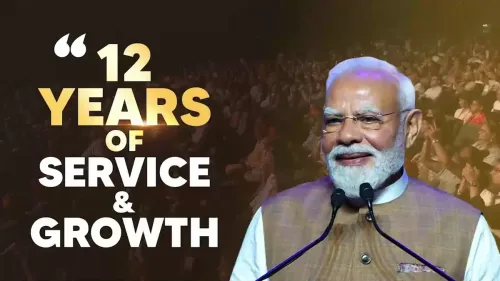
Prime Minister Narendra Modi on Tuesday, 9 June 2026 reflected on 12 years of his government, saying the period had been dedicated to trust, development and public welfare, and that no effort had been spared to empower youth, women and farmer siblings with the blessings of 140 crore Indians.
Context
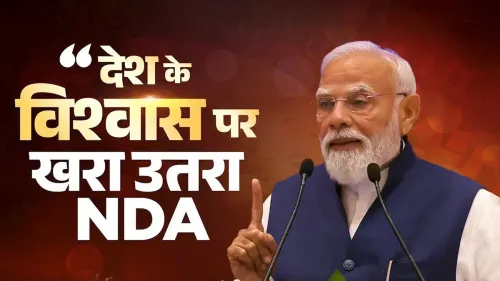
Posting in Hindi on X, Modi wrote: 'हमारी सरकार के बीते 12 वर्ष विश्वास, विकास और जनकल्याण को समर्पित रहे हैं' — 'The past 12 years of our government have been dedicated to trust, development and public welfare.' He added that with the blessings of 140 crore countrymen and a 'nation first' spirit, the government had left no stone unturned in empowering youth, women and farmer brothers and sisters, calling the outcomes a result of 'tireless efforts.'
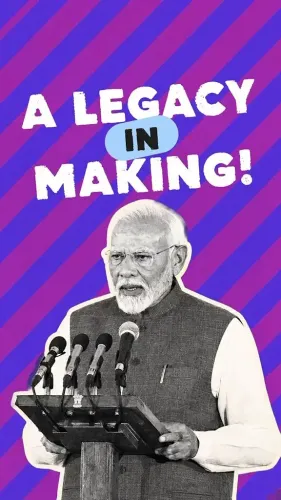
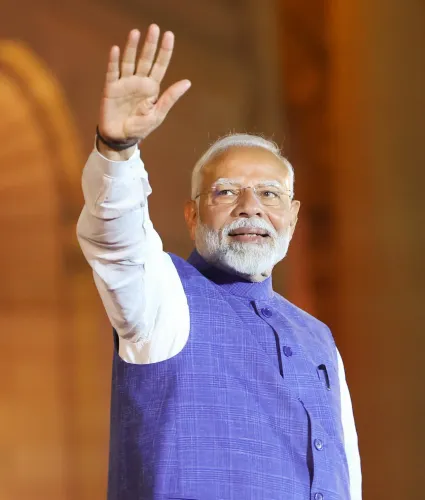
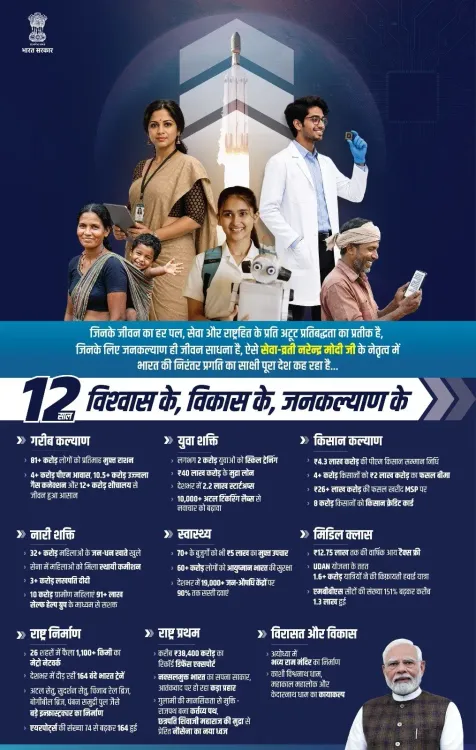
The post was accompanied by an image and a linked article elaborating on the government's claimed achievements. The National Democratic Alliance government led by Modi first took office in May 2014, making June 2026 roughly the midpoint of what would be a third consecutive term.
Policy Backdrop
Since 2014, successive central budgets have channelled resources into three broad pillars: direct income support for farmers, financial inclusion and skilling for women, and employment and entrepreneurship programmes for youth. These strands have been consistent features of Independence Day addresses, budget speeches and party manifestos, forming what the government frames as an 'inclusive growth' architecture.
The 'nation first' (Rashtra Pratham) framing has recurred across official communication for over a decade, signalling continuity of ideological messaging even as specific scheme names and allocations have evolved. Reflective posts tallying multi-year achievements typically appear ahead of major policy reviews or electoral cycles.
Stakeholders and Impact
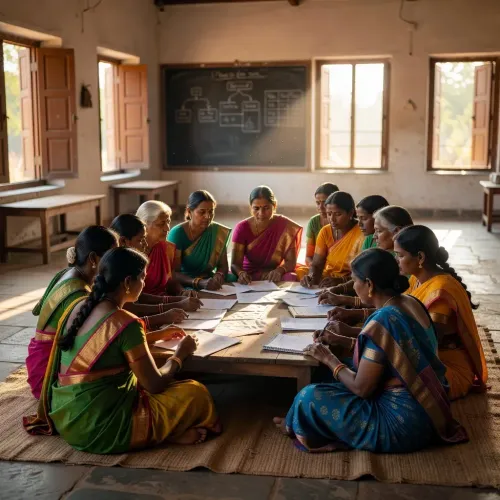
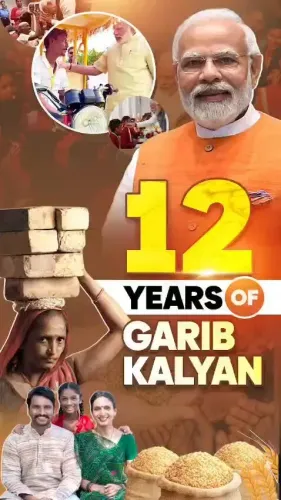
Farmers have been a central focus, with direct income-transfer schemes and crop-insurance programmes among the flagship interventions cited by the government. Women have been targeted through financial inclusion drives, housing schemes in their names and self-help group credit linkages. Youth have been addressed through skill-development missions and start-up incentive frameworks.
India's population crossing 140 crore — a figure Modi regularly invokes — underscores the scale at which these programmes are intended to operate. Critics have questioned implementation gaps and data quality, but the government points to rising beneficiary counts and direct-benefit-transfer volumes as evidence of delivery.
What's Next
Attention now turns to the 2026-27 Union Budget and parliamentary sessions, where the government is expected to announce the next phase of agricultural, skilling and women-centric schemes. The reflective tone of the post suggests the ruling dispensation is laying the narrative groundwork for fresh policy announcements framed as continuations of a proven 12-year track record.
Any new scheme names, revised beneficiary targets or budgetary allocations announced in the coming weeks will be closely watched by opposition parties, civil-society groups and state governments dependent on central transfers.
Point of View
Women and youth, Modi activates the broadest possible voter coalition while staying above specific policy disputes. The '140 crore blessings' framing converts a governance anniversary into a quasi-democratic mandate renewal. Appearing at the midpoint of a third term, the post likely signals that the government is preparing to package its next legislative or budgetary push as a continuation of a proven 12-year arc rather than a fresh departure — a strategy that has historically insulated it from opposition charges of policy fatigue.
NationPress
23 Oct 2026
Frequently Asked Questions
What did PM Modi say about 12 years of his government?
PM Modi said the past 12 years had been dedicated to trust, development and public welfare, and that the government had spared no effort in empowering youth, women and farmers with the blessings of 140 crore Indians.
When did Narendra Modi first become Prime Minister of India?
Narendra Modi first became Prime Minister of India in May 2014, when the BJP-led NDA won a majority in the Lok Sabha elections.
What welfare schemes has the Modi government launched for farmers, women and youth?
The NDA government has introduced direct income-transfer schemes for farmers, financial inclusion and housing programmes for women, and skill-development and start-up incentive frameworks for youth since 2014.
What is the significance of '140 crore' in Modi's posts?
'140 crore' refers to India's approximate total population, a figure Modi regularly invokes to frame government schemes as reaching every citizen and to convert policy milestones into expressions of popular mandate.
What can we expect from the Modi government after the 12-year milestone post?
Policy watchers expect the 2026-27 Union Budget and upcoming parliamentary sessions to carry fresh announcements in agriculture, women's welfare and youth skilling, framed as extensions of the 12-year governance record.