PM Modi marks 12 years in power, cites governance shift since 2014
Synopsis
Prime Minister Narendra Modi on 10 June 2026 marked 12 years of his government, saying the hope of 2014 has grown into national self-confidence and that right-intent governance delivers rapid development — a message timed ahead of late-2026 state elections.
Key Takeaways
PM Narendra Modi posted on 10 June 2026 , marking 12 years since the BJP-led NDA came to power in May 2014 .
He described 2014 as the rise of a 'sun of hope' that has since become a 'beacon of new self-confidence' for India.
Modi stated that Indians have seen 'for the first time' that governance with the right intent produces rapid development.
The post is consistent with the BJP 's long-standing narrative contrasting post-2014 governance with the preceding UPA era.
The message is seen as early positioning ahead of state assembly elections scheduled for late 2026 .
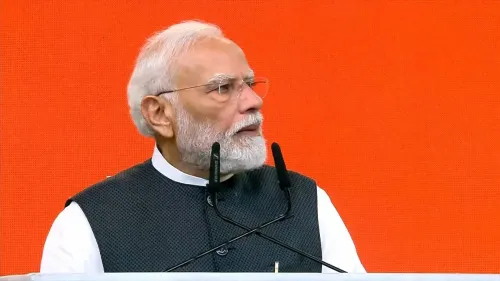
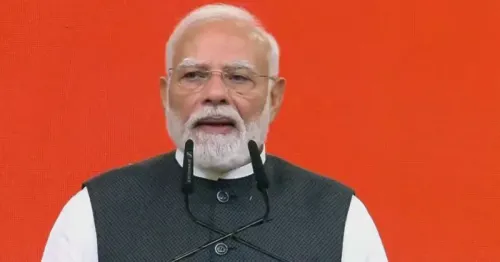
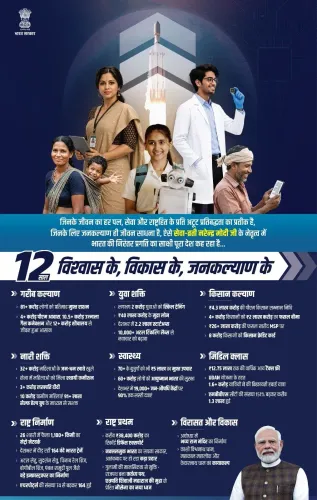
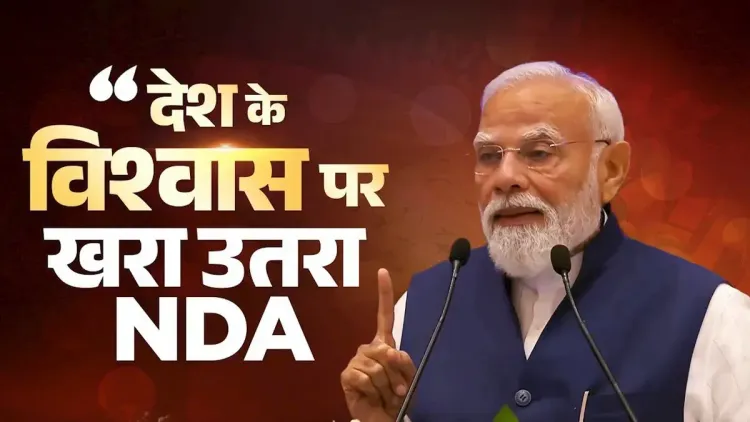
The post was accompanied by a video and was written in Hindi , reflecting outreach to a broad domestic audience.
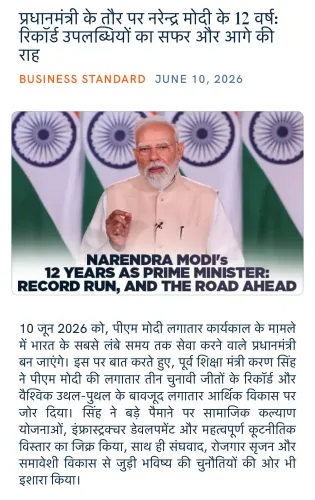
Prime Minister Narendra Modi on Wednesday, 10 June 2026 reflected on 12 years of his government's tenure, declaring that the 'sun of hope' that rose in 2014 has transformed into a beacon of new self-confidence for India.
Posting in Hindi on X, Modi wrote: '2014 mein aasha ke jis sooraj ka uday hua, woh aaj naye aatmavishwas ke prakashpunj mein badal chuka hai' — 'The sun of hope that rose in 2014 has today turned into a radiant source of new self-confidence.' He added that over the past 12 years, Indians have witnessed for the first time that 'when a government functions with the right intent, rapid development follows.'
Context
Narendra Modi was sworn in as Prime Minister on 26 May 2014 after the BJP-led NDA won a clear parliamentary majority, ending a decade of UPA rule. His party secured a second consecutive majority in the 2019 general election, making the June 2026 post a milestone reflection at the 12-year mark of uninterrupted governance.
The post was accompanied by a video, the contents of which are not independently accessible, but the framing is consistent with the government's long-running communication around development milestones and governance reform.
Policy Backdrop
Since taking office, the Modi administration has anchored its public narrative on flagship programmes including Swachh Bharat Abhiyan, Make in India, and a broader push for digital delivery of welfare schemes under the 'minimum government, maximum governance' philosophy.
Successive Union Budgets and party manifestos have consistently framed the post-2014 era as a structural break from what the BJP describes as the slow, coalition-constrained governance of earlier decades. The emphasis on 'right intent' in the 10 June post echoes language used in official budget speeches and election campaigns across multiple cycles.
Stakeholders and Impact
Indian citizens and voters are the primary audience for this messaging, which reinforces the government's accountability narrative ahead of state assembly elections expected in late 2026. The framing of development as a direct product of political intent rather than structural factors is central to the BJP's electoral positioning.
Opposition parties have historically contested the government's development claims, arguing that headline growth figures mask uneven distribution of benefits. The post does not cite specific metrics, leaving the broader debate open to competing interpretations.
What's Next
Observers will watch whether the 2026-27 Union Budget speech and upcoming party platforms explicitly invoke the 12-year governance record as a centrepiece argument. With several state polls on the horizon, the BJP's communication machinery is likely to amplify the '2014 to 2026' arc as a core campaign theme.
The post signals that Modi intends to make the full sweep of his tenure — rather than any single scheme or statistic — the defining frame for the next electoral cycle.
Point of View
The messaging is designed to be both aspirational and insulated from statistical challenge. This fits a well-established BJP communication pattern: framing elections as referendums on governance character rather than discrete outcomes. With state polls approaching, the post functions as the opening note of a larger electoral symphony.
NationPress
26 Oct 2026
Frequently Asked Questions
Why did PM Modi post about 2014 in June 2026?
June 2026 marks approximately 12 years since Narendra Modi was first sworn in as Prime Minister on 26 May 2014 , making it a milestone that the BJP is using to highlight its governance record.
What did Modi say in his Hindi post on X?
Modi said the 'sun of hope' that rose in 2014 has become a 'radiant source of new self-confidence,' and that Indians have seen for the first time that governance with the right intent leads to rapid development.
What schemes did the Modi government launch after 2014?
Key programmes launched after 2014 include Swachh Bharat Abhiyan , Make in India , and a range of digital welfare-delivery initiatives under the 'minimum government, maximum governance' framework.
Is PM Modi's claim about development since 2014 verified?
The post makes a broad qualitative claim about governance and development pace; it does not cite specific statistics, and the assertion reflects the BJP 's official narrative, which opposition parties have historically disputed.
What is the political significance of Modi's 12-year governance post?
With state assembly elections expected in late 2026 , the post is widely read as early electoral positioning, framing the BJP 's entire tenure as a record of intent-driven development to contrast with earlier governments.