Modi at 12: How India changed from 2014 to 2026 under BJP rule
Synopsis
On 26 May 2026, it is 12 years since Narendra Modi took oath as India's 15th Prime Minister — ending three decades of coalition governments with a single-party majority. From GST and Jan Dhan to surgical strikes and a doubled GDP, the period is defined by sweeping ambition, structural reform, and persistent questions about outcomes.
Key Takeaways
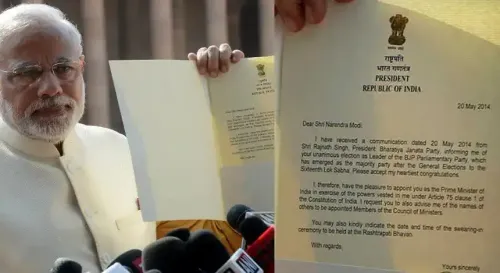
Narendra Modi was sworn in as India's 15th Prime Minister on 26 May 2014 at Rashtrapati Bhavan , New Delhi.
The BJP won 282 seats in the 543-member Lok Sabha — the first single-party majority in 30 years .
Heads of government from all eight SAARC nations attended the swearing-in, an unprecedented diplomatic signal.
India's nominal GDP grew from approximately USD 2 trillion in 2014 to USD 4.2–4.3 trillion by 2025 .
Key reforms include the GST (2017), Digital India , Jan Dhan Yojana , and the Direct Benefit Transfer system.
The 2016 surgical strikes and 2019 Balakot airstrike marked a shift to a more assertive national-security posture.
Exactly 12 years ago, on 26 May 2014, Narendra Modi was sworn in as India's 15th Prime Minister at the forecourt of Rashtrapati Bhavan in New Delhi, marking the start of a political era that continues to define the country's trajectory. The occasion followed a landmark general election in which the Bharatiya Janata Party (BJP) won 282 seats in the 543-member Lok Sabha — a clear outright majority that no single party had achieved in 30 years.
A Historic Mandate
The 2014 verdict was the first time since 1984 that a single party crossed the majority mark on its own. The last comparable mandate had come under the late Rajiv Gandhi, when the Indian National Congress (Congress) swept 400-plus seats on the back of a sympathy wave following Indira Gandhi's assassination, commanding more than 76% of the vote share. Between 1989 and 2014, India was governed by coalition arrangements — the United Front, the National Democratic Alliance (NDA), and the United Progressive Alliance (UPA) — with no single party able to govern alone.
Modi's BJP nonetheless chose to lead the broader NDA, which together held 336 seats, honouring what political observers termed 'coalition dharma' even when it was not strictly necessary.
The Swearing-In That Signalled a New Foreign Policy
The oath-taking ceremony on the evening of 26 May 2014 drew over 4,000 guests — diplomats, business leaders, artists, and civil-society figures — to the forecourt of Rashtrapati Bhavan. Then-President Pranab Mukherjee administered the oath of office and secrecy. Notably, heads of government from all eight SAARC nations were in attendance, an unprecedented diplomatic gesture that signalled a 'neighbourhood first' orientation in India's foreign policy from day one.
Modi's first Council of Ministers comprised 24 Cabinet ministers, 12 ministers of state, and 10 ministers of state with independent charge.
Economic and Governance Reforms Over 12 Years
Modi arrived in office as India grappled with slowing growth, elevated inflation, frequent power shortages, and a widespread perception of policy paralysis. His campaign slogan — 'Sabka Saath, Sabka Vikas' (Together with all, development for all) — was explicitly framed as a pivot from 'entitlement politics' to 'performance governance'.
Among the most consequential structural reforms was the Goods and Services Tax (GST), rolled out in 2017, which unified more than a dozen central and state levies into a single indirect tax regime. The Pradhan Mantri Jan Dhan Yojana (PMJDY) expanded formal banking to hundreds of millions of previously unbanked citizens, enabling the Direct Benefit Transfer (DBT) system to route subsidies — including LPG subsidies and rural employment payments — directly to Aadhaar-linked accounts, reportedly reducing leakages.
India's nominal GDP roughly doubled over this period, from around USD 2 trillion in 2014 to approximately USD 4.2–4.3 trillion by 2025, according to available estimates. Pre-COVID growth rates periodically touched the 7–8% range, though the pandemic disrupted that trajectory.
Infrastructure, Digital India, and Welfare Schemes
The 'Digital India' initiative drove e-governance, rural broadband expansion, and a push towards paperless public services. Flagship welfare programmes — Pradhan Mantri Awas Yojana (housing for all), Ujjwala Yojana (free LPG connections for women below the poverty line), and Ayushman Bharat (health insurance for low-income families) — have been cited by the government as evidence of broad-based social security outreach, though independent assessments of implementation outcomes have varied.
The 'Make in India' campaign sought to attract manufacturing investment, streamline regulatory clearances, and develop industrial corridors and smart cities. Critics have argued that manufacturing's share of GDP has not risen as sharply as targeted, even as foreign direct investment flows increased.
Security Posture and Global Standing
On the security front, the 2016 surgical strikes across the Line of Control — conducted in response to the Uri terrorist attack — and the 2019 Balakot airstrike following the Pulwama attack marked a publicly declared shift to a more assertive national-security doctrine. Both actions drew significant domestic political support, though they also generated debate over escalation risks.
Internationally, the Modi government pursued strategic autonomy, diversifying defence and trade partnerships across the United States, Japan, Russia, and European capitals. Initiatives such as the Act East Policy and the International Solar Alliance were positioned to reinforce India's standing as a consequential global actor.
Twelve years on, the arc of Modi's tenure — characterised by centralised decision-making, large-scale welfare delivery, digital governance, and an assertive foreign policy — remains a subject of both celebration and scrutiny, with the next chapter of Indian politics still being written.
Point of View
But much of that reflects global price levels and a low base. Manufacturing's share of GDP has stubbornly refused to move toward the 25% target despite three distinct industrial campaigns. The welfare delivery architecture — Jan Dhan, Aadhaar, DBT — is genuinely transformative and likely irreversible regardless of who governs next. The security doctrine shift, from strategic restraint to publicised strikes, has reshaped the domestic political conversation around national security permanently. What the next 12 years test is whether the institutions built around one leader's decision-making style can sustain outcomes when the political context changes.
NationPress
21 Sept 2026
Frequently Asked Questions
When did Narendra Modi first become Prime Minister of India?
Narendra Modi was sworn in as India's 15th Prime Minister on 26 May 2014 at the forecourt of Rashtrapati Bhavan in New Delhi. President Pranab Mukherjee administered the oath of office and secrecy at a ceremony attended by over 4,000 guests.
How many seats did the BJP win in the 2014 Lok Sabha election?
The BJP won 282 seats in the 543-member Lok Sabha in 2014, securing an outright majority on its own — the first time a single party had done so in 30 years. Together with NDA allies, the coalition held 336 seats.
What were the major economic reforms introduced under Modi's government?
Key reforms include the Goods and Services Tax (GST) in 2017, which unified multiple indirect taxes; the Pradhan Mantri Jan Dhan Yojana, which expanded banking access to hundreds of millions; and the Direct Benefit Transfer system, which linked subsidies to Aadhaar-linked accounts to reduce leakages.
How has India's GDP changed since 2014?
India's nominal GDP roughly doubled from around USD 2 trillion in 2014 to approximately USD 4.2–4.3 trillion by 2025, according to available estimates. Pre-COVID growth rates periodically reached the 7–8% range.
What were the surgical strikes and why are they significant?
The 2016 surgical strikes were cross-border military operations conducted across the Line of Control in response to a terrorist attack at Uri. The 2019 Balakot airstrike followed the Pulwama attack. Both marked a publicly declared shift toward a more assertive national-security doctrine under the Modi government.