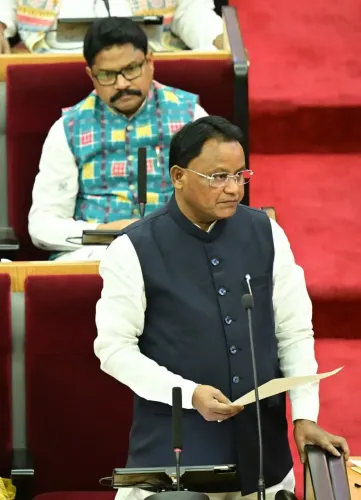
CM Majhi's Odisha Budget Puts ₹5,100 Cr Behind Disasters

Synopsis
Odisha CM Mohan Charan Majhi has announced a ₹5,100 crore disaster management allocation in the Supplementary Budget 2026–27, reinforcing the state's pre-emptive preparedness model built after Cyclones Phailin and Fani.
Key Takeaways
₹5,100 crore allocated for disaster management in Odisha's Supplementary Budget 2026–27 .
The allocation explicitly prioritises preparedness and proactive response alongside rescue, relief and rehabilitation.
CM Mohan Charan Majhi (BJP) made the announcement on 19 November 2026 .
Odisha's disaster-management model has been progressively strengthened after Cyclone Phailin (2013) and Cyclone Fani (2019) .
Detailed utilisation orders and scheme guidelines are expected after the supplementary budget is passed by the legislature.
When the next cyclone barrels into Odisha's coastline, the state intends to be ready — and it is now putting serious money behind that promise. Odisha Chief Minister Mohan Charan Majhi announced on Thursday, 19 November 2026 that the Supplementary Budget 2026–27 earmarks ₹5,100 crore for disaster management, with an explicit focus on pre-emptive preparedness as much as rescue and relief.
Posting in both Odia and English, CM Majhi stated: 'The Supplementary Budget 2026–27 allocates ₹5,100 crore for disaster management. The allocation focuses on strengthening preparedness and proactive response, along with rescue, relief and rehabilitation efforts to enhance the state's disaster management capabilities.'
Why ₹5,100 crore signals a strategic shift
The scale of the allocation is notable in context. Odisha sits on one of the most disaster-exposed coastlines in South Asia, battered by multiple cyclones and floods every decade. The state's approach has evolved sharply since Cyclone Phailin in 2013 and the even more destructive Cyclone Fani in 2019 — events that forced a rethink of how governments plan for, not just react to, catastrophe.
What distinguishes the current framing is the deliberate pairing of 'preparedness and proactive response' alongside the traditional pillars of rescue, relief and rehabilitation. That ordering matters. It signals that the Odisha State Disaster Management Authority (OSDMA) is being resourced not merely to clean up after disaster, but to blunt its impact before it arrives — through early-warning infrastructure, large-scale pre-emptive evacuations, and community-level readiness.
Odisha's national reputation for disaster governance
Odisha has drawn consistent recognition at the national level for transforming its disaster response model over the past decade. Where earlier cycles saw the state largely dependent on post-event relief, successive budget cycles have ring-fenced funds specifically for resilience-building. The pattern has translated into markedly lower casualty figures in recent cyclone events relative to storm intensity — a metric that disaster-management experts track closely.
The ₹5,100 crore supplementary outlay continues that trajectory. For the coastal communities and disaster-vulnerable households who live in cyclone corridors and flood-prone river basins, the allocation represents a direct commitment: that preparedness infrastructure, evacuation logistics, and rehabilitation pipelines will not run dry mid-crisis.
What follows the announcement
The supplementary budget announcement sets the headline figure; the operational detail comes next. Detailed utilisation orders and scheme-level guidelines are expected once the supplementary budget clears the state legislature. The harder question — whether the ₹5,100 crore is efficiently deployed before the next monsoon or cyclone season — will be answered in implementation, not in the allocation itself.
For now, CM Majhi has placed disaster resilience at the centre of Odisha's mid-year fiscal statement. In a state where the sea does not wait for budgets to be passed, the bet is that money committed early saves far more than money spent late.
Point of View
100 crore disaster management allocation fits neatly into a decade-long Odisha pattern of treating disaster preparedness as core infrastructure rather than emergency expenditure — a posture that has become a political differentiator for successive state governments. For the Majhi administration, the mid-year supplementary allocation signals continuity with that model and an intent to institutionalise it further under BJP governance. The emphasis on 'proactive response' over reactive relief also reflects a broader national push — visible in central NDMA policy — toward investing upstream in resilience rather than downstream in damage control. Whether the outlay translates into operational capacity will ultimately be tested the next time a major cyclone makes landfall on Odisha's coast.
NationPress
19 Nov 2026
Frequently Asked Questions
How much has Odisha allocated for disaster management in the Supplementary Budget 2026–27?
Odisha has allocated ₹5,100 crore for disaster management in the Supplementary Budget 2026–27, as announced by Chief Minister Mohan Charan Majhi on 19 November 2026.
What will the ₹5,100 crore disaster management fund be used for?
The allocation is focused on strengthening disaster preparedness and proactive response, as well as funding rescue, relief and rehabilitation operations to enhance the state's overall disaster management capabilities.
What is Odisha's track record on disaster management?
Odisha has been nationally recognised for shifting from post-disaster relief to pre-emptive preparedness, including early-warning systems and large-scale evacuations, particularly after the experiences of Cyclone Phailin in 2013 and Cyclone Fani in 2019.
Who is Mohan Charan Majhi?
Mohan Charan Majhi is the BJP Chief Minister of Odisha, a position he has held since June 2024.
When will the Odisha supplementary budget disaster funds be deployed?
Detailed utilisation orders and scheme guidelines are expected to follow once the Supplementary Budget 2026–27 is formally passed by the state legislature.