CM Mann Writes to Centre, Rejects Higher Education Bill 2025
Synopsis
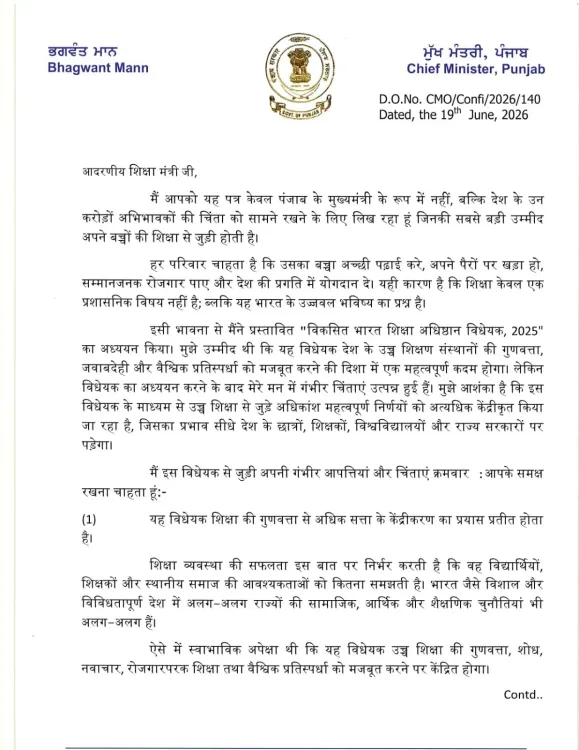
Punjab Chief Minister Bhagwant Mann wrote to the Union Education Minister on 20 June 2026, opposing the Viksit Bharat Ucch Shiksha Bill 2025. He accused the Centre of encroaching on states' rights and vowed that Punjab's universities would not be governed from Delhi, warning against turning education into a business beyond the common man's reach.
Key Takeaways
Punjab CM Bhagwant Mann wrote to the Union Education Minister on 20 June 2026 opposing the Viksit Bharat Ucch Shiksha Bill 2025 .
Mann accused the Central government of using the bill to directly seize states' rights over higher education.
He asserted that Punjab 's universities cannot be administered from Delhi and that the state will determine its youth's future.
Mann warned against education being turned into a business that prices out ordinary families.
Education is on the Concurrent List , making it a recurring site of Centre-state conflict, especially with AAP -governed states.
The bill's tabling in Parliament and potential legal challenges by states are the key developments to watch.
Punjab Chief Minister Bhagwant Mann on Saturday, 20 June 2026, wrote to the Union Education Minister opposing the 'Viksit Bharat Ucch Shiksha Bill 2025', accusing the Central government of using the proposed legislation to directly seize states' rights over higher education. Mann declared that Punjab would not tolerate what he called 'bullying' by the Centre and that the state would determine the future of its youth on its own terms.
Context
Writing in both Punjabi and Hindi, Mann stated: 'Kendra sarkar Viksit Bharat Ucch Shiksha Bill 2025 di aaD vich subiaN de adhikaraN te sidha kabja kar rahi hai' — ['The Central government, under the cover of the Viksit Bharat Higher Education Bill 2025, is directly encroaching on the rights of states.']. He told the Union Education Minister in his letter that Punjab's universities cannot be run from air-conditioned rooms in Delhi.
Mann also drew a sharp social line, warning: 'We will not allow education to become a business where the common man cannot afford to educate his children.' The statement signals both a federalism dispute and a concern about privatisation of public universities.
Policy Backdrop
Education sits on India's Concurrent List under the Seventh Schedule of the Constitution, meaning both Parliament and state legislatures can legislate on it — a structural source of recurring friction. The National Education Policy 2020 had already introduced sweeping new accreditation and regulatory frameworks, prompting concerns among several state governments about shrinking administrative space.
The University Grants Commission Act, 1956 and its successive amendments have periodically expanded central oversight over state-funded universities. Earlier, AAP-governed Delhi and Punjab clashed with the Centre over appointments and funding in local universities, establishing a pattern that the proposed 2025 bill appears to be extending.
Stakeholders and Impact
Punjab's state-funded universities — including institutions in Chandigarh, Patiala, and Amritsar — stand at the centre of this dispute, with their administrative autonomy and funding structures potentially subject to new central mandates under the bill. University administrations, faculty bodies, and student unions could all face altered governance structures if the legislation passes in its reported form.
For low-income students and families, the concern Mann raises is concrete: centralised or market-oriented reforms could affect fee structures, admissions policies, and scholarship frameworks currently managed by the state. AAP's political positioning in both Punjab and Delhi has consistently framed affordable public education as a non-negotiable commitment.
What's Next
All eyes will be on the tabling of the Viksit Bharat Ucch Shiksha Bill 2025 in Parliament and any committee-stage debates where state governments may seek to present their objections formally. Mann's letter to the Union Education Minister could be the opening move in a coordinated pushback by opposition-ruled states.
If the bill proceeds without addressing states' concerns, legal challenges before the Supreme Court on legislative competence remain a distinct possibility. The outcome will set a significant precedent for how far the Centre can extend its regulatory reach over state universities under the Concurrent List framework.
Point of View
He fuses a constitutional argument about the Concurrent List with AAP's core electoral promise of free, accessible public services. This fits a broader pattern where opposition-ruled states have used public letters and press statements to contest central legislation before it reaches Parliament, building political and legal groundwork simultaneously. The sharpness of the language — 'dhakkeshaahi' (bullying) and 'sidha dakka' (direct raid) — suggests AAP intends this as a mobilising issue ahead of any parliamentary debate on the bill.
NationPress
21 Jun 2026
Frequently Asked Questions
What is the Viksit Bharat Ucch Shiksha Bill 2025?
The Viksit Bharat Ucch Shiksha Bill 2025 is a proposed Central government legislation on higher education that Punjab CM Bhagwant Mann says would give the Union government direct control over state universities, encroaching on states' constitutional rights under the Concurrent List.
Why did Bhagwant Mann write to the Union Education Minister?
Mann wrote to the Union Education Minister on 20 June 2026 to formally oppose the bill, arguing that Punjab's universities cannot be governed from Delhi and that the legislation amounts to the Centre seizing states' administrative rights.
Does the Centre have the right to legislate on higher education?
Education is on India's Concurrent List, meaning both Parliament and state legislatures can make laws on it. This shared jurisdiction is the constitutional basis for the dispute between Punjab and the Central government over the proposed bill.
What is AAP's position on central control of state universities?
The Aam Aadmi Party, which governs Punjab, has consistently opposed what it sees as central overreach in education. Mann's letter continues a pattern of AAP-ruled governments challenging Centre directives on curriculum, appointments, and governance of local universities.
What could happen next after Mann's letter?
The immediate focus is on the bill's tabling in Parliament and committee-stage debates. If the Centre proceeds without addressing state concerns, legal challenges before the Supreme Court on legislative competence are considered a likely next step.