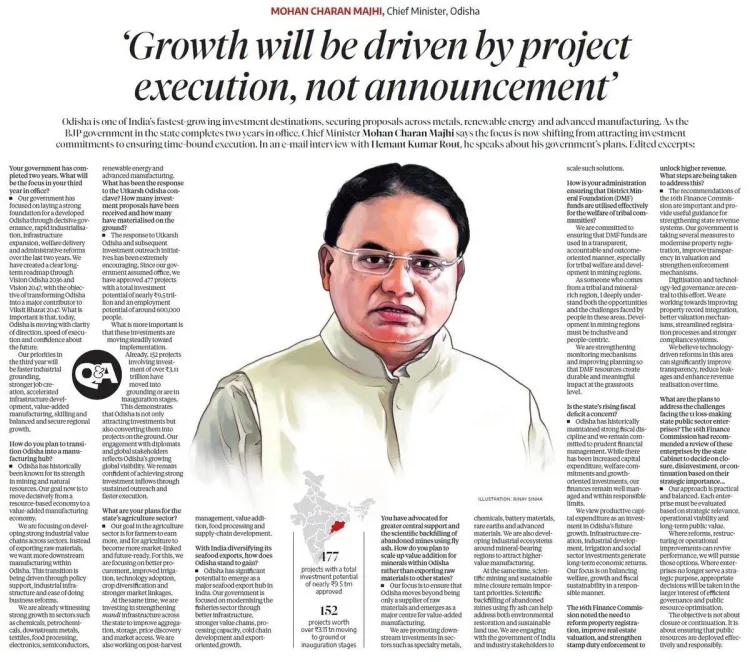
CM Mohan Majhi: 152 Projects Worth ₹3.11 Trillion Moving to Ground
Synopsis
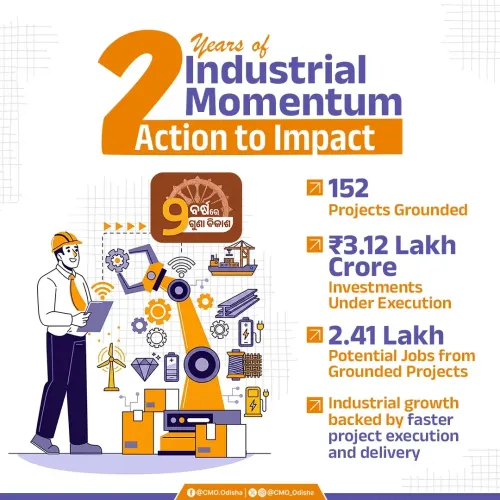
Chief Minister Mohan Majhi says Odisha is fast-tracking 152 projects worth over ₹3.11 trillion to grounding stages, prioritising execution over announcements under the Viksit Odisha 2036 vision through time-bound delivery and tech-driven governance.
Key Takeaways
152 projects worth over ₹3.11 trillion are advancing to grounding stages in Odisha , according to the Chief Minister's Office.
CM Mohan Majhi has framed the government's approach around execution over announcement, a deliberate departure from investor-summit-heavy strategies.
The Viksit Odisha 2036 framework is the long-term roadmap guiding the state's industrial and economic transformation.
Priority sectors include value-added manufacturing and modernisation across industries, leveraging Odisha's mineral resource base.
Tech-driven governance and time-bound delivery are cited as the key mechanisms for ensuring sustainable economic progress reaches grassroots communities.
The approach aligns with the national Atmanirbhar Bharat framework emphasising domestic manufacturing and job creation.
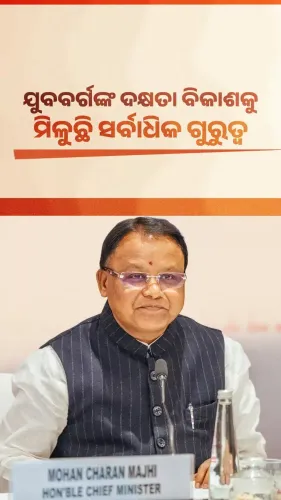
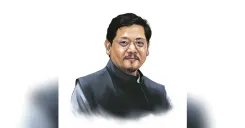
The Chief Minister's Office of Odisha on Friday, 10 July 2026 shared a statement from Chief Minister Shri Mohan Majhi reaffirming the state government's focus on converting investment pledges into operational projects, with 152 projects worth over ₹3.11 trillion already advancing to grounding stages under the Viksit Odisha 2036 vision.
Context
In the statement, CM Majhi drew a sharp distinction between announcements and execution: 'Growth will be driven by project execution, not announcement.' The remark signals a deliberate shift in the state's industrial strategy — from the high-visibility investor summits that generated large pledge volumes toward measurable, time-bound delivery on the ground. The Viksit Odisha 2036 framework serves as the long-term roadmap anchoring this transition.
The Chief Minister specifically highlighted value-added manufacturing and modernisation across sectors as priority areas, pointing to tech-driven governance as the mechanism for ensuring accountability and speed in project clearances and implementation.
Policy Backdrop
Odisha has hosted multiple editions of the Make in Odisha Conclave — beginning with the inaugural edition in 2016 — each generating substantial investment pledges in metals, petrochemicals, downstream industries, and infrastructure. The state sits atop significant mineral reserves, and successive administrations have sought to move the economy from raw-material exports toward higher-value industrial output.
This execution-first posture aligns with the national Atmanirbhar Bharat push for domestic manufacturing and job creation. Odisha has in recent years pursued ease-of-doing-business reforms and single-window clearance mechanisms to reduce the gap between pledged and commissioned investments — a gap that has historically been a challenge across Indian states.
The Majhi government, which came to power after the 2024 assembly elections, has framed industrial execution as a core governance priority, distinguishing its approach from what it characterises as a culture of announcements without follow-through.
Stakeholders and Impact
The primary beneficiaries of accelerated project grounding would be Odisha's manufacturing workforce and the communities surrounding proposed industrial corridors. Value-added processing units — particularly in metals, minerals, and petrochemicals — tend to generate significantly more local employment than raw extraction operations.
For investors, the government's emphasis on time-bound delivery and tech-driven governance is a signal of reduced regulatory friction. Domestic and foreign manufacturers evaluating Odisha as a destination will watch whether the 152-project pipeline translates into commissioning milestones within stated timelines. Sustainable economic progress reaching 'the grassroots of Odisha,' as the Chief Minister put it, will ultimately be measured by employment numbers, wage data, and district-level industrial output.
What's Next
The government's credibility on this front will be tested by the pace at which projects in the current pipeline move from grounding to commissioning. Upcoming state economic surveys and budget documents are expected to carry data on actual project commissioning rates, providing a measurable benchmark against the ₹3.11 trillion pipeline figure cited by the Chief Minister's Office.
Any follow-up investor meet or sector-specific conclave organised under the Viksit Odisha 2036 banner will be closely watched to see whether the state's narrative of execution over announcement holds up against independent assessments of industrial activity on the ground.
Point of View
Raising the accountability stakes for the government. This execution-first framing fits a broader pattern among state governments competing for manufacturing investment in the post-pandemic industrial reorientation, where investors increasingly discount announcements and demand commissioning timelines. Whether Odisha can sustain this narrative will depend on independent data on project commissioning rates emerging in the next budget cycle.
NationPress
10 Jul 2026
Frequently Asked Questions
What is Viksit Odisha 2036?
Viksit Odisha 2036 is the long-term development vision of the Government of Odisha , aimed at transforming the state into a developed economy by the year 2036 through industrial growth, infrastructure modernisation, and sustainable development.
How many projects are being fast-tracked in Odisha?
According to the Chief Minister's Office of Odisha , 152 projects worth over ₹3.11 trillion are currently advancing to grounding stages under the state's industrial execution push.
What is the Make in Odisha Conclave?
The Make in Odisha Conclave is a series of investor summits organised by the Government of Odisha since 2016 to attract investment pledges in sectors including metals, petrochemicals, IT, and manufacturing.
What sectors is Odisha focusing on for industrial growth?
Odisha is prioritising value-added manufacturing and modernisation across sectors, particularly leveraging its mineral resource base to move from raw-material exports toward higher-value industrial output.
Who is the Chief Minister of Odisha?
Mohan Majhi is the Chief Minister of Odisha , having assumed office after the 2024 state assembly elections . His government has placed industrial project execution at the centre of its governance agenda.