CM Mohan Yadav to Set Up 4 Fast Track Courts for Youth in MP
Synopsis
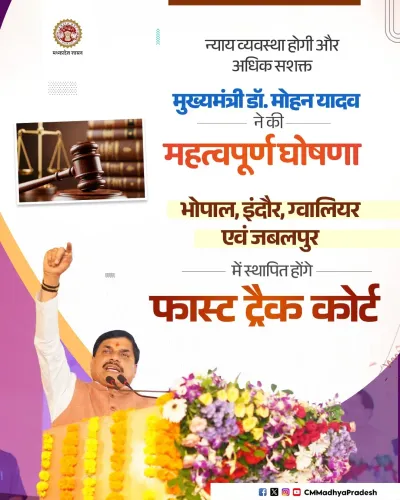
Madhya Pradesh CM Dr. Mohan Yadav has announced four Fast Track Courts in Indore, Bhopal, Gwalior and Jabalpur to deliver swift justice on youth-related matters, extending a national model of specialised courts to address judicial backlog in the state's major cities.
Key Takeaways
Four Fast Track Courts will be established in Indore, Bhopal, Gwalior and Jabalpur , Madhya Pradesh's four largest cities.
The courts are specifically designed to handle matters related to youth , enabling quicker judicial decisions for this demographic.
The announcement was made by Chief Minister Dr.
Mohan Yadav on 25 July 2026 via a post on X.
India's Fast Track Court model dates to 2000 , when it was introduced under the Eleventh Finance Commission to reduce case backlogs.
Specific timelines, funding, and the exact scope of 'youth-related matters' are yet to be officially disclosed by the state government.
The initiative may be extended to additional districts once the four pilot courts are operational, according to policy watchers.
Madhya Pradesh Chief Minister Dr. Mohan Yadav announced on Friday, 25 July 2026 that the state government will establish four Fast Track Courts in Indore, Bhopal, Gwalior, and Jabalpur to enable swift judicial decisions on matters concerning youth.
Posting on X, the Chief Minister stated — 'मध्यप्रदेश में इंदौर, भोपाल, ग्वालियर और जबलपुर में युवाओं से जुड़े मसलों पर त्वरित निर्णय के लिए चार फास्ट ट्रैक कोर्ट बनाने जा रहे हैं' — meaning: 'In Madhya Pradesh, four Fast Track Courts are being established in Indore, Bhopal, Gwalior and Jabalpur for swift decisions on issues related to youth.'
Context
The announcement targets four of Madhya Pradesh's most populous and economically significant cities. Indore is the state's largest city and a major industrial and educational centre; Bhopal is the state capital and administrative hub; Gwalior holds cultural and educational prominence in northern Madhya Pradesh; and Jabalpur is the state's established judicial nerve centre in the east.
Youth-related cases — spanning education disputes, employment grievances, and criminal matters involving young persons — often face prolonged pendency in ordinary courts. Dedicated Fast Track Courts are designed to cut through that backlog and deliver timely outcomes for this demographic.
Policy Backdrop
Fast Track Courts are not a new concept in India. The central government first introduced them in 2000 under the Eleventh Finance Commission framework to address mounting case backlogs across the country's criminal justice system. Over the following two decades, states have periodically revived and expanded the model to cover specific categories of cases — from crimes against women to matters involving senior citizens.
Dr. Mohan Yadav, who assumed office as Chief Minister in December 2023, has positioned judicial efficiency and youth welfare as policy priorities. This announcement fits within a broader pattern of state-level judicial reforms aimed at faster resolution of cases involving particular demographic groups, continuing a national trend of targeted court specialisation.
Stakeholders and Impact
The primary beneficiaries are young residents of the four cities who are either parties to, or subjects of, legal proceedings. Faster resolution reduces the economic and psychological burden of prolonged litigation on youth at a formative stage of their lives.
The judiciary in Madhya Pradesh stands to gain as well — dedicated benches ease the docket pressure on general civil and criminal courts. Legal practitioners, student bodies, and youth-facing civil society organisations across Indore, Bhopal, Gwalior and Jabalpur are among the stakeholders who will closely watch the courts' operationalisation and scope of jurisdiction.
What's Next
The state government is yet to announce specific timelines, budget allocations, and the precise categories of youth-related matters that will fall under the new courts' jurisdiction. Observers will watch whether the initiative is extended to smaller districts once the four flagship courts are functional.
The success of the courts will likely depend on adequate staffing, infrastructure, and a clear definition of 'youth-related matters' — details that are expected to emerge as the government moves from announcement to implementation.
Point of View
Bhopal, Gwalior and Jabalpur — cities that together represent the state's economic, administrative and educational weight — the government maximises both reach and visibility. The move fits a broader national pattern in which state governments use specialised courts as a governance signalling tool, demonstrating responsiveness without requiring legislative action. The real test will be in implementation: whether these courts are staffed, funded and operational within a defined timeframe, or remain an announcement awaiting follow-through.
NationPress
25 Jul 2026
Frequently Asked Questions
What are the Fast Track Courts announced by Madhya Pradesh CM Mohan Yadav?
Chief Minister Dr. Mohan Yadav has announced four Fast Track Courts — one each in Indore, Bhopal, Gwalior and Jabalpur — specifically to handle matters related to youth and deliver swift judicial decisions.
Which cities will get Fast Track Courts in Madhya Pradesh?
The four cities are Indore, Bhopal, Gwalior and Jabalpur, which are among the largest and most significant urban centres in Madhya Pradesh.
What types of cases will these Fast Track Courts handle?
The courts are intended for youth-related matters, though the government has not yet specified the exact categories of cases that will fall under their jurisdiction.
When were Fast Track Courts first introduced in India?
Fast Track Courts were first introduced in India in 2000 under the Eleventh Finance Commission framework to address case backlogs in the criminal justice system.
When did Dr. Mohan Yadav become Chief Minister of Madhya Pradesh?
Dr. Mohan Yadav assumed office as Chief Minister of Madhya Pradesh in December 2023 as a BJP leader.