CM Nayab Saini Honours C.V. Raman on Birth Anniversary
Synopsis
Haryana Chief Minister Nayab Singh Saini on November 7, 2026 paid tribute to Nobel laureate and Bharat Ratna awardee C.V. Raman on his birth anniversary, calling him an eternal inspiration for future generations of Indian scientists.
Key Takeaways
Haryana CM Nayab Singh Saini posted a tribute to C.V.
Raman on his birth anniversary on November 7, 2026 .
Raman won the Nobel Prize in Physics in 1930 for the discovery of the Raman Effect.
Raman was among the first recipients of the Bharat Ratna in 1954 , India's highest civilian honour.
He was the first Asian and first non-white scientist to win a Nobel Prize in a science category.
CM Saini highlighted curiosity, resolve, and continuous effort as Raman's enduring lessons for India's youth.
On the birth anniversary of Sir Chandrasekhara Venkata Raman — the physicist who carried India's name to Stockholm and back — Haryana Chief Minister Nayab Singh Saini paid tribute on Saturday, November 7, 2026, saluting the Nobel laureate's towering legacy in science.
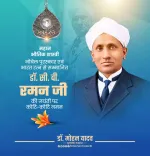
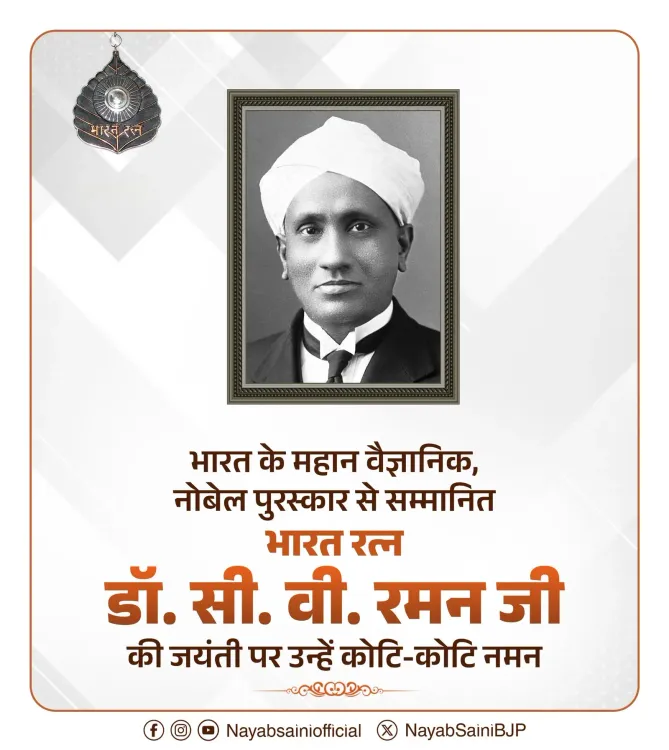
Posting in Hindi, CM Saini wrote: 'महान वैज्ञानिक, नोबेल पुरस्कार एवं भारत रत्न से सम्मानित डॉ. सी. वी. रमन जी की जयंती पर कोटि-कोटि नमन' — 'A billion salutes to the great scientist Dr. C.V. Raman, honoured with the Nobel Prize and the Bharat Ratna, on his birth anniversary.' He described Raman's extraordinary talent, unbroken curiosity, and tireless labour as the forces that gave India a global identity in science.
The discovery that changed how we see light
C.V. Raman was awarded the Nobel Prize in Physics in 1930 for the discovery of the Raman Effect — the phenomenon by which light scattering through a transparent material changes wavelength, revealing the material's molecular composition. It remains one of the most elegant experiments in the history of physics: conducted with modest instruments, powered entirely by curiosity. He was the first Asian and first non-white scientist to win the Nobel Prize in a science category.
Four years after independence, the nation returned the honour. In 1954, Raman became one of the first recipients of the Bharat Ratna, India's highest civilian award, cementing his place not just in the scientific canon but in the national memory.
A pattern of tribute — and what it signals
CM Saini's post follows a well-worn but meaningful ritual in Indian public life: leaders across the political spectrum mark the anniversaries of scientific and cultural giants to anchor contemporary ambitions in historical achievement. The message Saini drew out — that 'curiosity, resolve, and continuous effort can turn every challenge into an opportunity' — is pitched squarely at students and young scientists, the generation India is betting on to power its next technological leap.
Raman's life, built on institutional perseverance and a refusal to accept that world-class science required Western resources, carries a quietly radical argument: that rigour and imagination, not geography, produce breakthroughs. That argument has only grown more resonant as India accelerates investments in research and space exploration.
Generations will keep returning to that argument — and to the man who proved it.
Point of View
Space, and technology. By spotlighting Raman's Bharat Ratna alongside his Nobel, the post implicitly frames national honour and global excellence as inseparable — a framing that resonates with India's current push to raise its profile in global science rankings. The appeal to 'future generations' is a durable political signalling device, connecting historical pride to youth-oriented policy. Tributes like these also serve a soft-power function: reinforcing the idea that India's civilisational contribution to knowledge predates and transcends any single government.
NationPress
7 Nov 2026
Frequently Asked Questions
Why is C.V. Raman's birth anniversary celebrated in India?
C.V. Raman's birth anniversary, November 7 , marks the birth of India's first Nobel laureate in science. His 1930 Nobel Prize for the Raman Effect made him a symbol of Indian intellectual achievement, and the day is observed as National Science Day falls on February 28 — the date in 1928 when he announced the discovery — while his birthday is marked by tributes from leaders and institutions.
What is the Raman Effect?
The Raman Effect is the phenomenon where light passing through a transparent medium scatters at a different wavelength, revealing information about the medium's molecular structure. C.V. Raman discovered it in 1928 and was awarded the Nobel Prize in Physics in 1930 for this finding.
What awards did C.V. Raman receive?
C.V. Raman received the Nobel Prize in Physics in 1930 and the Bharat Ratna in 1954 , India's highest civilian honour, making him one of the most decorated scientists in Indian history.
Who is Nayab Singh Saini?
Nayab Singh Saini is the Chief Minister of Haryana and a senior leader of the Bharatiya Janata Party (BJP) . He has served as CM of Haryana and regularly uses social media to mark national anniversaries and issue policy statements.
Was C.V. Raman the first Asian Nobel laureate in science?
Yes. C.V. Raman was the first Asian and first non-white scientist to win a Nobel Prize in a science category, receiving the Nobel Prize in Physics in 1930 for the discovery of the Raman Effect.