CM Office Highlights Peace and Progress in Bastar
Synopsis
The Chief Minister's Office of Chhattisgarh declared on 15 July 2026 that Bastar's transformation is now visible to the world, highlighting peace, security, and development as hallmarks of good governance in the long-troubled southern tribal division.
Key Takeaways
The Chief Minister's Office of Chhattisgarh posted on 15 July 2026 highlighting Bastar's transformation under good governance.
Bastar is a seven-district division in southern Chhattisgarh with a predominantly tribal population and a long history of left-wing extremism.
The state has pursued a dual strategy of security operations and infrastructure investment in Bastar since the mid-2000s.
Similar development-linked security approaches have been adopted in Jharkhand and Odisha across the Red Corridor.
Tribal communities of Bastar are the primary stakeholders in any sustained improvement in peace and development.
Upcoming state budget allocations and assembly session announcements will be key indicators of the government's concrete commitments to the region.
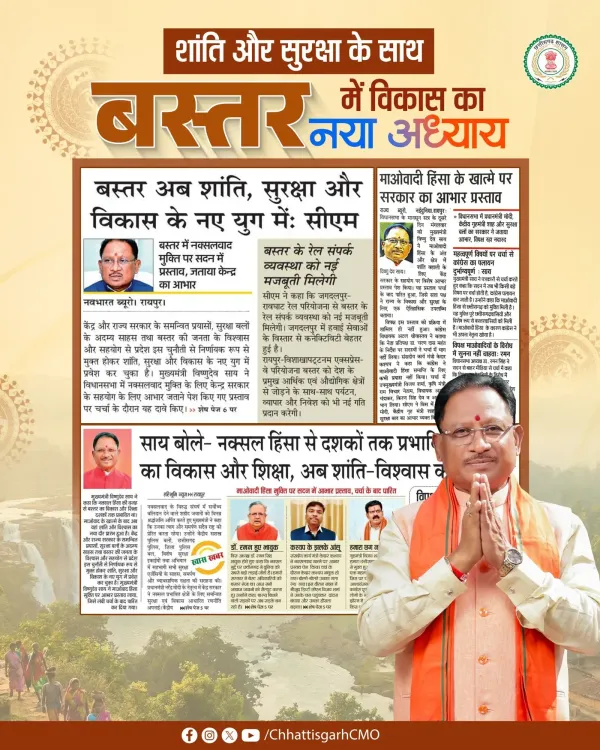
The Chief Minister's Office of Chhattisgarh on Wednesday, 15 July 2026 posted on X that the changing face of Bastar is now visible to the world, framing the southern division's transformation as a new dawn of peace, security, and development under good governance.
Context
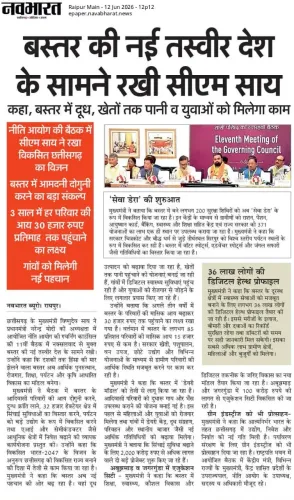
The post, shared in Hindi, reads: 'Bastar ki badalti tasveer ab duniya dekh rahi hai. Sushaasan mein shanti, suraksha aur vikaas ka naya savera.' ('The changing picture of Bastar is now being seen by the world. A new dawn of peace, security, and development under good governance.') The message was accompanied by an image and tagged with hashtags including #Bastar, #Badlav (Change), #NewDawn, and #Sushasansarkar (Good Governance Government).
Bastar is a division in southern Chhattisgarh comprising seven districts with a predominantly tribal population. For decades, the region was among the most severely affected areas in India's so-called Red Corridor, where left-wing extremist groups exercised significant influence over large tracts of forest and village territory.
Policy Backdrop
Chhattisgarh has pursued a twin-track strategy in Bastar since the mid-2000s, combining intensified counter-Naxal security operations with accelerated infrastructure investment — roads, schools, health facilities, and welfare delivery — to extend the reach of civilian administration into former Maoist strongholds.
This approach mirrors parallel efforts in neighbouring states such as Jharkhand and Odisha, where road connectivity and social-sector spending have been linked to measurable reductions in insurgent influence. The broader national pattern has been to use visible governance outcomes as both a security tool and a political narrative in internal-security theatres.
Stakeholders and Impact
The primary beneficiaries of any sustained improvement in Bastar are its tribal communities, who have historically borne the brunt of conflict between security forces and left-wing extremists. Better roads, schools, and health access translate directly into livelihood and welfare gains for these populations.
The CMO's messaging also signals to investors and development agencies that the region is stabilising, which can attract economic activity and accelerate the state government's own development agenda for the division.
What's Next
Observers will watch Chhattisgarh's upcoming legislative session and state budget allocations for concrete figures on infrastructure spending earmarked for Bastar. Any follow-up security or welfare announcements from the government will indicate whether this communication marks the beginning of a broader policy push or forms part of routine governance messaging.
The emphasis on 'the world watching' Bastar's transformation suggests the state government may be positioning the region's progress as a model, with implications for how India frames its internal-security and development narrative at the national level.
Point of View
Positioning Bastar's security gains as a development dividend rather than merely a law-and-order achievement — a framing that has become standard for states seeking to attract investment and federal support in former conflict zones. By invoking 'the world watching,' the messaging reaches beyond domestic audiences to signal regional stabilisation at a time when India's internal-security record in tribal areas faces international scrutiny. The hashtag cluster — pairing #Badlav (change) with #Sushasansarkar — links the ruling dispensation's identity directly to Bastar's transformation, making the region's progress a core political asset. Whether the narrative is matched by verifiable data on infrastructure delivery and civilian welfare will determine its durability as a policy story.
NationPress
15 Jul 2026
Frequently Asked Questions
What is the current situation in Bastar, Chhattisgarh?
Bastar is a seven-district division in southern Chhattisgarh that has seen decades of left-wing extremist activity. The Chhattisgarh government has been pursuing combined security operations and development investments to stabilise the region, and the CMO's July 2026 post signals that authorities believe significant progress has been made.
Why is Bastar important for Chhattisgarh's development?
Bastar is home to a large tribal population and rich natural resources, but prolonged conflict historically limited infrastructure and welfare delivery. Stabilising the region is central to the state's broader economic and social development goals.
What does 'Sushaasan Sarkar' mean in the context of Chhattisgarh?
'Sushaasan Sarkar' translates to 'Good Governance Government' and is a political tag used by the Chhattisgarh government to brand its administrative approach, emphasising transparency, security, and development delivery.
How has the Chhattisgarh government addressed Naxalism in Bastar?
Since the mid-2000s, Chhattisgarh has combined counter-insurgency security operations with accelerated infrastructure projects — roads, schools, and health facilities — to extend civilian administration into areas previously under Maoist influence.
Which other Indian states have similar development strategies in Naxal-affected areas?
Jharkhand and Odisha have pursued comparable approaches, linking road connectivity and social-sector spending to reduced insurgent influence, as part of a broader national pattern of pairing security operations with development in the Red Corridor.