CM Bhupendra Patel: India exited Fragile Five under PM Modi
Synopsis
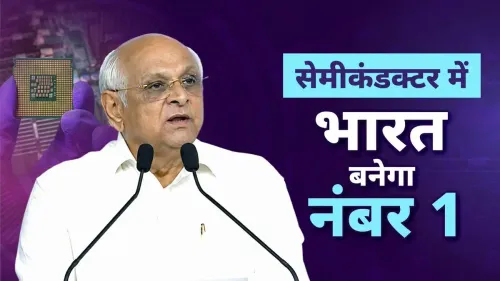
Gujarat Chief Minister Bhupendra Patel on 4 July 2026 declared that India has emerged from the 'Fragile Five' vulnerable economies and is now a fast-growing economy, crediting PM Narendra Modi's leadership, on the occasion of the Prime Minister's visit to Sanand, Gujarat's semiconductor hub.
Key Takeaways
CM Bhupendra Patel stated that India has exited the 'Fragile Five' group of vulnerable economies under PM Narendra Modi's leadership.
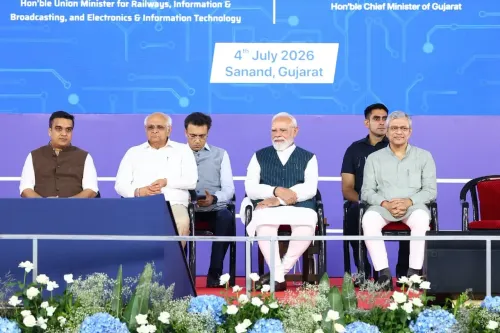
The remarks were made on 4 July 2026 during PM Modi's visit to Sanand , Gujarat, a key semiconductor and electronics manufacturing hub.
The 'Fragile Five' label dates to around 2013 , when India was identified as vulnerable due to high current-account deficits and capital-flow dependence.
India's economic repositioning has been supported by the Make in India initiative, PLI schemes for electronics, and the India Semiconductor Mission approved in 2021 .
Sanand has attracted significant semiconductor investment aligned with both central and Gujarat state incentive frameworks.
Commissioning timelines for approved semiconductor fabrication units in Sanand will be a key indicator of whether policy momentum translates into industrial output.
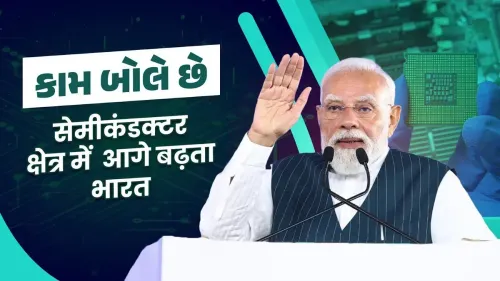
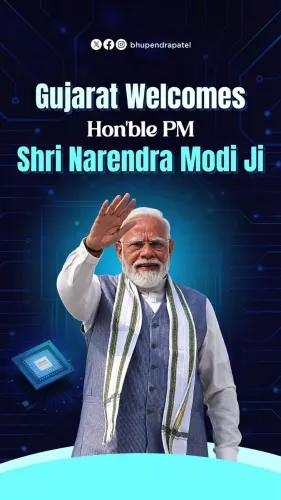
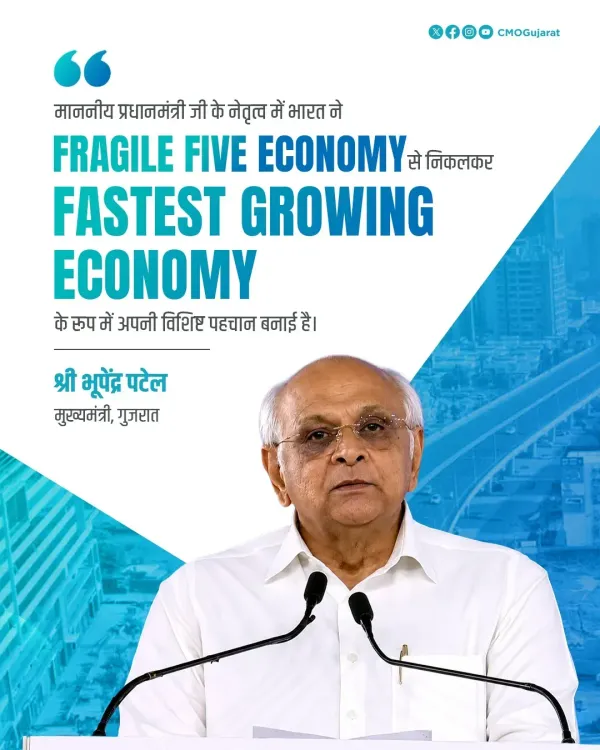
Chief Minister Bhupendra Patel of Gujarat on Saturday, 4 July 2026, proudly declared that India has emerged from the so-called 'Fragile Five' group of vulnerable economies and is now among the world's fastest-growing major economies — a transformation he attributed to the leadership of Prime Minister Narendra Modi. The statement came on the occasion of the Prime Minister's visit to Sanand, Gujarat's rising industrial and semiconductor hub, marked on social media by the hashtags #SemiconHubBharat and #PMinSanand.
Context
The post, shared by the Chief Minister's Office of Gujarat, quotes CM Bhupendra Patel as saying with pride that under PM Modi's leadership, India has moved out of the 'Fragile Five' and become a rapidly growing economy. The original Gujarati reads: 'ભારત ફ્રેજાઇલ ફાઇવ ઇકોનોમીમાંથી બહાર નીકળીને તેજ ગતિથી વિકસી રહેલ અર્થવ્યવસ્થા બની છે' — meaning 'India has come out of the Fragile Five economies and become a rapidly developing economy.' The remarks were made in the context of PM Modi's presence in Sanand, a town in Gandhinagar district that has become central to India's semiconductor ambitions.
Policy Backdrop
The 'Fragile Five' label was coined around 2013 to describe emerging-market economies — including India — that were considered vulnerable due to high current-account deficits and dependence on foreign capital flows. Since 2014, the central government has pursued a series of structural reforms under the Make in India initiative, the Production Linked Incentive (PLI) scheme for electronics and IT hardware (introduced in 2020), and the India Semiconductor Mission, whose framework was approved in 2021 with substantial financial incentives for fabrication and design units.
Sanand has been a focal point of this strategy, attracting semiconductor and electronics manufacturing investments backed by both central and state-level incentives. Gujarat's alignment of its own industrial policy with central schemes has positioned the state as a preferred destination for high-technology manufacturing projects.
Stakeholders and Impact
The primary beneficiaries of the policy arc being celebrated include semiconductor investors, electronics manufacturers, and the broader industrial ecosystem in Gujarat. For domestic industry, a stable macroeconomic environment combined with targeted incentives reduces the risk premium on long-gestation capital investments such as chip fabrication plants.
Workers and ancillary suppliers in Sanand and surrounding areas stand to gain from expanded manufacturing activity if commissioning timelines for approved semiconductor units proceed as planned. The narrative also carries political significance for Gujarat, framing the state as an engine of national economic transformation ahead of any future investment summits.
What's Next
Attention will now turn to the commissioning timelines and capacity utilisation of semiconductor units already approved under the India Semiconductor Mission in Sanand. Any follow-up announcements — whether fresh investment commitments, state-level incentive packages, or central scheme expansions — emerging from PM Modi's visit are expected to sharpen the policy picture in the coming weeks. Gujarat's ability to translate political momentum into operational manufacturing capacity will be the key test of the narrative being articulated by CM Bhupendra Patel.
Point of View
The Chief Minister draws a sharp before-and-after contrast that is designed to resonate with both domestic investors and an international audience tracking India's economic trajectory. The timing, coinciding with the Prime Minister's physical presence in Sanand, amplifies the signal that the central government views Gujarat as a showcase for its high-technology manufacturing agenda. Whether the narrative holds will ultimately depend on how quickly semiconductor units in Sanand move from approval to production.
NationPress
3 Oct 2026
Frequently Asked Questions
What is the Fragile Five and was India part of it?
The 'Fragile Five' was a term coined around 2013 for five emerging-market economies — including India — deemed vulnerable to capital outflows due to high current-account deficits. India has since undertaken structural reforms that have substantially improved its macroeconomic position.
Why did PM Modi visit Sanand in Gujarat?
PM Modi visited Sanand, an industrial township in Gujarat, in the context of India's semiconductor manufacturing push; Sanand has attracted major electronics and chip-related investments under central and state incentive schemes.
What is the India Semiconductor Mission?
The India Semiconductor Mission is a central government programme approved in 2021 to develop domestic semiconductor design and fabrication capabilities, offering financial incentives to companies setting up units in India.
What did CM Bhupendra Patel say about India's economy?
CM Bhupendra Patel proudly stated that under PM Narendra Modi's leadership, India has emerged from the 'Fragile Five' group of vulnerable economies and is now one of the fastest-growing major economies in the world.
What is Sanand's role in India's semiconductor industry?
Sanand in Gujarat has been positioned as a key hub for semiconductor and electronics manufacturing, with investments supported by the India Semiconductor Mission and Gujarat's own state-level industrial incentives.