CM Bhupendra Patel Meets Western Naval Command Chief in Gandhinagar
Synopsis
Gujarat CM Bhupendra Patel met Vice Admiral Sanjay Vatsayan, chief of the Western Naval Command, in Gandhinagar on October 21, discussing the security of Gujarat's strategic coastline, Arabian Sea trade lanes, and the Navy's operational activities along India's western seaboard.
Key Takeaways
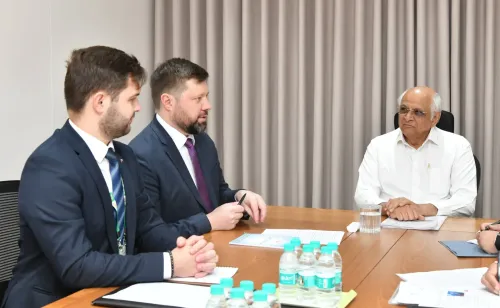
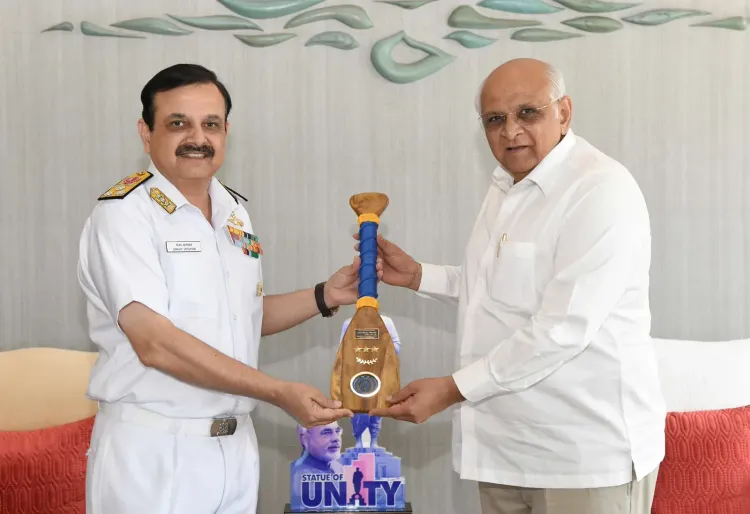
Gujarat CM Bhupendra Patel met Vice Admiral Sanjay Vatsayan , Flag Officer Commanding-in-Chief of the Western Naval Command , in Gandhinagar on October 21, 2026 .
Discussions centred on the security of Gujarat's strategic coastline and operational activities of the Indian Navy along the western seaboard.
The Western Naval Command , headquartered in Mumbai , is responsible for maritime security across the Arabian Sea , including critical energy and trade routes.
The engagement reflects India's post- 2008 coastal security framework, which mandates closer coordination between state governments and naval commands.
CM Patel conveyed best wishes to Vice Admiral Vatsayan for a successful tenure as head of the Western Naval Command.
Gujarat's 1,600-kilometre coastline — dotted with major ports, LNG terminals, and oil refineries — sat at the centre of a high-level security conversation in Gandhinagar on Wednesday, October 21, 2026, as Gujarat Chief Minister Bhupendra Patel met Vice Admiral Sanjay Vatsayan, Flag Officer Commanding-in-Chief of the Western Naval Command, to discuss the state's maritime security posture.
A coastline that carries India's economic lifeline
Gujarat's seaboard is no ordinary stretch of water. It handles a substantial share of India's hydrocarbon imports, container traffic, and port-led commerce — making it one of the most strategically sensitive coastlines in the country. The Western Naval Command, headquartered in Mumbai, holds operational responsibility for the entire western seaboard, covering the Arabian Sea sea lanes through which energy tankers and cargo vessels flow daily into India's economy.
CM Patel described the meeting as 'insightful', noting that discussions covered 'the security of Gujarat's strategic coastline and the various operational activities of the Indian Navy.' He added that the Western Naval Command 'plays a paramount role in safeguarding India's maritime borders and securing crucial trade and energy routes.'
State-Navy coordination: a post-2008 imperative
The meeting is part of an established national framework that took on urgency after the 2008 Mumbai attacks, when gaps between state administrations and naval command structures were exposed in sharp relief. In the years since, India systematically strengthened coastal security architecture — integrating maritime police, coastal radar networks, and regular coordination between state governments and service commands.
Chief ministers meeting regional service commanders has become standard practice in this architecture, ensuring that state-level infrastructure priorities — port expansion, coastal highway development, industrial zones — are factored into operational and intelligence planning at the naval level. Gujarat, with its density of critical assets, sits near the top of that priority list.
What the meeting signals going forward
CM Patel conveyed his best wishes to Vice Admiral Vatsayan for a successful tenure at the helm of the Western Naval Command. The engagement points to continued alignment between the Gujarat government and the Navy on questions of coastal surveillance, emergency response coordination, and the protection of energy infrastructure that India's import-dependent economy cannot afford to leave vulnerable.
With Arabian Sea trade lanes remaining a live pressure point in a volatile geopolitical environment, meetings like this one are less ceremonial than they appear — they are the working joints of India's layered coastal defence architecture, quietly holding it together.
Point of View
Rather than a passive bystander. For Gujarat, whose coastline anchors a disproportionate share of India's energy import infrastructure, these engagements carry real operational weight. CM Patel's visible investment in naval coordination also fits a broader BJP governance pattern of aligning state administrations tightly with national security priorities. As geopolitical pressures in the Arabian Sea persist, the frequency and depth of such state-navy engagements will be a quiet but meaningful indicator of India's coastal preparedness.
NationPress
21 Oct 2026
Frequently Asked Questions
Why did Gujarat CM Bhupendra Patel meet the Western Naval Command chief?
CM Bhupendra Patel met Vice Admiral Sanjay Vatsayan in Gandhinagar on October 21, 2026 to discuss the security of Gujarat's strategic coastline and the operational activities of the Indian Navy along India's western seaboard.
What is the Western Naval Command responsible for?
The Western Naval Command, headquartered in Mumbai, is the Indian Navy's operational command responsible for maritime security along India's entire western seaboard, including the Arabian Sea trade and energy routes.
Why is Gujarat's coastline considered strategically important?
Gujarat's approximately 1,600-kilometre coastline hosts major ports, LNG terminals, and oil refineries, handling a large share of India's hydrocarbon imports and container traffic, making it one of India's most critical maritime zones.
How did India strengthen coastal security after the 2008 Mumbai attacks?
After the 2008 Mumbai attacks, India overhauled its coastal security architecture by setting up maritime police units, coastal radar networks, and formalising regular coordination between state governments and naval commands.
Who is Vice Admiral Sanjay Vatsayan?
Vice Admiral Sanjay Vatsayan is the Flag Officer Commanding-in-Chief of the Indian Navy's Western Naval Command, overseeing maritime security operations along India's western coast and the Arabian Sea.