CM Bhupendra Patel Reviews Sabarmati Riverfront Phase-2 & 3
Synopsis
Chief Minister Bhupendra Patel visited multiple Sabarmati Riverfront Phase-2 and Phase-3 worksites in Ahmedabad on 16 November 2026, reviewing a six-lane automated barrage-bridge, canopy structures, and embankment works, and directing officials to accelerate the project toward its 40-km completion goal.
Key Takeaways
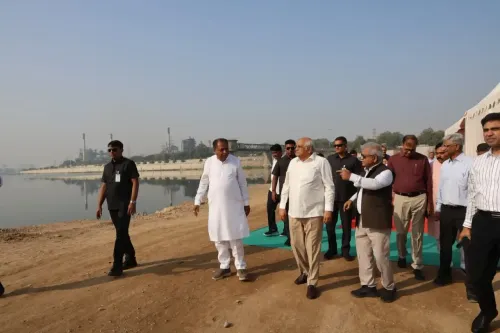
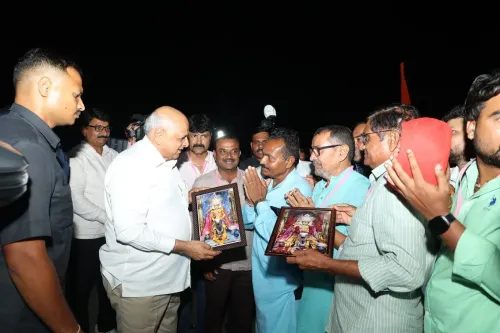
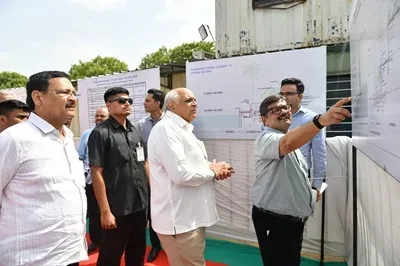
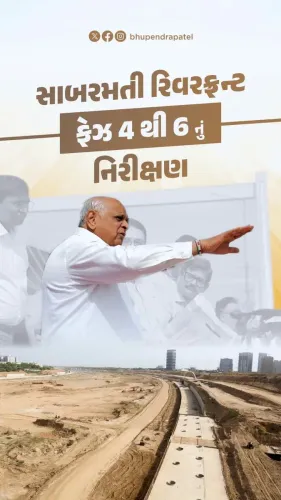
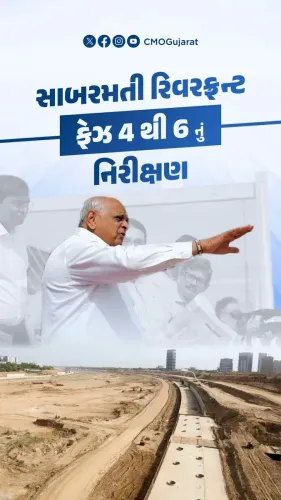
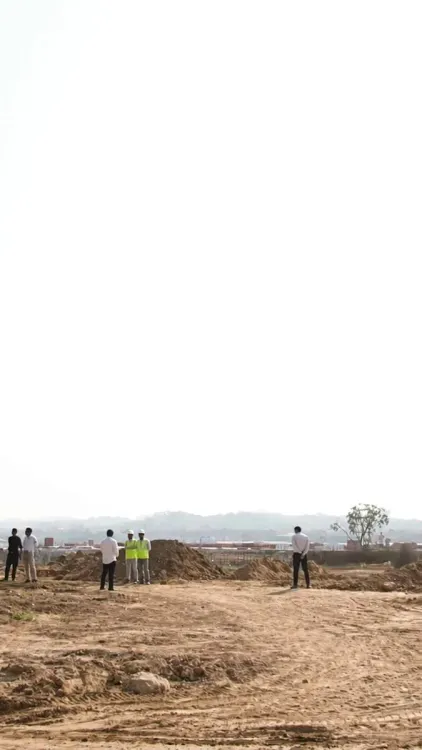
CM Bhupendra Patel conducted a personal site visit on 16 November 2026 to review Sabarmati Riverfront Phase-2 and Phase-3 works in Ahmedabad .
Under Phase-2 , he inspected the Sardar Patel Enclave canopy structure , work near Koteshwar Mahadev temple , and construction under Indira Bridge .
Under Phase-3 , he reviewed sites near Kotarpur (western bank) and Karai near the Narmada Canal Escape (eastern bank).
A six-lane automatic-control barrage-cum-bridge connecting the western and eastern banks is a key component under Phase-2.
Completion of Phases 2 and 3 will bring the total riverfront length to 40 kilometres along both banks of the Sabarmati.
The expanded riverfront will feature green zones, landscaped gardens, children's play areas, food plazas, and art and culture spaces .
Forty kilometres of riverfront, a six-lane automated barrage-bridge, green zones, food plazas, and art spaces — that is what Ahmedabad is being built toward. On Monday, 16 November 2026, the Chief Minister's Office of Gujarat confirmed that Chief Minister Bhupendra Patel made a personal site visit to review the ongoing works under Phase-2 and Phase-3 of the Sabarmati Riverfront Development Project, inspecting progress firsthand and directing senior officials to accelerate execution.
What CM Patel Inspected on the Ground
The Chief Minister's review covered a sweeping set of sites along both banks of the Sabarmati. Under Phase-2, he examined the Sardar Patel Enclave canopy structure, work behind the Koteshwar Mahadev temple, and construction beneath the Indira Bridge. The centrepiece inspection was the six-lane barrage-cum-bridge being built between Achar on the western bank and Camp Sadar Bazaar on the eastern bank — a structure that will be equipped with an automatic control system and serve as both a flood-management barrage and a road crossing.
Under Phase-3, he reviewed progress on the western end near Kotarpur and on the eastern side near Karai, close to the Narmada Canal Escape. At each site, he held detailed review meetings with senior officers and provided directions for faster completion.
The 40-km Vision for Ahmedabad's Riverfront
The Sabarmati Riverfront Development Project has roots going back to the 1990s, when it was first conceptualised as an urban renewal and flood-control response for Gujarat's largest city. Phase-1 construction moved in earnest from 2005 and was formally opened in 2012, transforming a stretch of degraded riverbank into a public promenade that became one of Ahmedabad's defining landmarks.
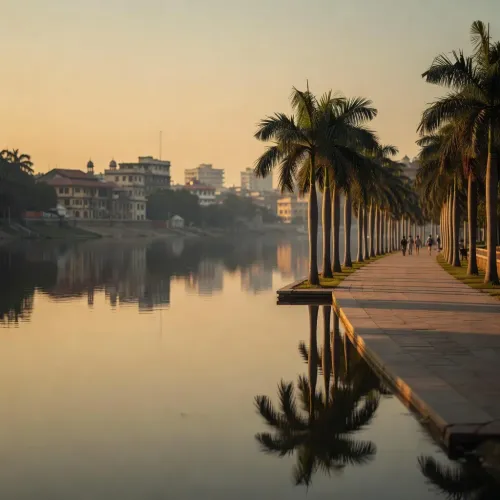
Phases 2 and 3 are designed to nearly triple that footprint. Once complete, the project will span a total of 40 kilometres across both banks, integrating flood management infrastructure with public amenities: green zones, landscaped gardens, children's play areas, food plazas, and dedicated art and culture spaces. The stated goal is to position the expanded riverfront as a convergence point for ecology and tourism — a model Gujarat has pursued across other waterfront projects in the state.
Why a CM Site Visit Signals Urgency
An in-person inspection by a Chief Minister — rather than a routine departmental progress report — typically signals one of two things: political priority or execution concern. Here, the visit came with an explicit instruction for 'rapid completion', suggesting the government wants to convert a landmark-in-progress into a deliverable before the momentum shifts. With Phase-1 already a touchstone for Ahmedabad's urban identity, the pressure on Phases 2 and 3 to meet their promise is real and public.
For residents, the stakes are tangible: 40 km of publicly accessible riverfront, a new bridge corridor across the Sabarmati, and green recreational infrastructure are not abstract policy outcomes. They are the daily commute, the weekend walk, the city's skyline.
Point of View
Whose Phase-1 was closely associated with the era of Narendra Modi as Chief Minister, carries strong symbolic continuity; completing Phases 2 and 3 would let the current administration claim a generational urban infrastructure win. The 40-km target also fits Gujarat's broader pattern of large-scale waterfront development as a template for integrating flood control, tourism, and civic identity — a model that has drawn replication interest from other Indian states.
NationPress
16 Nov 2026
Frequently Asked Questions
What is the Sabarmati Riverfront Development Project?
It is a major urban renewal initiative along the Sabarmati River in Ahmedabad, Gujarat, that transforms degraded riverbanks into public promenades with green spaces, recreational facilities, and infrastructure. Phase-1 opened in 2012, and Phases 2 and 3 are now under construction.
What is included in Sabarmati Riverfront Phase-2 and Phase-3?
Phase-2 includes the Sardar Patel Enclave canopy structure, work near the Koteshwar Mahadev temple, construction under Indira Bridge, and a six-lane automatic-control barrage-cum-bridge. Phase-3 covers the western bank near Kotarpur and the eastern bank near Karai close to the Narmada Canal Escape.
How long will the Sabarmati Riverfront be once fully complete?
Once Phases 2 and 3 are complete, the total Sabarmati Riverfront will span 40 kilometres across both banks of the river through Ahmedabad.
What is the six-lane barrage-cum-bridge on the Sabarmati?
It is a combined flood-control barrage and six-lane road bridge equipped with an automatic control system, connecting the western bank at Achar to the eastern bank at Camp Sadar Bazaar in Ahmedabad.
What amenities will the expanded Sabarmati Riverfront offer?
The completed 40-km riverfront will include green zones, landscaped gardens, children's play areas, food plazas, art and culture spaces, and the six-lane barrage-bridge, aiming to serve both environmental goals and tourism.