CM Bhupendra Patel pays tribute to Shyamji Krishna Varma on birth anniversary
Synopsis
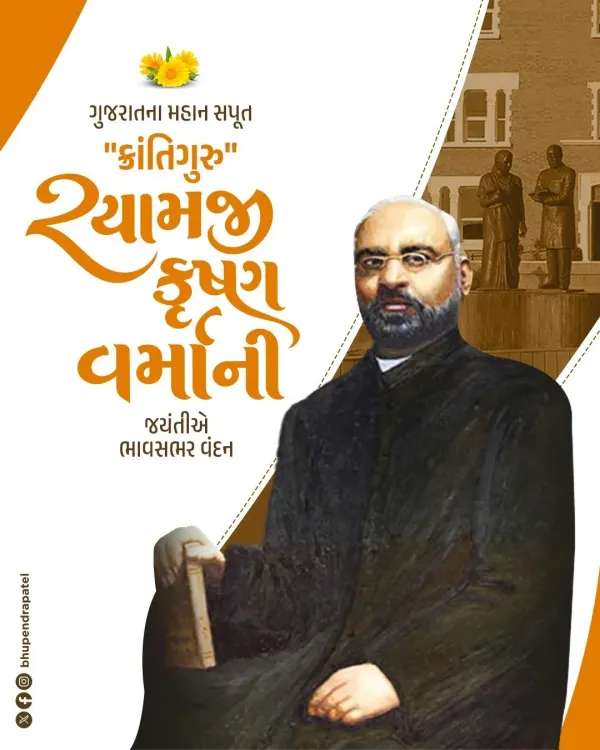
Gujarat Chief Minister Bhupendra Patel honoured Shyamji Krishna Varma on his birth anniversary, remembering the Kutch-born revolutionary who founded India House in London and published 'The Indian Sociologist' to ignite the flame of independence among Indians studying abroad.
Key Takeaways
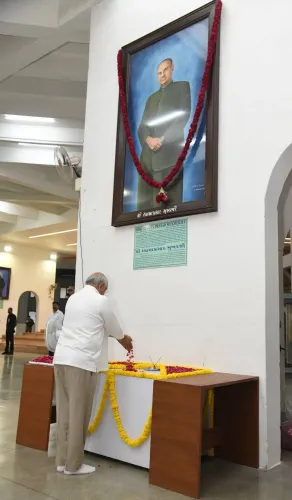
Bhupendra Patel , Gujarat Chief Minister, paid homage to Shyamji Krishna Varma on his birth anniversary on October 4, 2026 .
Varma was born in Mandvi, Kutch , and is remembered as a Kraanti Guru (Revolution Guru) of the Indian freedom movement.
He founded India House in London , a hub for Indian revolutionary nationalism that drew students from across Britain.
His journal 'The Indian Sociologist' championed Indian independence and was banned by British colonial authorities in India.
Varma spent his final years in exile in Geneva and died in 1930 ; his ashes were later returned to Mandvi, Kutch.
CM Patel described Varma as 'the pride of Kutch and Gujarat' whose life remains a lasting source of inspiration.
On the birth anniversary of one of India's lesser-celebrated but fiercely consequential freedom fighters, Gujarat Chief Minister Bhupendra Patel offered his tribute to Shyamji Krishna Varma — the Kutch-born revolutionary who carried the torch of Indian independence to the streets of London long before the world was watching.
Posting on Sunday, October 4, 2026, CM Patel wrote in Gujarati: 'વિદેશની ધરતી પર ભારતીય સ્વાતંત્ર્ય સંગ્રામનું બ્યુગલ ફૂંકનાર' — 'the one who sounded the bugle of India's freedom struggle on foreign soil.' He remembered Varma as a Kraanti Guru (Revolution Guru), a devoted patriot, and a proud son of Kutch whose life remains an eternal source of inspiration.
Shyamji Krishna Varma and the London front of India's freedom struggle
Shyamji Krishna Varma was born in Mandvi, Kutch, and went on to become one of the most audacious architects of Indian revolutionary thought abroad. In London, he founded India House — a residence and intellectual hub that became a crucible for radical Indian nationalism in the early twentieth century. Young Indian students studying in Britain gathered there, absorbing ideas of self-rule, resistance, and revolution far from the reach of colonial censors.
Varma also launched 'The Indian Sociologist', a journal that openly challenged British imperial authority and propagated the case for Indian independence. The publication was considered so seditious by colonial authorities that it was eventually banned in British India. Through these twin institutions — a physical home and a printed voice — Varma built an overseas network of revolutionary thought that influenced a generation of freedom fighters.
Kutch's pride, Gujarat's heritage
CM Patel's tribute underlines a consistent strand in Gujarat's political identity: honouring its extraordinary gallery of freedom fighters and nation-builders. Varma's legacy holds particular resonance for Kutch, a region that often stands at the margins of mainstream historical narratives about the independence movement. By naming him 'Kachch ane Gujaratnu Gaurav' — 'the pride of Kutch and Gujarat' — Patel reconnects a younger generation to a revolutionary tradition that stretched well beyond the subcontinent's borders.
Varma spent his later years in exile in Europe, eventually settling in Geneva, where he died in 1930. His ashes were brought back to India decades later and immersed at his birthplace in Mandvi — a homecoming delayed by history but eventually honoured by the nation he spent his life serving.
Revolutionaries who operated abroad rarely receive the same commemorative weight as those who marched on Indian soil. Shyamji Krishna Varma is one reminder that the fight for Swaraj was always a global struggle — and that Kutch sent one of its finest sons to wage it from the heart of the Empire itself.
Point of View
Gesturing toward India's historical global reach at a time when the country actively projects its civilisational heritage on the world stage.
NationPress
4 Oct 2026
Frequently Asked Questions
Who was Shyamji Krishna Varma?
Shyamji Krishna Varma was a Kutch-born Indian revolutionary and patriot who founded India House in London and published 'The Indian Sociologist' journal to spread the idea of Indian independence among Indians studying abroad in the early twentieth century.
What was India House in London?
India House was a residence and intellectual centre founded by Shyamji Krishna Varma in London that served as a hub for Indian nationalist thought and revolutionary activity, bringing together Indian students who were studying in Britain.
Why is Shyamji Krishna Varma called Kraanti Guru?
Shyamji Krishna Varma is called Kraanti Guru, meaning Revolution Guru, because he inspired and mentored a generation of Indian revolutionaries abroad through India House and his journal, making him a guiding force of the overseas independence movement.
Where was Shyamji Krishna Varma born?
Shyamji Krishna Varma was born in Mandvi, Kutch, in present-day Gujarat, India.
Why did Bhupendra Patel pay tribute to Shyamji Krishna Varma?
Gujarat Chief Minister Bhupendra Patel posted a tribute on X on October 4, 2026, to mark the birth anniversary of Shyamji Krishna Varma, honouring him as the pride of Kutch and Gujarat and acknowledging his role in carrying India's freedom struggle to foreign soil.