CM Pema Khandu moved by Hindi poetry on Tawang
Synopsis
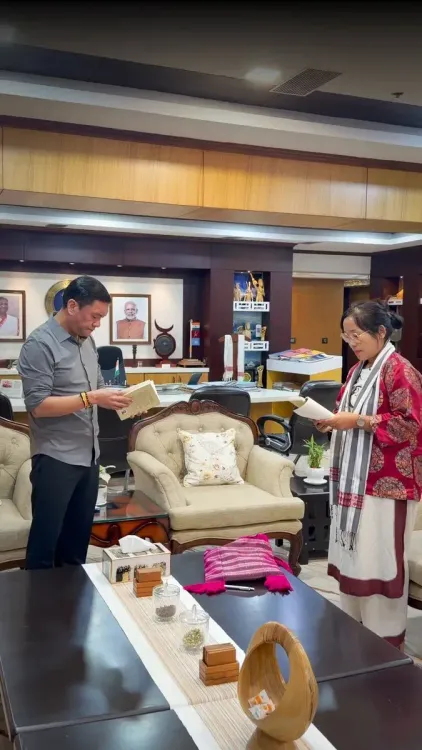
Arunachal Pradesh CM Pema Khandu shared his appreciation after listening to poet Dr. Gumpi Nguso recite from 'Tawang se Tagum', a Hindi poetry collection capturing the landscapes, people, and culture of Arunachal Pradesh.
Key Takeaways
Pema Khandu , Chief Minister of Arunachal Pradesh, publicly appreciated poet Dr.
Gumpi Nguso's recitation on 23 October 2026 .
The poem is from the collection Tawang se Tagum , a Hindi poetry book capturing Arunachal Pradesh's landscapes, people, culture, struggles and lived experiences.
Tawang is a high-altitude district near the India-China border and home to one of Asia's largest Buddhist monasteries.
The collection represents a growing trend of Northeast India's regional narratives finding expression through national-language literature.
Khandu described the experience as 'special,' highlighting the emotional resonance of one's homeland being celebrated through art.
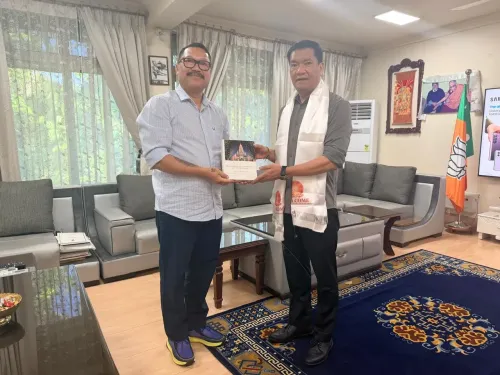
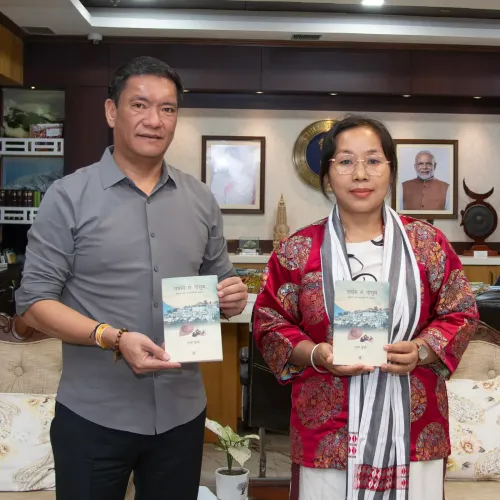
When a poem about your homeland is read aloud in your presence, something shifts. Arunachal Pradesh Chief Minister Pema Khandu felt exactly that on Friday, 23 October 2026, listening to poet Dr. Gumpi Nguso recite her work on Tawang — a verse drawn from her collection Tawang se Tagum, a book of Hindi poems that maps the landscapes, people, culture, struggles, and lived experiences of Arunachal Pradesh.
A book that carries the Northeast in Hindi verse
Tawang se Tagum is described by Khandu as a collection capturing Arunachal Pradesh through 'the beauty of Hindi poetry.' The title itself gestures at geography: Tawang, the high-altitude district home to one of Asia's largest Buddhist monasteries, and Tagum, a reference that evokes the state's wider terrain. For a state defined by dozens of tribal languages and oral traditions, rendering its world in Hindi is a deliberate, quietly political act — a bridge between the region's intimate local voices and a national literary audience.
Tawang's weight — cultural, strategic, deeply felt
Tawang is no ordinary district. Perched near the India-China border, it carries strategic significance that makes it a constant presence in geopolitical conversation. But it is also a living cultural landscape — monasteries, festivals, alpine meadows, and communities whose histories stretch back centuries. Poetry that holds all of that in a single frame does something no policy document can. Khandu's response — 'It feels special to hear your own land celebrated through poetry' — speaks to that gap between the administrative and the deeply human.
Hindi as a lens for regional identity
Arunachal Pradesh is one of India's most linguistically diverse states, with well over 26 major tribal groups and a mosaic of languages. The choice to celebrate a Hindi-language work on the state's culture is part of a broader pattern: Northeast India increasingly finding national-language expression for stories that once circulated only locally. Literary events and heritage documentation efforts in border districts have grown steadily, with state governments recognising that soft cultural visibility — poems, films, festivals — builds a kind of recognition that connectivity projects alone cannot.
Dr. Nguso's recitation, and the Chief Minister's public appreciation of it, nudges that conversation forward. The next question is whether moments like this catalyse a state-level literary platform that gives writers from Arunachal's tribal heartlands a sustained, institutionalised stage.
Point of View
The elevation of literary art is a counter-narrative worth watching. It also underscores a quiet effort by the BJP-led state government to deepen emotional and cultural bonds with the region's diverse communities alongside infrastructure investment. If this translates into institutional support — literary festivals, publication grants, school curricula — it could meaningfully widen Arunachal's cultural footprint nationally.
NationPress
23 Oct 2026
Frequently Asked Questions
Who is Dr. Gumpi Nguso?
Dr. Gumpi Nguso is a poet whose Hindi collection Tawang se Tagum captures the landscapes, people, culture, struggles, and lived experiences of Arunachal Pradesh. CM Pema Khandu shared his appreciation after listening to her recite from the book on 23 October 2026.
What is 'Tawang se Tagum' about?
'Tawang se Tagum' is a collection of Hindi poems by Dr. Gumpi Nguso that celebrates Arunachal Pradesh — its landscapes, communities, culture, and lived experiences — with Tawang as a central reference point.
Why is Tawang culturally significant?
Tawang is a high-altitude district in Arunachal Pradesh known for its ancient Buddhist monastery — one of Asia's largest — its tribal communities, alpine terrain, and its location near the sensitive India-China border.
What did CM Pema Khandu say about the poetry?
Khandu said, 'It feels special to hear your own land celebrated through poetry,' describing his experience of listening to Dr. Gumpi Nguso recite her work on Tawang from her book Tawang se Tagum .
Why is Hindi poetry about Northeast India significant?
Arunachal Pradesh has over 26 major tribal groups and a rich mosaic of local languages. Hindi-language works about the region help bring Northeast India's stories to a national audience and represent a growing bridge between regional identity and mainstream literary culture.