CM Pema Khandu, Union Ministers Review Flood Damage in Keyi Panyor
Synopsis
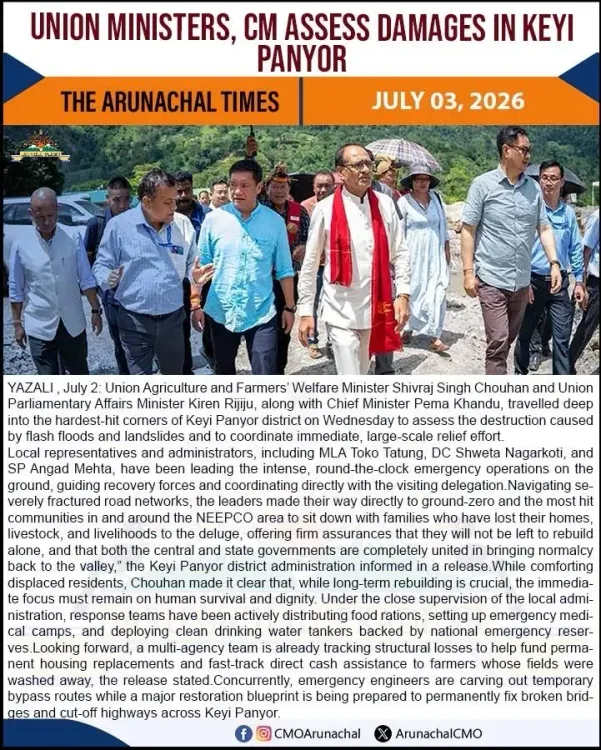
Chief Minister Pema Khandu joined Union Ministers Shivraj Singh Chouhan and Kiren Rijiju on 3 July 2026 to assess monsoon flood damage in Keyi Panyor district, Arunachal Pradesh, and review ongoing relief and rehabilitation operations on the ground.
Key Takeaways
Chief Minister Pema Khandu accompanied Union Ministers Shivraj Singh Chouhan and Kiren Rijiju to Keyi Panyor district on 3 July 2026 to assess flood damage.
The visit focused on reviewing relief and rehabilitation efforts currently under way in the flood-affected district.
Keyi Panyor is a recently created district in Arunachal Pradesh situated in a riverine zone highly vulnerable to seasonal Himalayan flooding.
India's disaster response is governed by the National Disaster Management Act, 2005 , with relief funds channelled through the NDRF and SDRF .
The joint central-state ministerial visit is consistent with cooperative federalism protocols for disaster management in Northeast India.
Formal damage reports and potential central fund releases are expected to follow the ground assessment in the coming weeks.
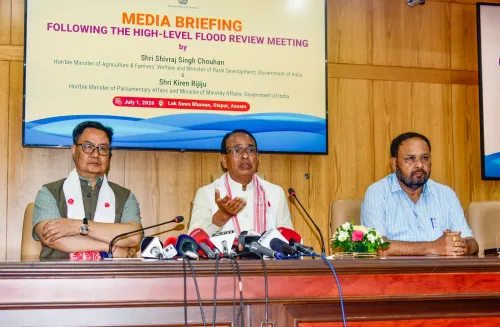
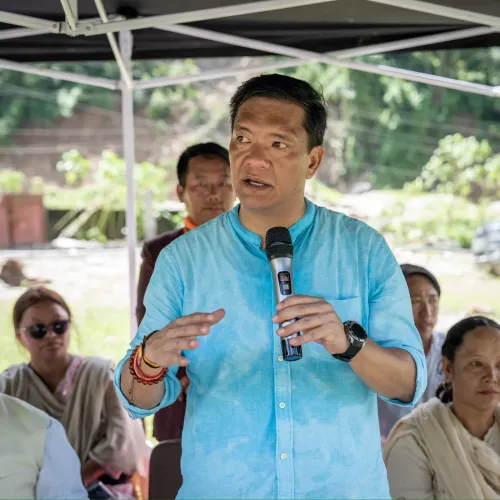
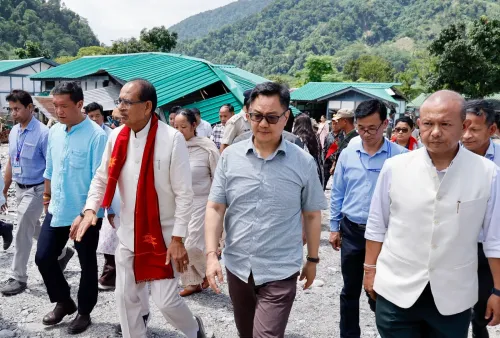
The Chief Minister's Office of Arunachal Pradesh announced on Friday, 3 July 2026 that Chief Minister Pema Khandu accompanied Union Ministers Shivraj Singh Chouhan and Kiren Rijiju on a ground-level assessment of flood damage and an on-site review of relief and rehabilitation efforts in Keyi Panyor district.
Context
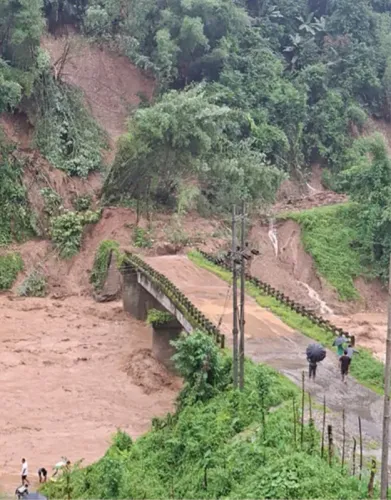
Keyi Panyor, one of Arunachal Pradesh's newer administrative districts carved out during recent reorganisations, sits in a riverine belt of the eastern Himalayas that is acutely vulnerable to monsoon flooding. The joint visit by the state's chief minister and two senior Union ministers signals the seriousness with which the centre and state are treating this season's damage. The three leaders conducted an in-person survey to gauge the scale of destruction before directing relief operations.
The post by the official Chief Minister's Office account stated that the delegation accompanied Chouhan and Rijiju to 'assess flood damage and review relief and rehabilitation efforts in Keyi Panyor district.' No specific damage figures were released in the official communication.
Policy Backdrop
India's disaster response architecture is governed by the National Disaster Management Act, 2005, which establishes a cooperative framework between the central government and states for flood relief, rehabilitation, and reconstruction. Funds flow through the National Disaster Response Fund (NDRF) and the State Disaster Response Fund (SDRF), with releases typically accelerated following ministerial ground assessments of this kind.
Arunachal Pradesh is among the most flood- and landslide-prone states in India owing to its dense network of Himalayan river systems, including the Brahmaputra and its tributaries. Joint central-state review visits have become a standard feature of monsoon governance in the Northeast, reflecting the broader policy priority of building infrastructure resilience in India's border regions.
Stakeholders and Impact
The most immediate stakeholders are the flood-affected residents of Keyi Panyor district, whose homes, agricultural land, and local infrastructure may have sustained damage. The district administration is tasked with coordinating rescue, relief distribution, and temporary shelter under the oversight of state and central authorities.
Union Minister Shivraj Singh Chouhan, who brings experience from multiple terms as Chief Minister of Madhya Pradesh — a state with its own history of flood management — adds administrative depth to the central delegation. Kiren Rijiju, a senior BJP leader from Arunachal Pradesh itself, brings both local knowledge and direct access to central decision-making channels, making his presence particularly significant for expediting relief approvals.
What's Next
Following ministerial assessments of this nature, the standard sequence involves submission of damage reports to the National Disaster Management Authority (NDMA) and a formal request for additional central funds under the NDRF. Observers will watch for any announcement of special relief packages or accelerated infrastructure repair timelines for Keyi Panyor in the coming weeks.
The visit also feeds into the broader pattern of central attention to Northeast connectivity and resilience ahead of the post-monsoon review cycle. Any follow-up parliamentary discussion or NDMA-level review on monsoon preparedness for northeastern states could reference this ground assessment as a basis for policy decisions.
Point of View
He serves as a direct conduit between district-level distress and New Delhi's relief machinery. The visit fits a well-established pattern where ministerial ground assessments precede accelerated NDRF disbursements, effectively using visible political attention to fast-track bureaucratic processes. More broadly, it reflects the centre's sustained focus on Northeast governance as both a development and national-security priority.
NationPress
3 Jul 2026
Frequently Asked Questions
Why did CM Pema Khandu visit Keyi Panyor district?
Chief Minister Pema Khandu visited Keyi Panyor district on 3 July 2026 to assess flood damage and review the relief and rehabilitation efforts being carried out there, accompanied by Union Ministers Shivraj Singh Chouhan and Kiren Rijiju.
Which Union Ministers visited flood-affected areas in Arunachal Pradesh in July 2026?
Union Ministers Shivraj Singh Chouhan and Kiren Rijiju accompanied Arunachal Pradesh Chief Minister Pema Khandu during the flood damage assessment visit to Keyi Panyor district on 3 July 2026.
Where is Keyi Panyor district located?
Keyi Panyor is a district in Arunachal Pradesh, situated in a riverine zone of the eastern Himalayas that is highly susceptible to seasonal monsoon flooding and landslides.
How does the central government provide flood relief funds to Arunachal Pradesh?
Flood relief funds are channelled through the National Disaster Response Fund (NDRF) and the State Disaster Response Fund (SDRF) under the framework of the National Disaster Management Act, 2005, typically following damage assessments and formal state requests.
What is Kiren Rijiju's connection to Arunachal Pradesh?
Kiren Rijiju is a senior BJP leader and Union Minister who hails from Arunachal Pradesh, giving him both local knowledge of the state's challenges and direct access to central government decision-making for expediting relief measures.