CM Madhya Pradesh Highlights State's Lead in PM SVANidhi Scheme
Synopsis
The Chief Minister's Office of Madhya Pradesh declared on 3 July 2026 that the state leads India in implementing PM SVANidhi Yojana, which provides collateral-free working capital loans to street vendors under the Atmanirbhar Bharat initiative launched in June 2020.
Key Takeaways
The Chief Minister's Office of Madhya Pradesh claimed on 3 July 2026 that the state leads India in PM SVANidhi scheme implementation.
PM SVANidhi was launched in June 2020 to provide collateral-free working capital loans to street vendors affected by pandemic restrictions.
The scheme initially offered loans of up to Rs 10,000 with no collateral requirement, with enhanced tranches for timely repayers.
The nodal ministry is the Ministry of Housing and Urban Affairs (MoHUA) , which monitors state-wise performance.
Chief Minister Mohan Yadav and the MP Urban Development Department were tagged in the official post.
The state's national leadership claim will be measured against forthcoming official MoHUA progress reports .
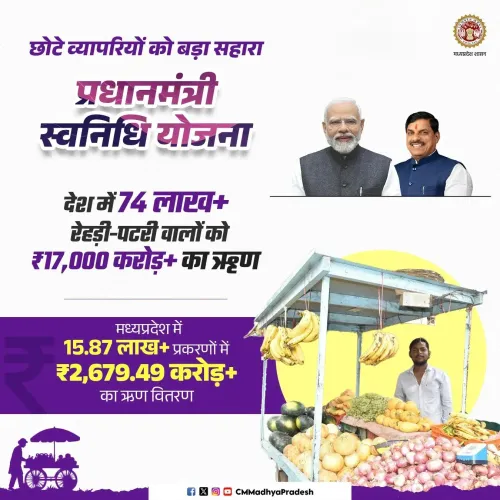
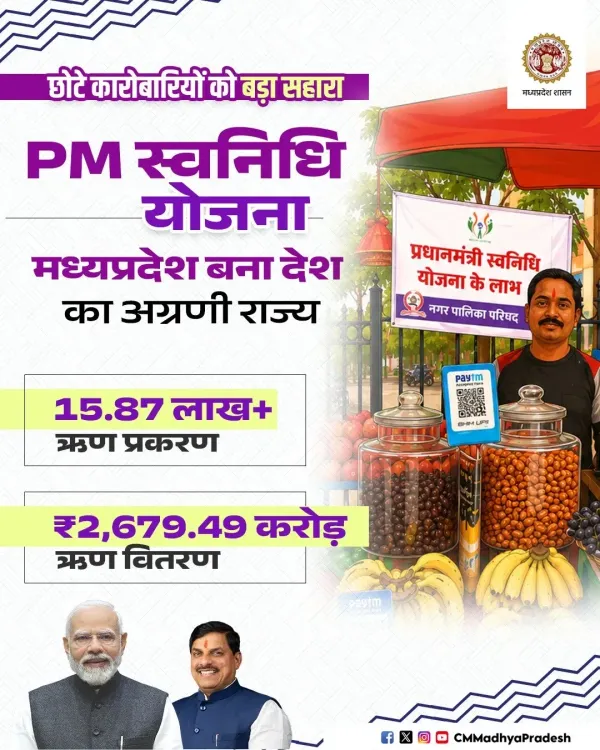
The Chief Minister's Office of Madhya Pradesh on Friday, 3 July 2026, declared that Madhya Pradesh is leading the country in the effective implementation of the PM SVANidhi Yojana, a central government scheme that provides collateral-free working capital loans to street vendors.
The post, shared on the official @CMMadhyaPradesh handle and tagging Chief Minister Mohan Yadav and the Ministry of Housing and Urban Affairs (MoHUA), stated: 'Pradhanmantri SVANidhi Yojana path-vikretaon ko bina guarantee rin ki suvidha' ('The PM SVANidhi Scheme provides collateral-free loan facilities to street vendors'), adding that Madhya Pradesh is at the forefront of the scheme's effective rollout nationally.
Context
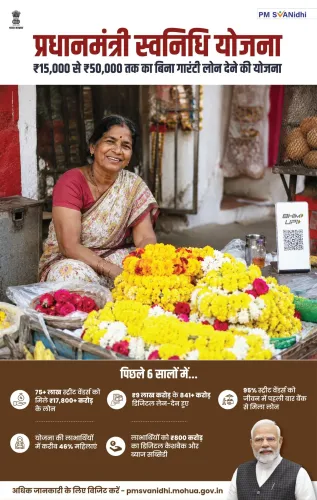
PM SVANidhi — formally the PM Street Vendor's AtmaNirbhar Nidhi scheme — was launched in June 2020 as part of the Atmanirbhar Bharat economic stimulus package. Its primary objective was to extend micro-credit to street vendors whose livelihoods had been severely disrupted by pandemic-related restrictions. The scheme initially offered working capital loans of up to Rs 10,000 on a collateral-free basis, with provisions for enhanced credit in subsequent tranches for timely repayment.
The nodal ministry for the scheme's nationwide rollout and monitoring is the Ministry of Housing and Urban Affairs, which tracks state-wise disbursement performance and beneficiary enrolment. Urban local bodies serve as the primary implementation machinery at the ground level.
Policy Backdrop
Madhya Pradesh has consistently positioned itself as an active implementer of centrally sponsored urban welfare schemes. Chief Minister Mohan Yadav, who has led the state since December 2023, has continued to align state urban development machinery with central government priorities, particularly those targeting the informal economy and financial inclusion for unorganised workers.
The PM SVANidhi scheme targets one of India's most economically vulnerable urban groups — street vendors — who typically lack access to formal credit due to the absence of collateral or documented income. By removing the guarantee requirement, the scheme aims to bring this segment into the formal financial ecosystem.
Stakeholders and Impact
Street vendors across Madhya Pradesh's urban centres stand as the direct beneficiaries of the scheme's implementation. Access to collateral-free working capital allows vendors to restock goods, expand their operations, and reduce dependence on informal moneylenders who charge significantly higher interest rates.
Urban local bodies in the state play a pivotal role in identifying eligible vendors, facilitating loan applications, and coordinating with banking partners for disbursement. The state's claim of national leadership, if reflected in official MoHUA data, would signal strong administrative coordination between the state government, municipal bodies, and lending institutions.
What's Next
The Ministry of Housing and Urban Affairs periodically publishes state-wise progress reports on loan disbursements and beneficiary coverage under PM SVANidhi. Madhya Pradesh's assertion of national leadership will be tested against the next official MoHUA rankings, which track metrics including number of loans sanctioned, amounts disbursed, and repayment rates.
Any further expansion of the scheme — including higher loan tranches for repeat borrowers or broader eligibility criteria — would be a key development to watch for vendors and state administrators alike. The state's performance under this scheme may also influence its standing in other urban livelihoods and financial inclusion indices tracked at the national level.
Point of View
The state is simultaneously reinforcing the CM's developmental image and seeking visibility in the central ministry's ecosystem. The move fits a broader pattern where BJP-governed states actively publicise alignment with New Delhi's flagship welfare schemes to consolidate their informal-sector voter base. The credibility of the claim, however, rests entirely on the next official MoHUA data release, which will either validate or complicate this positioning.
NationPress
3 Jul 2026
Frequently Asked Questions
What is PM SVANidhi scheme and who benefits from it?
PM SVANidhi — PM Street Vendor's AtmaNirbhar Nidhi — is a central government scheme launched in June 2020 that provides collateral-free working capital loans to street vendors. It primarily benefits urban street vendors who lack access to formal credit due to absence of collateral or documented income.
Why is Madhya Pradesh claiming to lead in PM SVANidhi implementation?
The Chief Minister's Office of Madhya Pradesh posted on 3 July 2026 that the state is at the forefront of the scheme's effective rollout nationally, though this claim is yet to be independently verified against official MoHUA state-wise rankings.
How much loan do street vendors get under PM SVANidhi?
Under PM SVANidhi, street vendors are initially eligible for working capital loans of up to Rs 10,000 without any collateral or guarantee. Timely repayment qualifies vendors for enhanced loan amounts in subsequent tranches.
Which ministry oversees PM SVANidhi across India?
The Ministry of Housing and Urban Affairs (MoHUA) is the nodal central ministry responsible for the rollout, monitoring, and state-wise tracking of PM SVANidhi across India.
Who is the Chief Minister of Madhya Pradesh in 2026?
Mohan Yadav is the Chief Minister of Madhya Pradesh. He has held the position since December 2023 and has been overseeing the state's implementation of central urban welfare and financial inclusion schemes.