CM Rajasthan: Centre absorbed Rs 75,000 cr fuel loss
Synopsis
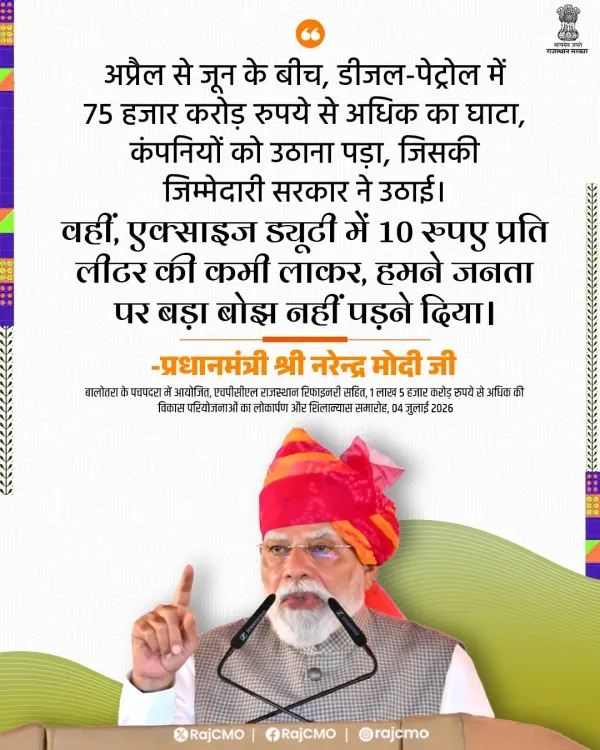
The Rajasthan Chief Minister's Office credited PM Narendra Modi's government for absorbing over Rs 75,000 crore in losses that oil marketing companies incurred on diesel and petrol sales between April and June 2026, linking the central fiscal relief to the state's development goals.
Key Takeaways
The Rajasthan CMO stated that oil marketing companies faced losses exceeding Rs 75,000 crore on diesel and petrol between April and June 2026 .
The post credits the Union government under PM Narendra Modi for taking on responsibility for these losses.
Public sector firms IOC, BPCL, and HPCL are the primary companies exposed to such under-recoveries during periods of elevated crude prices.
The Centre previously cut excise duty on petrol by Rs 8/litre and diesel by Rs 6/litre in May 2022 during a comparable price surge.
The messaging is framed under the #PMModi4ViksitRajasthan campaign, tying central energy policy to Rajasthan's development narrative.
Quarterly results of oil marketing companies and the next Union Budget will clarify the full scope of compensation.
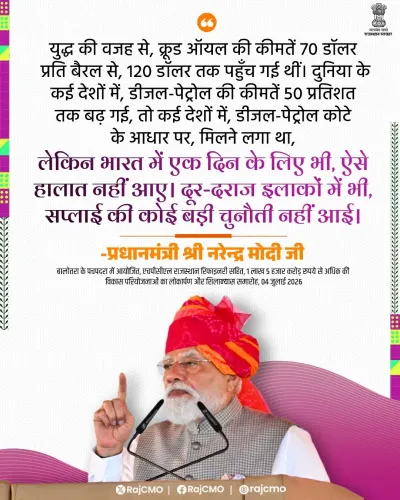
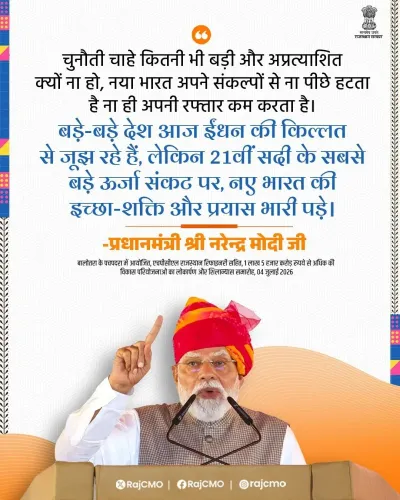
The Chief Minister's Office of Rajasthan on Saturday, 4 July 2026 credited the central government under Prime Minister Narendra Modi for absorbing losses exceeding Rs 75,000 crore incurred by oil marketing companies on diesel and petrol sales between April and June 2026, framing the fiscal relief as part of broader development support for the state.
Context
The post, shared from the official Rajasthan CMO handle, states in Hindi: 'April se June ke beech, diesel-petrol mein 75 hazar crore rupaye se adhik ka ghata, companies ko uthana pada, jiski jimmedari sarkar ne uthayi' — meaning, 'Between April and June, losses exceeding Rs 75,000 crore on diesel and petrol had to be borne by companies; the government took on that responsibility.' The message directly tags @narendramodi and is hashtagged #PMModi4ViksitRajasthan and #AapnoAgraniRajasthan ('Our leading Rajasthan'), tying central energy policy to the state's development narrative.
Policy Backdrop
India's public sector oil marketing companies — primarily Indian Oil Corporation (IOC), Bharat Petroleum (BPCL), and Hindustan Petroleum (HPCL) — have historically been exposed to under-recoveries when retail fuel prices are held below market cost during periods of elevated global crude prices. The Union government has periodically stepped in through excise duty reductions, direct compensation, or deferred pricing adjustments to shield consumers from price shocks and contain inflation.
A notable precedent came in May 2022, when the Centre cut central excise duty on petrol by Rs 8 per litre and on diesel by Rs 6 per litre amid a surge in international crude prices. The Rajasthan CMO's post appears to reference a similar episode of government-absorbed losses during the first quarter of the 2026-27 fiscal year.
Stakeholders and Impact
The primary stakeholders in such arrangements are the oil marketing companies, whose balance sheets bear the immediate financial strain, and fuel consumers — households and businesses — who benefit from price stability at the pump. When the government assumes responsibility for these losses, it effectively subsidises consumption, protecting household budgets and keeping transport and logistics costs in check.
For Rajasthan, a large state with significant agricultural and transport activity, stable diesel prices carry particular importance for farmers, truckers, and rural consumers. By attributing the relief to PM Modi, the CMO post positions the central intervention as a direct benefit flowing to the state's residents under the Viksit Rajasthan ('Developed Rajasthan') vision.
What's Next
Quarterly financial results of the major oil marketing companies will offer a clearer picture of the actual scale of under-recoveries and how they were offset during the April–June 2026 period. Any further announcements on excise adjustments or compensation packages in the upcoming Union Budget will be closely watched by the energy sector and state governments alike.
The broader pattern of central fiscal support for fuel pricing suggests that as long as global crude volatility persists, the interplay between Union government relief measures and state-level political messaging will remain a recurring feature of India's energy policy landscape.
Point of View
Fiscal relief for oil companies — to reinforce a ruling-party narrative of good governance. By tagging PM Modi directly and anchoring the claim to a specific loss figure of Rs 75,000 crore, the post attempts to make an abstract macroeconomic intervention feel tangible to ordinary consumers. This mirrors a broader BJP communication pattern of attributing central economic decisions to PM Modi's personal leadership, particularly ahead of electoral cycles. The framing under 'Viksit Rajasthan' also signals an effort to align state identity with the Centre's 'Viksit Bharat' vision, deepening the political synergy between Jaipur and New Delhi.
NationPress
5 Jul 2026
Frequently Asked Questions
What is the Rs 75,000 crore fuel loss mentioned by Rajasthan CMO?
The Rajasthan CMO's post states that oil marketing companies incurred losses exceeding Rs 75,000 crore on diesel and petrol sales between April and June 2026, and that the central government took responsibility for these losses.
Why do oil companies face losses on petrol and diesel in India?
When global crude oil prices rise sharply, public sector oil marketing companies like IOC, BPCL, and HPCL may sell fuel at retail prices below their actual cost, resulting in under-recoveries or losses. The government periodically compensates them or cuts excise duties to bridge the gap.
How has the Indian government supported oil companies during price shocks before?
In May 2022, the Union government reduced central excise duty on petrol by Rs 8 per litre and on diesel by Rs 6 per litre to offset surging international crude prices, a precedent for the kind of fiscal support referenced in the Rajasthan CMO post.
What is Viksit Rajasthan?
'Viksit Rajasthan' translates to 'Developed Rajasthan' and is a state-level development vision that the Rajasthan government has aligned with the Centre's broader 'Viksit Bharat' programme under PM Modi.
Which oil companies are affected by under-recoveries in India?
The main public sector oil marketing companies exposed to under-recoveries are Indian Oil Corporation (IOC), Bharat Petroleum (BPCL), and Hindustan Petroleum (HPCL), which together handle the bulk of India's fuel retail distribution.