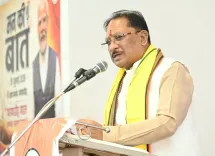
CM Rekha Gupta Congratulates New Delhi Minority Commission Chief
Synopsis
Delhi Chief Minister Rekha Gupta congratulated Nirmal Jain on his appointment as Delhi Minority Commission chairman on 26 July 2026, calling on the reconstituted body to uphold minority rights and social harmony under the 'Sabka Saath, Sabka Vikas' framework.
Key Takeaways
Delhi CM Rekha Gupta publicly congratulated Nirmal Jain on his appointment as chairman of the Delhi Minority Commission on 26 July 2026 .
The Chief Minister also extended wishes to all newly appointed members of the reconstituted commission.
CM Gupta invoked the 'Sabka Saath, Sabka Vikas, Sabka Vishwas, Sabka Prayas' mantra as the guiding philosophy for the commission's work.
The commission is a statutory body mandated to protect the constitutional rights and welfare of minority communities in Delhi .
The appointment signals the BJP government's intent to align the commission's agenda with inclusive development and social harmony goals.
Delhi Chief Minister Rekha Gupta on Sunday, 26 July 2026, congratulated Nirmal Jain on his appointment as Chairman of the Delhi Minority Commission, along with all newly inducted members, expressing confidence that the reconstituted body would work dedicatedly for the rights, dignity, and welfare of all sections of society.
Context
Posting in Hindi on X, CM Gupta extended what she called 'hardik badhai evam shubhkamnayein' (heartfelt congratulations and best wishes) to Nirmal Jain and the full membership of the commission. She expressed full confidence that they would work with dedication to strengthen the rights, dignity, and welfare of all communities across the capital.
The Chief Minister invoked the BJP-led central government's governing philosophy, urging the new commission to carry forward the mantra of 'Sabka Saath, Sabka Vikas, Sabka Vishwas, Sabka Prayas' — 'Together with all, development for all, trust of all, efforts of all' — as the guiding framework for the body's work.
Policy Backdrop
The Delhi Minority Commission is a statutory body constituted to safeguard the constitutional rights of minority communities in the national capital and to promote their welfare. At the national level, the National Commission for Minorities was established under the National Commission for Minorities Act, 1992, providing the legislative template that state-level commissions broadly follow.
The reconstitution of such commissions is a standard governance exercise, but the framing of the appointment under the 'Sabka Saath, Sabka Vikas' rubric reflects a deliberate alignment with the BJP's inclusive-development narrative. BJP-governed states have increasingly used minority commission appointments to signal outreach to minority groups while anchoring institutional mandates within this framework.
Stakeholders and Impact
Delhi's minority communities — including Muslims, Christians, Sikhs, Buddhists, Jains, and Parsis — are the primary stakeholders of the commission's work. The body's mandate covers addressing grievances, recommending policy measures, and promoting social harmony in one of India's most diverse urban populations.
The emphasis on 'samajik sadbhav aur samaveshi vikas' (social harmony and inclusive development) in CM Gupta's statement signals the thematic priorities she expects the new panel to pursue. The appointment of Nirmal Jain as chairman places a specific leadership identity at the helm of the commission at a time when the BJP government in Delhi is seeking to consolidate its administrative footprint in the capital.
What's Next
Attention will now turn to the initial public outreach programmes, recommendations, and policy positions that the reconstituted Delhi Minority Commission issues in the months ahead. These will serve as the clearest indicator of whether the body's agenda matches the inclusive mandate articulated by CM Gupta at the time of the appointments.
How the commission engages with minority community organisations and whether it takes up pending grievances proactively will be closely watched by civil society groups and political observers in the capital.
Point of View
But its framing carries political weight: by anchoring the Delhi Minority Commission's mandate explicitly within the 'Sabka Saath, Sabka Vikas' framework, CM Rekha Gupta is positioning the BJP's Delhi government as a credible steward of minority welfare — a constituency the party has historically struggled to win over in the capital. The choice of language mirrors a broader national pattern in which BJP-led state governments use minority body appointments to project inclusive governance without departing from the party's core ideological messaging. The real test will lie in the commission's operational independence and the tangibility of its outreach, rather than the optics of the appointment itself.
NationPress
26 Jul 2026
Frequently Asked Questions
Who is the new chairman of the Delhi Minority Commission?
Nirmal Jain has been appointed as the new chairman of the Delhi Minority Commission , as confirmed by Delhi Chief Minister Rekha Gupta's congratulatory post on 26 July 2026 .
What is the Delhi Minority Commission?
The Delhi Minority Commission is a statutory body set up to safeguard the constitutional rights of minority communities in the national capital and to promote their welfare and social harmony.
What did CM Rekha Gupta say about the Delhi Minority Commission appointment?
CM Rekha Gupta extended heartfelt congratulations to Nirmal Jain and all members, expressing confidence they would work dedicatedly for the rights, dignity, and welfare of all sections of society under the 'Sabka Saath, Sabka Vikas, Sabka Vishwas, Sabka Prayas' framework.
Which minorities does the Delhi Minority Commission serve?
The commission serves all notified minority communities in Delhi , including Muslims, Christians, Sikhs, Buddhists, Jains, and Parsis.
What is 'Sabka Saath, Sabka Vikas, Sabka Vishwas, Sabka Prayas'?
It is the governing philosophy of the BJP-led central government, translating broadly to 'Together with all, development for all, trust of all, efforts of all,' and is frequently cited as the framework for inclusive governance initiatives.