CM Rekha Gupta congratulates new Delhi Women's Commission chief

Synopsis
Delhi Chief Minister Rekha Gupta on 26 July 2026 congratulated Lata Gupta on her appointment as chairperson of the Delhi Commission for Women, urging the reconstituted body to coordinate with the state government to advance women's safety, dignity, and empowerment in the capital.
Key Takeaways
Delhi CM Rekha Gupta publicly congratulated Lata Gupta on her appointment as chairperson of the Delhi Commission for Women on 26 July 2026 .
The Delhi Commission for Women is a statutory body established under the Delhi Commission for Women Act, 1994 , mandated to protect women's rights and advise the state government.
CM Gupta called for close coordination between the reconstituted commission and the Delhi government on women's safety, dignity, rights, and empowerment.
The reconstitution is the first major overhaul of the DCW under the BJP-led Delhi government that returned to power in 2025.
The new commission's early public hearings, recommendations, and any related proposals in the Delhi Assembly will be closely watched by gender-rights advocates.
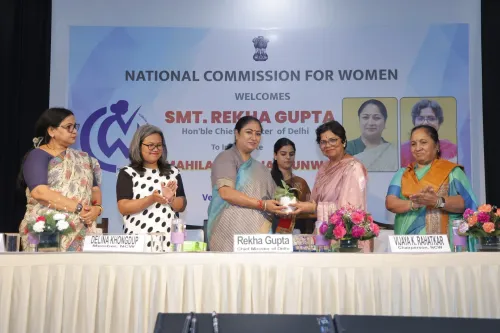
Delhi Chief Minister Rekha Gupta on Sunday, 26 July 2026 extended congratulations to Lata Gupta on her appointment as chairperson of the Delhi Commission for Women (DCW), expressing confidence that the reconstituted body will work in coordination with the state government to strengthen women's safety, dignity, rights, and empowerment in the national capital.
Posting in Hindi on X, CM Rekha Gupta addressed the newly appointed chairperson and all members of the commission directly, saying she was fully confident they would 'महिलाओं की सुरक्षा, गरिमा, अधिकारों और सशक्तिकरण को नई दिशा देंगी' — that is, 'give new direction to women's safety, dignity, rights, and empowerment' — and contribute meaningfully to building a 'sensitive, just, and safe Delhi'.
Context
The Delhi Commission for Women is a statutory body established under the Delhi Commission for Women Act, 1994. It is mandated to investigate complaints related to gender justice, advise the government on women-centric policies, and coordinate with law-enforcement and social-welfare agencies across the capital. The commission's chairperson and members are appointed by the state government, making reconstitutions a routine but politically significant exercise.
The appointment of Lata Gupta as the new DCW chairperson marks the first major reconstitution of the body under the current BJP-led Delhi government, which came to power in early 2025 after the party's return to office in the national capital.
Policy Backdrop
Women's safety has remained a high-priority issue in Delhi for over a decade, following a series of high-profile incidents that drew national and international attention. Successive Delhi governments have used reconstitutions of the DCW to signal their administrative approach to gender issues and to align the commission's functioning with their broader policy agenda.
CM Rekha Gupta's emphasis on 'coordination with the Delhi government' reflects the standard operating relationship between the executive and a statutory commission of this nature. The DCW functions as a quasi-judicial and advisory body, and its effectiveness has historically depended on how closely it works with the police, judiciary, and welfare departments.
Stakeholders and Impact
The reconstituted commission is expected to be the primary institutional interface for women in Delhi — a population of over 80 lakh — seeking redress on issues ranging from domestic violence and workplace harassment to trafficking and property rights. Gender-rights advocates and civil-society groups will closely watch the commission's early public hearings and recommendations for signals about its priorities.
The DCW also plays an advisory role in shaping legislative proposals and budgetary allocations related to women's welfare in the Delhi Assembly. The new leadership's relationship with both the state government and independent civil society will determine how effectively it balances institutional coordination with autonomous oversight.
What's Next
Attention will now turn to the commission's inaugural public hearings, its first set of recommendations to the state government, and any related budgetary or legislative proposals in the Delhi Assembly concerning women's safety programmes. Observers will also watch whether the reconstituted DCW takes up pending complaints and cases that may have accumulated during any gap in the commission's full-strength functioning.
The broader test for the new leadership will be whether the commission can establish itself as a credible, independent voice on gender justice in Delhi while maintaining the coordination with the state government that CM Rekha Gupta has explicitly called for.
Point of View
Framed around coordination and sensitivity, are calibrated to present the new DCW leadership as an extension of the government's women-welfare agenda rather than an independent watchdog. The emphasis on 'coordination with the Delhi government' is standard for such statutory commissions, but it will inevitably invite scrutiny from civil society over the commission's autonomy. How the reconstituted DCW navigates the tension between institutional alignment and independent oversight will define its credibility over the coming months.
NationPress
25 Oct 2026
Frequently Asked Questions
Who is the new chairperson of the Delhi Commission for Women?
Lata Gupta has been appointed as the new chairperson of the Delhi Commission for Women (DCW) , as announced on 26 July 2026 .
What is the Delhi Commission for Women and what does it do?
The Delhi Commission for Women is a statutory body set up under the Delhi Commission for Women Act, 1994 . It investigates complaints related to gender justice, advises the state government on women-centric policies, and coordinates with law-enforcement and social-welfare agencies in Delhi .
What did CM Rekha Gupta say about the new DCW appointment?
CM Rekha Gupta extended congratulations to Lata Gupta and all newly appointed members, expressing full confidence that they would give 'new direction to women's safety, dignity, rights, and empowerment' and help build a 'sensitive, just, and safe Delhi' in coordination with the state government.
Why is the reconstitution of the DCW significant?
The reconstitution is significant because it is the first major overhaul of the Delhi Commission for Women under the current BJP-led Delhi government , and it signals the ruling dispensation's approach to gender-justice institutions and women's welfare policy in the capital.
What should we watch for from the new Delhi Women's Commission?
Key things to watch include the commission's inaugural public hearings, its early recommendations to the Delhi government , any related budgetary or legislative proposals in the Delhi Assembly , and how it handles pending complaints related to women's safety and rights.