CM Rekha Gupta Hails Agni-4 Test as Proof of India's Strategic Might

Synopsis
Delhi Chief Minister Rekha Gupta praised the successful test of the Agni-4 medium-range ballistic missile on 6 August 2026, crediting PM Modi's leadership and congratulating DRDO scientists and Strategic Forces Command personnel for advancing India's indigenous strategic deterrence.
Key Takeaways
Delhi CM Rekha Gupta publicly congratulated DRDO and the Strategic Forces Command on the successful Agni-4 MRBM test on 6 August 2026 .
The Agni-4 is an indigenously developed medium-range ballistic missile central to India's nuclear deterrence architecture.
India's missile programme traces back to the Integrated Guided Missile Development Programme launched in 1983 .
The first successful Agni-4 test was conducted in 2014 from the Integrated Test Range, Odisha .
The test aligns with the Atmanirbhar Bharat initiative announced in 2020 , prioritising self-reliance in defence production.
The Strategic Forces Command manages India's nuclear and strategic missile assets, including the Agni series.
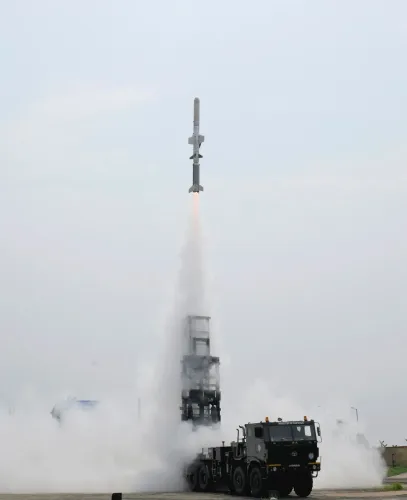
A ballistic missile rising from the Odisha coast is more than a weapons test — it is a statement. Delhi Chief Minister Rekha Gupta on Thursday, 6 August 2026 saluted the successful test-firing of the medium-range ballistic missile Agni-4, calling it clear proof that India is fully capable of delivering a decisive answer to every challenge to its sovereignty and national security.
Posting in Hindi on X, CM Gupta credited Prime Minister Narendra Modi's leadership for ushering in what she described as a new era of self-reliance, modern technology, and unbreakable strategic capability. She extended warm congratulations to the Strategic Forces Command (SFC) and all scientists and personnel of DRDO for the 'glorious achievement' — gauravpurn uplabdhi [glorious achievement].
Agni-4: Four Decades of Indigenous Ambition
The Agni-4 is no overnight success story. It traces its lineage directly to the Integrated Guided Missile Development Programme, launched in 1983 under the vision of making India self-sufficient in strategic weaponry. The first successful Agni-4 test was conducted in 2014 from the Integrated Test Range in Odisha, establishing the missile as a credible pillar of India's nuclear deterrence architecture. Each successive test has refined range, accuracy, and mobility.
The missile sits within the inventory managed by the Strategic Forces Command, the tri-service body responsible for operating India's nuclear and strategic assets. DRDO's scientists have spent decades engineering the Agni series to reduce import dependence — a goal that now carries the formal policy banner of Atmanirbhar Bharat, announced in 2020.
Self-Reliance as Strategic Doctrine
CM Gupta's post is part of a broader chorus of political affirmation that has accompanied each milestone in India's indigenous defence programme. The framing — sovereignty, self-reliance, modern technology — maps precisely onto the BJP government's defence narrative, which has positioned domestic production not just as an economic goal but as a security imperative. Successive defence budgets have backed incremental investment in the Agni programme and allied missile systems.
What makes the Agni-4 test politically resonant beyond the technical is the symbolism of timing: every successful launch reinforces the argument that India's strategic deterrence is no longer dependent on foreign supply chains or foreign goodwill. That argument has bipartisan roots — the IGMDP began under a different political era — but the current government has made it a centrepiece of its national-security brand.
Analysts watching the programme will now track whether a formal induction announcement into SFC's operational inventory follows, and how the next defence budget session reflects allocation trends for the broader Agni family. India's strategic posture just got a little louder — and Delhi's chief minister made sure the political credit was on record.
Point of View
The post connects a technical event to a broader ideological arc of self-reliance that the party has made central to its identity. For the opposition, the challenge remains the same as always: the Agni programme predates the current government, but the political returns flow to whoever is in power when the missile flies.
NationPress
7 Aug 2026
Frequently Asked Questions
What is the Agni-4 missile?
The Agni-4 is an indigenously developed medium-range ballistic missile built by DRDO as part of India's strategic deterrence programme. It was first successfully tested in 2014 from the Integrated Test Range in Odisha and is managed operationally by the Strategic Forces Command.
Why did Delhi CM Rekha Gupta comment on the Agni-4 test?
CM Rekha Gupta posted on X to congratulate DRDO scientists and Strategic Forces Command personnel on the successful Agni-4 test, framing it as evidence of India's growing strategic self-reliance under PM Modi's leadership.
What is the Strategic Forces Command?
The Strategic Forces Command is a tri-service command of the Indian Armed Forces responsible for managing and operating India's nuclear and strategic missile assets, including the Agni series of ballistic missiles.
What is the Integrated Guided Missile Development Programme?
The Integrated Guided Missile Development Programme was launched in 1983 to build indigenous ballistic and other guided missiles for India's defence needs. It gave rise to the entire Agni missile family, among other systems.
How does the Agni-4 test relate to Atmanirbhar Bharat?
Atmanirbhar Bharat, announced in 2020, is a government policy prioritising self-reliance in defence design and production. The Agni-4's indigenous development by DRDO is cited as a practical example of this policy in action, reducing dependence on foreign weapons systems.