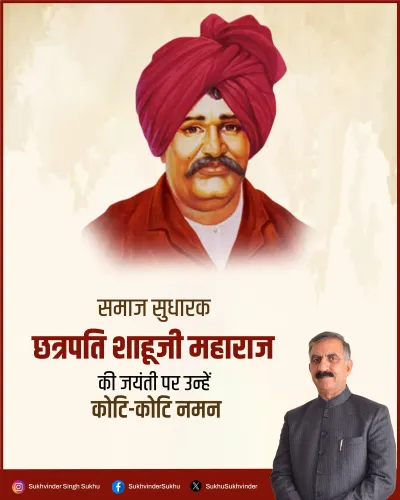
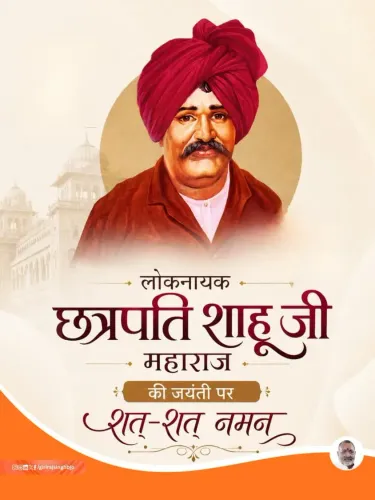
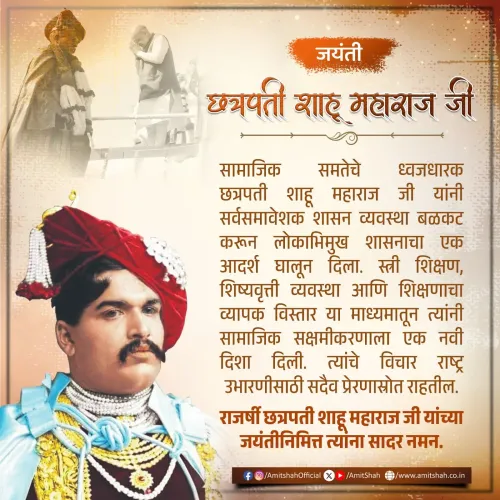
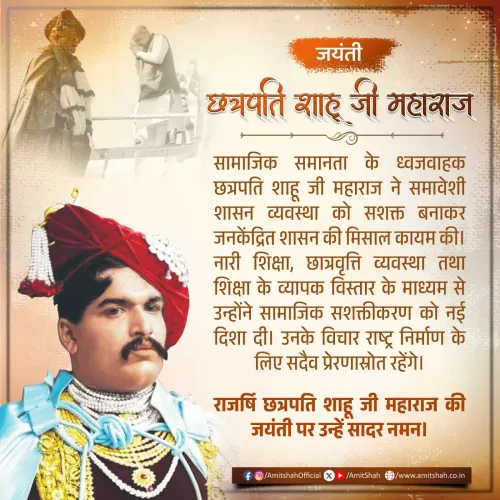
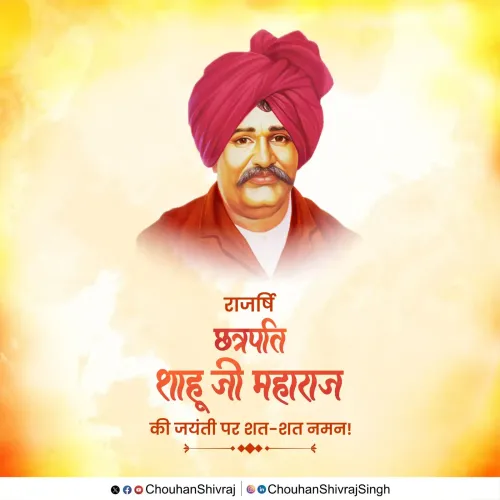
CM Rekha Gupta Pays Tribute to Chhatrapati Shahu Maharaj
Synopsis
Delhi Chief Minister Rekha Gupta paid tribute to Chhatrapati Shahu Ji Maharaj on his birth anniversary on June 26, 2026, saluting the Kolhapur ruler's pioneering 1902 reservation policy and lifelong work to bring marginalised communities into the mainstream through education and social reform.
Key Takeaways
Delhi CM Rekha Gupta posted a tribute to Chhatrapati Shahu Ji Maharaj on his birth anniversary on June 26, 2026 .
Shahu Maharaj (1874–1922) was the Maharaja of Kolhapur and introduced India's first formal reservation order in 1902 for backward-class communities in state services and schools.
Gupta described education as the reformer's primary tool for achieving social equality and connecting exploited sections to the mainstream.
The tribute is part of a broader BJP pattern of publicly honouring pre-independence social reformers to signal commitment to OBC and Dalit communities.
The birth anniversary is significant for OBC groups and marginalised communities across India , particularly in Maharashtra and Delhi .
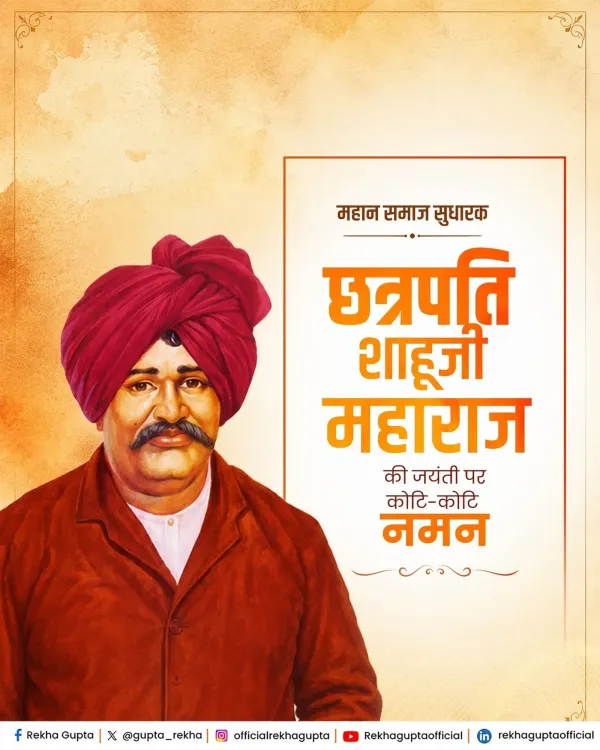
Delhi Chief Minister Rekha Gupta on Friday, June 26, 2026, paid tribute to Chhatrapati Shahu Ji Maharaj on his birth anniversary, honouring the 19th-century social reformer's legacy of championing education and equality for backward and marginalised communities.
Context
Posting on X, CM Rekha Gupta offered her respects, writing: 'सामाजिक न्याय के अग्रदूत... शत्-शत् नमन' — 'A hundred salutes to the pioneer of social justice, Chhatrapati Shahu Ji Maharaj, on his birth anniversary.' She described his contribution as making education a vehicle of social equality and connecting exploited sections to the mainstream as 'eternally memorable.'
Gupta added that his ideas 'will continue to inspire progress on the path of social equality and justice' — a sentiment that underscores the enduring relevance of Shahu Maharaj's reform agenda in contemporary Indian politics.
Policy Backdrop
Chhatrapati Shahu Ji Maharaj (1874–1922), the Maharaja of Kolhapur, is widely regarded as one of India's earliest architects of affirmative action. In 1902, he issued a landmark order reserving seats for non-Brahmin and backward-class communities in Kolhapur state services and schools — a full four decades before India's constitutional reservation framework came into existence.
His push to open schools, provide scholarships, and dismantle caste-based discrimination laid intellectual and institutional groundwork that later influenced the constitutional provisions for Other Backward Classes (OBCs) and Scheduled Castes. He earned the title 'Rajarshi' — 'sage-king' — in recognition of this reformist statecraft.
Stakeholders and Impact
OBC communities, Dalit groups, and marginalised students across India regard Shahu Maharaj's birth anniversary as a day of political and cultural significance. Tributes from ruling-party leaders carry symbolic weight, signalling alignment with the constitutional promise of inclusive development.
For the BJP, publicly honouring pre-independence social reformers such as Shahu Maharaj, B.R. Ambedkar, and Jyotirao Phule is part of a broader outreach to OBC and Dalit constituencies — groups that represent a decisive electoral bloc in states including Delhi, Maharashtra, and Uttar Pradesh.
What's Next
Tributes of this nature are often accompanied — or followed — by policy announcements on education access, scholarships, or welfare schemes for backward classes. Observers will watch whether the Delhi government uses the occasion to announce or highlight programmes targeting OBC and marginalised students in the capital.
The anniversary also serves as a reminder of the unfinished agenda of social equity, with civil society groups and opposition parties likely to use the day to press governments at the centre and state level on implementation of reservation policies and educational outreach for the most vulnerable communities.
Point of View
Gupta implicitly frames her own government's welfare agenda as part of a continuum stretching back to 1902. The tribute carries particular resonance ahead of any urban local body or state-level electoral cycle, where backward-class outreach can be decisive. It also reflects a wider contest among parties over who most authentically inherits the mantle of India's social justice tradition.
NationPress
26 Jun 2026
Frequently Asked Questions
Who was Chhatrapati Shahu Ji Maharaj?
Chhatrapati Shahu Ji Maharaj (1874–1922) was the Maharaja of Kolhapur in present-day Maharashtra. He is celebrated as a pioneering social reformer who introduced India's first formal reservation policy in 1902, reserving seats for backward and non-Brahmin communities in state services and educational institutions.
Why did Rekha Gupta pay tribute to Shahu Maharaj?
Delhi Chief Minister Rekha Gupta paid tribute on June 26, 2026, which marks the birth anniversary of Chhatrapati Shahu Ji Maharaj. She honoured his contributions to social equality, education access for marginalised communities, and his role as a pioneer of social justice in India.
What was Shahu Maharaj's reservation policy?
In 1902, Shahu Maharaj issued an order reserving seats for non-Brahmin and backward-class communities in Kolhapur state government services and schools. This is considered India's first formal affirmative-action policy, predating the constitutional reservation framework by several decades.
Why do BJP leaders pay tributes to Shahu Maharaj?
BJP leaders periodically pay public tributes to pre-independence social reformers like Shahu Maharaj, B.R. Ambedkar, and Jyotirao Phule as part of outreach to OBC and Dalit communities, who represent a significant electoral constituency across Indian states.
What is the significance of June 26 in Indian politics?
June 26 is observed as the birth anniversary of Chhatrapati Shahu Ji Maharaj, making it a day of political and cultural significance for OBC communities, Dalit groups, and social justice advocates across India, particularly in Maharashtra and Delhi.