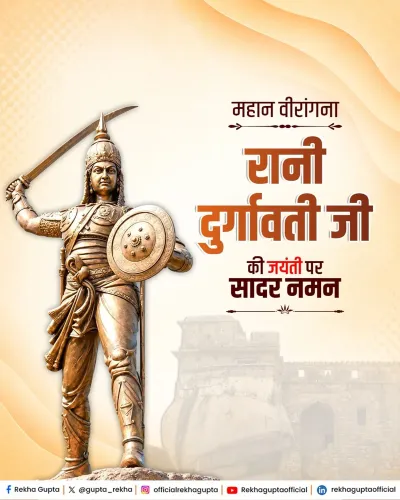
CM Rekha Gupta pays tribute to Durga Bhabhi on her birth anniversary
Synopsis
Delhi Chief Minister Rekha Gupta marked the birth anniversary of revolutionary Durga Bhabhi on October 7, 2026, honouring the freedom fighter who aided Bhagat Singh, Rajguru, and Sukhdev — calling her life an inspiring saga of courage and national devotion.
Key Takeaways
Delhi CM Rekha Gupta posted a tribute to Durga Bhabhi on her birth anniversary on October 7, 2026 .
Durga Bhabhi, born Durgavati Vohra , was a key figure in India's revolutionary freedom movement and part of the Hindustan Socialist Republican Association .
She famously helped Bhagat Singh escape Lahore in December 1928 by disguising herself as his wife after the killing of British officer J.P.
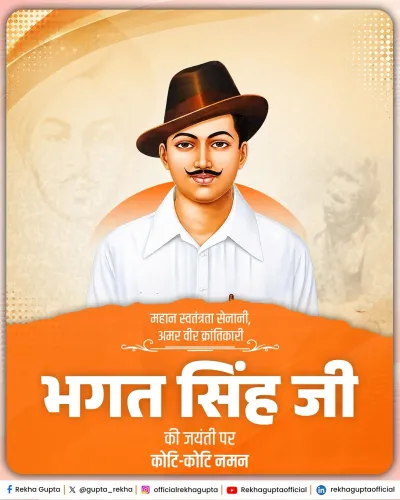
CM Gupta specifically cited her role in empowering the struggle of Bhagat Singh , Rajguru , and Sukhdev .
Durga Bhabhi lived until 1999 , outlasting independence by more than five decades, yet remained largely outside mainstream national commemoration.
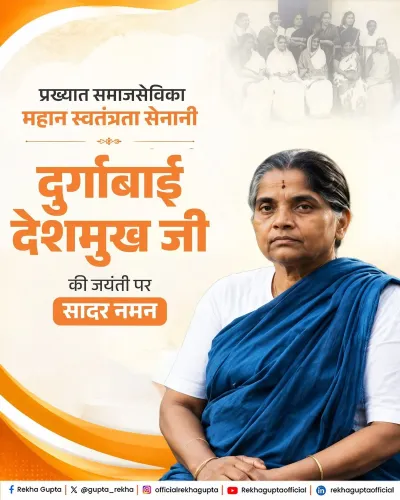
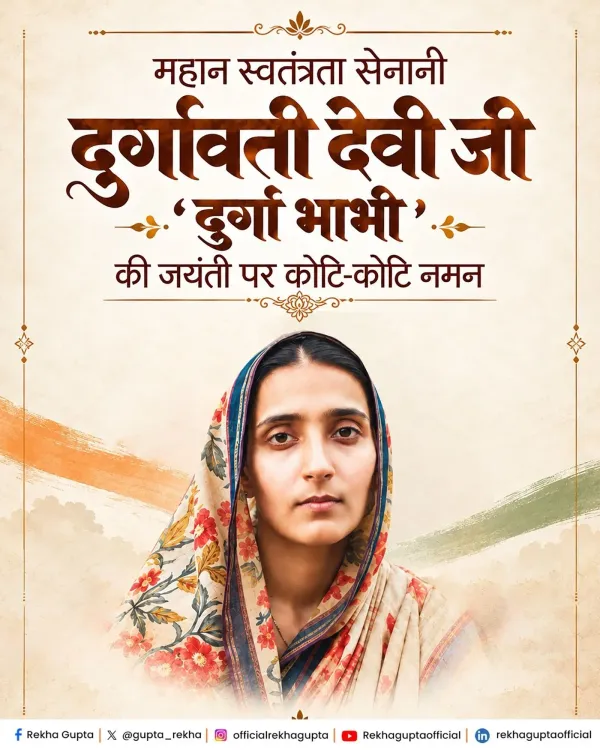
On the birth anniversary of revolutionary freedom fighter Durga Bhabhi, Delhi Chief Minister Rekha Gupta offered a heartfelt tribute on Wednesday, October 7, 2026, honouring the woman whose quiet courage helped sustain one of India's most daring chapters of resistance against colonial rule.
In her post, CM Gupta wrote: 'मां भारती की स्वाधीनता के लिए आजीवन संघर्षरत रहीं महान क्रांतिकारी दुर्गा भाभी जी की जयंती पर श्रद्धापूर्वक स्मरण।' — 'A reverential remembrance on the birth anniversary of the great revolutionary Durga Bhabhi, who struggled lifelong for the freedom of Mother India.' She noted that Durga Bhabhi's life was an inspiring saga of 'indomitable courage and devotion to the nation,' and that her sacrifice and unflinching dedication to the motherland would continue to awaken the spirit of patriotism across generations.
The woman who stood beside Bhagat Singh
Durga Bhabhi — born Durgavati Vohra — was a pivotal but long-underrecognised figure in India's revolutionary movement. Married to fellow revolutionary Bhagwati Charan Vohra, she became an indispensable partner in the Hindustan Socialist Republican Association's network. Her most celebrated act came in December 1928, when she disguised herself as the wife of Bhagat Singh to help him escape Lahore after the killing of British police officer J.P. Saunders — a feat of nerves that could have cost her everything.
CM Gupta's tribute specifically names Bhagat Singh, Rajguru, and Sukhdev — the trio hanged by the British in 1931 — acknowledging that Durga Bhabhi was a force who gave their struggle strength and kept the consciousness of revolution alive. Far from the margins, she was central to the planning, logistics, and morale of the movement.
A legacy still waiting for its full due
Durga Bhabhi's story is a reminder that the history of India's freedom struggle was written not only by those who faced the gallows, but also by the men and women who made their courage possible. She lived until 1999 — outlasting independence by over five decades — yet remained largely outside the mainstream of national commemoration. Tributes like CM Gupta's on her birth anniversary are part of a gradual, broader effort to restore such figures to public memory.
Her sacrifice, as CM Gupta put it, is a flame that must light successive generations — a sentiment that lands with particular weight when spoken from the chair of the Chief Minister of Delhi, the capital that is itself a living monument to the republic those revolutionaries died to build.
Point of View
Reflecting a broader effort to expand the nationalist canon beyond the Congress-era narrative of independence. By invoking Durga Bhabhi alongside Bhagat Singh, Rajguru, and Sukhdev — revolutionaries the BJP has long sought to foreground — CM Gupta reinforces a strand of historical memory that emphasises armed resistance and sacrifice. This is not merely ceremonial: it is an act of ideological curation, signalling which heroes a ruling party wants woven into public consciousness. For Durga Bhabhi herself, belated recognition is still recognition — and her story, regardless of who tells it, deserves to be told.
NationPress
7 Oct 2026
Frequently Asked Questions
Who was Durga Bhabhi and what did she do in India's freedom struggle?
Durga Bhabhi, born Durgavati Vohra, was a revolutionary freedom fighter and member of the Hindustan Socialist Republican Association. She is best known for helping Bhagat Singh escape Lahore in December 1928 by posing as his wife, and for supporting the revolutionary network around Bhagat Singh, Rajguru, and Sukhdev.
Why did Delhi CM Rekha Gupta post about Durga Bhabhi on October 7, 2026?
October 7 is observed as the birth anniversary of Durga Bhabhi. CM Rekha Gupta posted a tribute in Hindi honouring her lifelong contribution to India's independence movement and her role in strengthening the struggle of Bhagat Singh, Rajguru, and Sukhdev.
What connection did Durga Bhabhi have with Bhagat Singh?
Durga Bhabhi was instrumental in sheltering and aiding Bhagat Singh's revolutionary activities. Most famously, she disguised herself as his wife in December 1928 to help him flee Lahore safely after the killing of British police officer J.P. Saunders, an act of extraordinary personal risk.
When did Durga Bhabhi die?
Durga Bhabhi passed away in 1999, more than five decades after Indian independence, having lived long enough to see the free nation she had fought to build.
What was the Hindustan Socialist Republican Association?
The Hindustan Socialist Republican Association was a revolutionary organisation active in the 1920s and 1930s that sought to overthrow British colonial rule through armed resistance. Its members included Bhagat Singh, Rajguru, Sukhdev, and Bhagwati Charan Vohra — husband of Durga Bhabhi.