CM Rekha Gupta shares Modi's call to build future-ready industries
Synopsis
Delhi CM Rekha Gupta amplified PM Modi's call for Indian industries to anticipate future national and global demands, warning that resource weaponisation makes building indigenous capabilities a collective national responsibility.
Key Takeaways
PM Modi urged Indian industries to prepare for future national and global demands by building indigenous capabilities now.
He flagged the 'Weaponization of resources' as a defining geopolitical reality requiring proactive industrial readiness.
Atmanirbhar Bharat , launched in May 2020 , remains the policy framework underpinning this push for self-reliance.
PLI schemes rolled out from 2020 across electronics, pharma, and manufacturing are the operational tools for capability-building.
India's focus on semiconductors, rare earths, and critical minerals reflects awareness of strategic supply-chain vulnerabilities.
Further critical minerals policy signals are expected in the next Union Budget or economic survey.
In an era when critical resources are increasingly wielded as geopolitical weapons, Delhi Chief Minister Rekha Gupta on Thursday, November 19, 2026, amplified a sharp warning from Prime Minister Narendra Modi — that Indian industries must start building capabilities today for demands that do not yet exist.
Modi's warning: resource weaponisation is already here
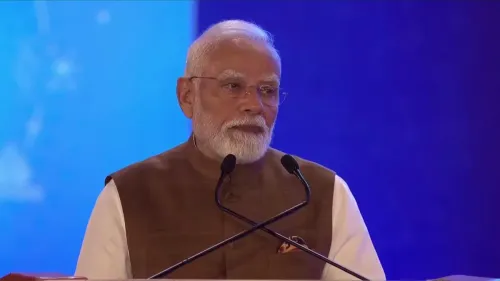
The Prime Minister's words, quoted by CM Gupta, were direct: 'Industries को उन Demands के लिए भी तैयार रहना होगा जो नेशनल और ग्लोबल स्तर पर भविष्य में सामने आएंगी' — 'Industries must also be prepared for demands that will emerge at the national and global level in the future. We have to work on those capabilities.' The kicker was harder still: in the age of 'Weaponization of resources,' securing the country's future is a collective responsibility.
That phrase — 'Weaponization of resources' — is not rhetorical flourish. It describes a documented global pattern: nations leveraging energy supplies, critical minerals, and semiconductor supply chains as instruments of strategic pressure. India has watched this dynamic unfold across continents and is now squarely in the frame as it scales up its own industrial ambitions.
From Atmanirbhar Bharat to supply-chain resilience
The philosophical backbone here is Atmanirbhar Bharat, the self-reliance campaign PM Modi launched in May 2020 in response to global supply-chain shocks. The programme set a clear agenda: reduce import dependence, build domestic manufacturing, and insulate India from the kind of external leverage that cripples economies overnight.
The operational instrument has been the Production Linked Incentive (PLI) scheme, rolled out from 2020 onwards across sectors including electronics, pharmaceuticals, and advanced manufacturing. These are not aspirational brochures — they represent targeted capital deployment to build precisely the capabilities Modi is now urging industries to anticipate ahead of the curve.
Why semiconductors and critical minerals are the real frontier
India's policy establishment has identified semiconductors, rare earths, and critical minerals as the next decisive battleground for economic sovereignty. Control over these inputs determines who can manufacture defence systems, electric vehicles, clean energy infrastructure, and next-generation electronics. Nations that outsource these supply chains outsource a piece of their strategic independence.
The Union Budget and forthcoming economic surveys are expected to sharpen India's critical minerals policy further, potentially announcing new PLI expansions targeting these high-stakes sectors. The message being amplified today is meant to prime industry well ahead of that policy signal.
Delhi CM's role in relaying the economic-security pitch
Rekha Gupta, as Chief Minister of a capital city that hosts major industrial and policy corridors, is not an idle relay here. By broadcasting Modi's framing to her audience, she is reinforcing a top-down demand: that the private sector align its investment and capacity-building roadmaps with the national economic-security agenda — not just the next quarterly earnings cycle.
The responsibility Modi and Gupta are naming is bilateral. Government signals direction and incentivises through PLI and policy. Industry reads the horizon and builds for it. Neither can wait for the other.
Point of View
CM Rekha Gupta is functioning as a force-multiplier for a BJP economic-nationalist narrative that connects Atmanirbhar Bharat's 2020 origins to a sharper, geopolitically-charged 2026 articulation. The pivot from 'self-reliance' to 'resource weaponisation' signals that the government views global supply-chain leverage not as a distant risk but as a present operational threat. Watch whether the next Union Budget translates this rhetoric into new PLI tranches specifically targeting critical minerals and semiconductor supply chains.
NationPress
19 Nov 2026
Frequently Asked Questions
What did PM Modi say about Indian industries and future demands?
PM Modi said industries must prepare for future national and global demands by building capabilities in advance, stressing that securing the country's future amid resource weaponisation is a collective responsibility of all Indians.
What is 'resource weaponisation' as mentioned by PM Modi?
'Resource weaponisation' refers to nations using control over critical resources — such as energy, minerals, and semiconductors — as tools of geopolitical leverage or coercion against other countries.
What is Atmanirbhar Bharat and how does it relate to this?
Atmanirbhar Bharat is PM Modi's self-reliance campaign launched in May 2020 to strengthen domestic manufacturing and reduce India's dependence on imports, forming the policy foundation for building indigenous industrial capabilities.
What are PLI schemes and which sectors do they cover?
Production Linked Incentive schemes, introduced from 2020, offer financial incentives to manufacturers to build domestic capacity in sectors including electronics, pharmaceuticals, and advanced manufacturing to reduce import dependence.
Why are critical minerals important for India's economic security?
Critical minerals like rare earths are essential inputs for defence systems, electric vehicles, clean energy, and electronics. Control over these supply chains determines strategic independence, making domestic capability in this area a national security priority.