CM Revanth Reddy Links Fine Rice Scheme to Learning Outcomes

Synopsis
Telangana Chief Minister A. Revanth Reddy on 8 July 2026 linked the state's Sanna Biyyam fine-rice distribution programme to literacy, arguing that hungry children cannot learn. The scheme operates under the Praja Palana welfare framework targeting BPL families across Telangana.
Key Takeaways
Revanth Reddy publicly connected the Sanna Biyyam fine-rice scheme to educational readiness on 8 July 2026 .
The scheme distributes fine-quality rice to below-poverty-line (BPL) households under the Praja Palana welfare framework.
Telangana has provided subsidised rice to BPL families since 2014 , with the current government upgrading grain quality.
The National Food Security Act of 2013 underpins the broader national trend of improving PDS grain quality across states.
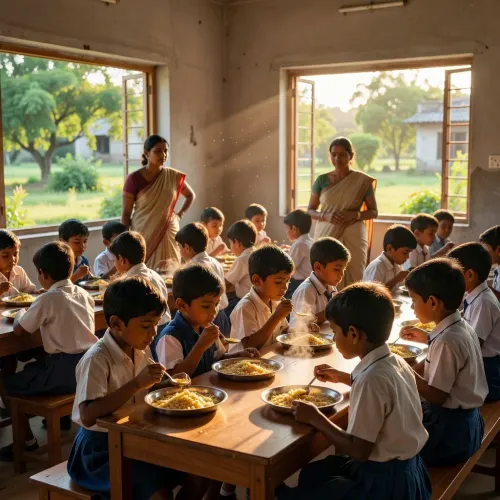
Key beneficiaries include BPL families and school-going children , for whom nutrition directly affects classroom participation.
District-wise rollout progress and supplementary budget allocations in the next assembly session are the immediate policy milestones to watch.
Telangana Chief Minister A. Revanth Reddy on Wednesday, 8 July 2026, invoked the link between hunger and literacy to reaffirm his government's commitment to distributing fine-quality rice to below-poverty-line households under the Sanna Biyyam initiative, part of the broader Praja Palana welfare framework.
Context
Posting in Telugu, the Chief Minister wrote: 'ఆకలి కడుపులకు… అక్షర జ్ఞానం అబ్బదు…' — 'Hungry stomachs cannot absorb the knowledge of letters' — adding, 'that is why we are feeding them with fine rice.' The statement frames the Sanna Biyyam scheme not merely as a food-subsidy measure but as a foundational investment in human capital, directly connecting nutritional support to educational readiness.
The post carried the hashtags #SannaBiyyam, #PrajaPalana, and #TelanganaGovernment, signalling an official push to amplify awareness of the programme among Telangana's residents.
Policy Backdrop
Telangana has distributed subsidised rice to BPL (below-poverty-line) families since the state's formation in 2014, when the earlier government introduced monthly allocations of 6 kg per person through the public distribution system. The current Congress administration has built on that foundation by upgrading the grain quality to fine — or 'sanna' — rice under the Praja Palana umbrella, which encompasses multiple subsidy and nutrition programmes.
The move reflects a nationwide trend that accelerated after the National Food Security Act of 2013, under which state governments have progressively improved the quality of grains supplied through the PDS to address both hunger and longer-term human-capital deficits. Revanth Reddy, who has served as Chief Minister and Telangana Pradesh Congress Committee (TPCC) president since December 2023, has positioned welfare delivery as a central pillar of his administration's identity.
Stakeholders and Impact
The primary beneficiaries of the Sanna Biyyam scheme are BPL families across Telangana, with particular emphasis on households with school-going children — the cohort most directly affected by the hunger-to-learning pipeline the Chief Minister articulated. Nutritional adequacy at home is widely recognised as a prerequisite for classroom participation, attendance, and retention.
By publicly linking rice distribution to literacy outcomes, the government signals an intent to evaluate the scheme not only on food-security metrics but also on educational indicators, which could shape how future budget allocations and district-level rollout targets are framed in coming assembly sessions.
What's Next
Observers will watch for district-wise rollout data and any supplementary budget provisions for the scheme in the next Telangana Legislative Assembly session. The government's ability to sustain and expand Sanna Biyyam coverage will be a key test of the Praja Palana framework's delivery capacity. How educational outcomes in beneficiary districts track over time may also become a political and policy reference point ahead of future state elections.
Point of View
Revanth Reddy is making a sophisticated human-capital argument that elevates welfare delivery into education policy. This rhetorical move is consistent with a broader Congress strategy in Telangana to recast entitlement programmes as investments with measurable developmental returns, not mere political handouts. It also pre-empts opposition critiques of fiscal populism by anchoring the scheme in a recognised causal chain — nutrition enabling learning — that cuts across ideological lines. Whether the government can produce district-level data to substantiate that link will determine how durable the narrative proves to be.
NationPress
8 Jul 2026
Frequently Asked Questions
What is the Sanna Biyyam scheme in Telangana?
Sanna Biyyam is a Telangana government initiative that distributes fine-quality rice to below-poverty-line households through the public distribution system, under the Praja Palana welfare framework launched by the Congress administration.
Why did CM Revanth Reddy link rice distribution to education?
Revanth Reddy argued that hungry stomachs cannot absorb knowledge, positioning the Sanna Biyyam fine-rice scheme as a foundational support for children's literacy and school participation, not just a food-subsidy measure.
Who benefits from the Sanna Biyyam scheme?
The primary beneficiaries are below-poverty-line families across Telangana, with a particular focus on households with school-going children who are most affected by hunger-related barriers to learning.
What is Praja Palana in Telangana?
Praja Palana is the Congress government's overarching welfare framework in Telangana, encompassing multiple subsidy, nutrition, and social-support programmes introduced after A. Revanth Reddy became Chief Minister in December 2023.
How long has Telangana been distributing subsidised rice?
Telangana has distributed subsidised rice to BPL families since the state's formation in 2014, when the earlier government introduced monthly allocations of 6 kg per person; the current administration upgraded the quality to fine rice.