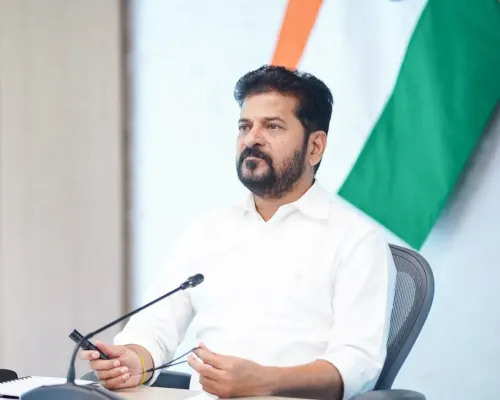
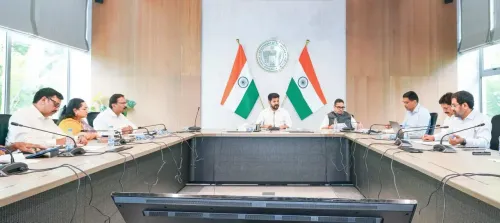
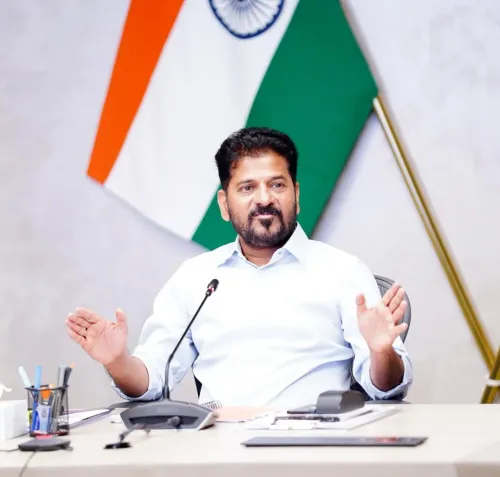
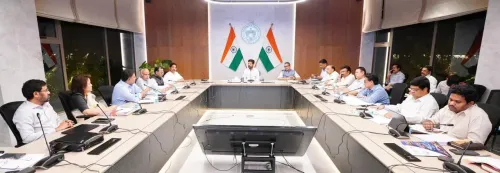
CM Revanth Reddy Marks HMWSSB's 37th Year, Flags El Niño Water Risk
Synopsis
On HMWSSB's 37th Formation Day, CM Revanth Anumula launched the 'Dial Green Tanker' treated-wastewater initiative, warned of El Niño-driven freshwater risks, and called on industries and citizens to make water conservation a collective urban responsibility in Hyderabad.
Key Takeaways
HMWSSB completed 37 years of operations on November 1, 2026 , serving Hyderabad's Core Urban Region (CURE).
CM Revanth Anumula flagged anticipated El Niño conditions as a reason to urgently conserve freshwater and cut non-domestic use.
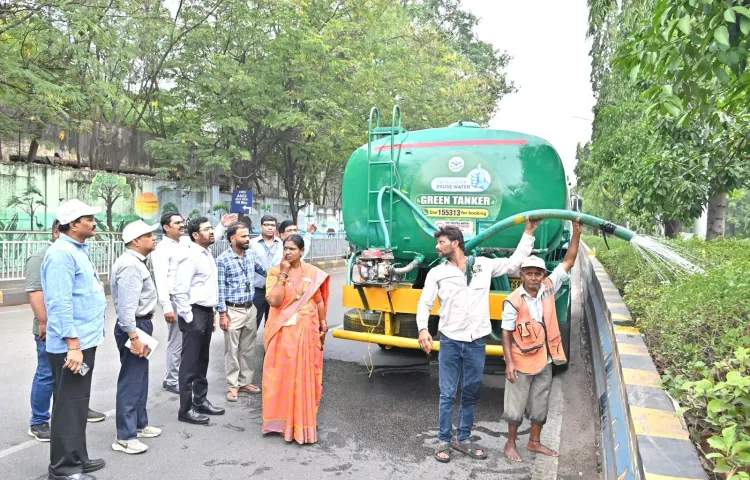
The ' Dial Green Tanker – Green Tanker Operations ' initiative was launched to supply treated wastewater to landscaping, construction and industrial users.
The CM called on government departments, industries, construction agencies and commercial establishments to switch to treated water for non-potable needs.
Hyderabad draws freshwater from the Krishna and Godavari basins — both vulnerable to El Niño-related rainfall deficits.
Water conservation was framed as a collective civic responsibility , not just a state infrastructure challenge.
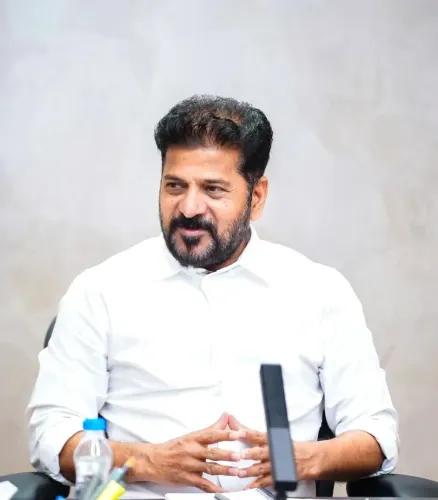
As Hyderabad's skyline stretches ever outward and its population swells, the city's water future has become a question of urgent arithmetic — and Chief Minister Revanth Anumula used the 37th Formation Day of the Hyderabad Metropolitan Water Supply and Sewerage Board (HMWSSB) on Sunday, November 1, 2026, to deliver a clear signal: treat every drop as precious, or pay the price.
Thirty-Seven Years of Pipes, Pressure and Public Health
Established in 1989 under the Hyderabad Metropolitan Water Supply and Sewerage Act, HMWSSB was built to serve a city that was a fraction of its current size. Today it anchors the water and sewerage infrastructure for the entire Core Urban Region (CURE) — a sprawling expanse that includes Hyderabad's fast-growing satellite zones. The Chief Minister commended the Board for its 'significant contribution to the city's growth, public health and overall development,' and wished it continued success in its mission.
The El Niño Warning Behind the Greetings
Beneath the celebratory tone was a precise climate-driven alarm. CM Revanth Anumula stressed that 'in view of the anticipated El Niño conditions,' the administration must move proactively — conserving freshwater and cutting its use for non-domestic purposes before shortages arrive, not after. El Niño events have historically suppressed monsoon rainfall across parts of India, tightening the supply from the Krishna and Godavari river basins that feed Hyderabad's reservoirs. Planning now, not in a crisis, is the explicit instruction.
The 'Dial Green Tanker' Initiative and the Case for Treated Water
The most concrete announcement of the day was the HMWSSB Managing Director's launch of 'Dial Green Tanker – Green Tanker Operations' — a scheme the Chief Minister described as 'a timely and important initiative towards sustainable water management.' The logic is straightforward: treated wastewater, which already exists in large volumes, can serve landscaping, construction sites and industrial processes that do not require drinking-grade purity. Every tanker of treated water that replaces freshwater is freshwater saved for kitchens and taps. CM Revanth called on government departments, industries, construction agencies and commercial establishments to adopt the service actively — a direct ask to the city's biggest discretionary water users.
Hyderabad's Water Compact: Collective Responsibility
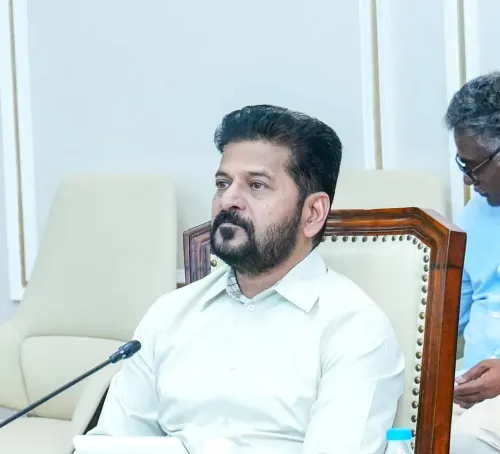
The Chief Minister closed with a civic appeal that framed water conservation not as a government programme but as a shared urban contract. 'Water security and the sustainable management of precious water resources must remain a top priority,' he said, calling on all stakeholders and citizens to make conservation a 'collective responsibility.' The framing matters: successive administrations have launched supply-side schemes, but demand management — changing how households, industries and builders actually use water — has remained the harder, unfinished half of the equation. With rapid urban expansion putting mounting pressure on existing infrastructure, the message from Hyderabad's top office is that infrastructure alone will not be enough.
The next test is straightforward: whether government departments themselves — the first constituency the Chief Minister called out — move from pledge to practice on the Dial Green Tanker before the summer heat turns the El Niño forecast into a lived reality.
Point of View
A harder political sell but an increasingly necessary one as climate variability compounds urban growth pressure. Framing El Niño as an imminent threat — rather than a distant possibility — is a calculated move to build public tolerance for restrictions before a crisis forces them. The Dial Green Tanker scheme, if adopted at scale by government departments first, could serve as a credibility test for the administration's own commitment. Whether the initiative translates into binding directives or remains advisory will determine its real-world impact.
NationPress
1 Nov 2026
Frequently Asked Questions
What is the HMWSSB Formation Day?
The Hyderabad Metropolitan Water Supply and Sewerage Board (HMWSSB) was constituted in 1989 under the Hyderabad Metropolitan Water Supply and Sewerage Act to manage drinking water supply and sewerage services across the Hyderabad metropolitan area. Its Formation Day marks the anniversary of that establishment — 2026 is the 37th such occasion.
What is the Dial Green Tanker initiative in Hyderabad?
' Dial Green Tanker – Green Tanker Operations ' is an initiative launched by HMWSSB to supply treated wastewater via tankers to users like landscaping projects, construction sites and industrial facilities, reducing their dependence on freshwater. CM Revanth Anumula described it as 'a timely and important initiative towards sustainable water management.'
Why is El Niño a concern for Hyderabad's water supply?
El Niño conditions are associated with below-normal monsoon rainfall across parts of India. Hyderabad draws freshwater from the Krishna and Godavari river basins, which are sensitive to rainfall deficits. CM Revanth cited anticipated El Niño conditions as a key reason to proactively conserve freshwater and restrict its use for non-domestic purposes.
What is Hyderabad's Core Urban Region (CURE)?
The Core Urban Region (CURE) refers to the expanded urban footprint that HMWSSB serves — encompassing Hyderabad's central zones as well as rapidly growing satellite areas. The Chief Minister specifically wished HMWSSB success in its mission of serving the people of CURE.
Who is responsible for water supply in Hyderabad?
HMWSSB — the Hyderabad Metropolitan Water Supply and Sewerage Board — is the statutory body responsible for drinking water supply and sewerage services in the Hyderabad metropolitan area, operating under the Government of Telangana.