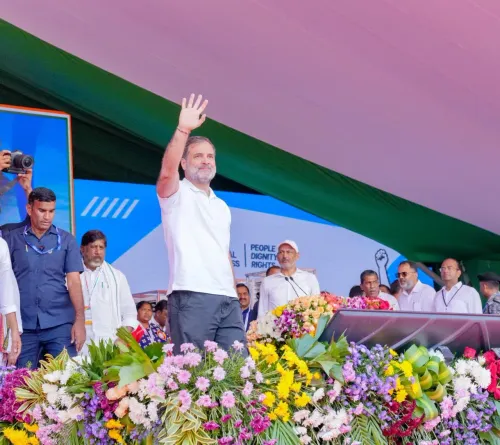
CM Revanth Reddy, Rahul Gandhi launch Gig Workers Welfare Scheme

Synopsis
Telangana CM A. Revanth Reddy and Lok Sabha LoP Rahul Gandhi jointly launched the Telangana Gig Workers Social Security and Welfare Scheme at HITEC City, Hyderabad on 14 November 2026, extending state-level welfare coverage to platform-economy workers.
Key Takeaways
Revanth Reddy and Lok Sabha LoP Rahul Gandhi jointly launched the scheme on 14 November 2026 .
The venue — HITEC City, Hyderabad — is a major platform-economy hub, underscoring who the scheme targets.
The initiative is designed to provide social security and welfare coverage to app-based gig workers in the state.
Rajasthan's 2023 Platform Based Gig Workers Act was the first state-level law of this kind; Telangana now joins that policy frontier.
Specific benefits, contribution rates, and aggregator obligations had not been disclosed ahead of the launch.
Rahul Gandhi's presence frames the scheme as a Congress party labour-welfare deliverable ahead of a broader national conversation on gig-worker rights.
A welfare safety net for Telangana's gig economy workforce became reality on Saturday, 14 November 2026, as Telangana Chief Minister A. Revanth Reddy and Congress Leader of Opposition in the Lok Sabha Rahul Gandhi jointly launched the Telangana Gig Workers Social Security and Welfare Scheme at a ceremony in HITEC City, Hyderabad — placing one of India's largest tech corridors at the centre of a landmark labour-welfare moment.
A platform-economy capital hosts a workers'-rights milestone
HITEC City is not an accidental choice of venue. The sprawling IT and business-process hub is home to dozens of platform companies whose app-based delivery riders, cab drivers, and logistics workers form the very workforce this scheme targets. Launching the initiative in their backyard sends an unmistakable signal about who the beneficiaries are — and who is expected to take note.
Gig workers in India's platform economy have long operated in a welfare vacuum: not employees entitled to provident fund or gratuity, not independent contractors with professional safety nets. Income volatility, work-related injuries without compensation, and zero retirement security have defined their working lives. This scheme is the Congress-led Telangana government's direct answer to that gap.
Where Telangana fits in India's emerging gig-worker policy map
Rajasthan became the first Indian state to legislate on the issue when it enacted the Platform Based Gig Workers (Registration and Welfare) Act in 2023, establishing a registration framework and a welfare board funded in part by platform aggregators. Telangana's move extends that momentum southward and deepens the competitive pressure on other states yet to act.
The push is backed by years of national-level advocacy: NITI Aayog reports have repeatedly flagged the need for portable social security for gig workers as the platform economy adds millions of participants each year. What was once a future-of-work talking point is now state-level legislation.
Rahul Gandhi's presence and the Congress political calculus
The appearance of the Lok Sabha Leader of Opposition alongside the Chief Minister elevates the launch well beyond a routine state-government announcement. It frames the scheme as a Congress party programme — a proof point that the opposition's labour-welfare agenda can be delivered in states where it holds power. With general political attention on workers in the informal economy growing sharper, that framing matters. Revanth Reddy, who also heads the Telangana Pradesh Congress Committee, gains a high-profile co-signatory for one of his government's most visible social initiatives.
What the scheme must still answer
The critical details — specific benefits, contribution rates, how aggregator platforms will be roped in, and the registration mechanism for workers — were not disclosed ahead of the launch. The scheme's real-world impact will hinge on those rules: whether enrolment is automatic or opt-in, whether funding draws on platform levies, and how claims will be processed for a workforce that is, by definition, scattered and paperwork-light.
Telangana has planted its flag. The fine print will determine whether this becomes a model for other states or a cautionary tale about implementation gaps.
Point of View
Raising the bar for BJP-ruled states that have yet to act. The real test, however, lies in implementation: Rajasthan's pioneering law has faced scrutiny over slow rollout and limited aggregator compliance, and Telangana will need to design its rules carefully to avoid the same pitfalls. If the scheme delivers on enrolment numbers and tangible benefits, it hands Congress a replicable template for the 2029 general election cycle.
NationPress
14 Nov 2026
Frequently Asked Questions
What is the Telangana Gig Workers Social Security and Welfare Scheme?
It is a state government initiative launched on 14 November 2026 to provide social security and welfare coverage to gig and platform-economy workers in Telangana, such as app-based delivery riders and cab drivers.
Who launched the Telangana gig workers scheme?
Telangana Chief Minister A. Revanth Reddy and Congress Lok Sabha Leader of Opposition Rahul Gandhi jointly launched the scheme at HITEC City, Hyderabad.
Where was the Telangana Gig Workers Welfare Scheme launched?
The scheme was launched at HITEC City in Hyderabad, a major IT and platform-economy corridor in the state.
Which was the first Indian state to pass a law for gig workers?
Rajasthan was the first Indian state to legislate on gig worker welfare, enacting the Platform Based Gig Workers (Registration and Welfare) Act in 2023.
What benefits will gig workers get under the Telangana scheme?
The specific benefit structure, contribution rates, and eligibility rules had not been officially disclosed ahead of the 14 November 2026 launch; details are expected to emerge with the publication of scheme rules.