Rahul Gandhi Live at Telangana Gig Workers Welfare Scheme Launch

Synopsis
Congress leader Rahul Gandhi broadcast live from Hyderabad on 14 November 2026 as Telangana launched its Gig Workers' Social Security and Welfare Scheme, extending formal protections to platform-based workers and positioning the Congress-governed state as a model for gig-economy welfare policy in India.
Key Takeaways
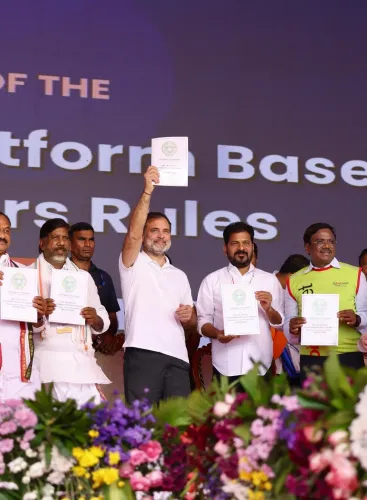
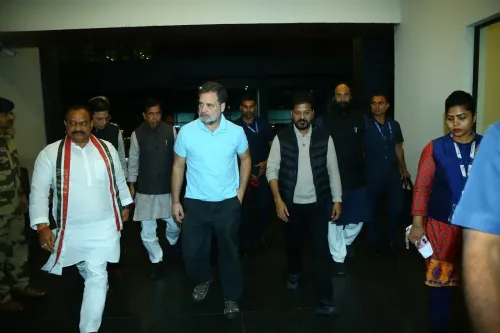
Rahul Gandhi went live from the launch of the Telangana Gig Workers' Social Security and Welfare Scheme in Hyderabad on 14 November 2026 .
The scheme aims to extend social security and welfare benefits to platform-based gig workers in Telangana who fall outside traditional labour law coverage.
Telangana's Congress government, in power since the 2023 assembly elections , has used the state as a welfare-policy laboratory since returning to office.
Rajasthan's Platform Based Gig Workers (Registration and Welfare) Act, 2023 was India's first state-level statutory framework for gig workers, providing a legislative precedent.
Multiple Indian states have moved to fill the regulatory gap left by the central government's pending Labour Code implementation.
Key implementation questions — registration mechanisms, funding sources, and benefit delivery — will determine the scheme's real-world impact.
Millions of delivery riders, cab drivers, and app-based freelancers work without a safety net — and Hyderabad, Telangana moved to change that on Saturday, 14 November 2026, as Congress leader Rahul Gandhi, Leader of the Opposition in Lok Sabha, went live from the launch of the Telangana Gig Workers' Social Security and Welfare Scheme.
A safety net for India's invisible workforce
India's gig economy has exploded in scale over the last decade, yet the workers powering it — food delivery agents, ride-hailing drivers, hyperlocal freelancers — have largely fallen outside the coverage of traditional labour laws and social security frameworks. The Telangana Gig Workers' Social Security and Welfare Scheme is the Congress-led state government's answer to that gap, extending formal welfare protections to platform-based workers who are classified as independent contractors rather than employees.
The move places Telangana among a growing cohort of states taking unilateral action on gig worker welfare. Rajasthan passed the landmark Platform Based Gig Workers (Registration and Welfare) Act, 2023 — India's first state-level statutory framework for registering and covering platform workers — setting a legislative template that other states have since looked to replicate or adapt.
Congress's Telangana as a welfare-policy laboratory
The Congress party returned to power in Telangana after the 2023 assembly elections, defeating the Bharat Rashtra Samithi after a decade in opposition. Since then, the state government has positioned itself as a testing ground for progressive welfare policy, with schemes targeting farmers, women, and now the gig economy workforce. Rahul Gandhi's presence at — and live broadcast of — the launch signals the party's intent to amplify this model nationally, particularly as gig-worker protections become a live political and economic debate ahead of future electoral cycles.
At the national level, the central government's four consolidated Labour Codes have been enacted but not yet fully notified for implementation across states, leaving a regulatory vacuum that state-level schemes are increasingly stepping into. Telangana's initiative fits squarely within this broader pattern of states moving faster than the centre on platform-worker welfare.
What determines whether this scheme delivers
The real test of any gig-worker welfare scheme lies in three execution details: how workers are registered and verified, how the scheme is funded (whether through a cess on platform companies, state budget allocation, or a combination), and how benefits are actually delivered to a workforce that is mobile, informal, and often multi-platform. These specifics will determine whether the Telangana scheme becomes a durable model or remains a well-intentioned announcement. Stakeholders — from platform companies like aggregator-based logistics and ride-hailing firms to worker collectives — will be watching the rollout closely.
For Rahul Gandhi, the live broadcast from Hyderabad is also a political statement: that the Opposition has governance answers, not just criticism, on one of the defining labour questions of the digital age.
Point of View
Amplified by Rahul Gandhi's live presence, is a deliberate attempt by the Congress party to build a governance-first narrative around labour rights — a space the party has increasingly claimed as its own in opposition. The move fits a clear pattern: state governments controlled by the Opposition are acting as policy incubators on issues — gig work, farm debt, urban poverty — where central legislation has stalled. Whether Telangana's scheme becomes a replicable blueprint or a state-specific outlier will depend heavily on the funding and enforcement architecture that emerges in the months ahead. The political calculus is equally clear: a working welfare model in a large southern state is a powerful counter to the charge that the Congress is a party of promises rather than delivery.
NationPress
14 Nov 2026
Frequently Asked Questions
What is the Telangana Gig Workers' Social Security and Welfare Scheme?
It is a state government scheme launched in Hyderabad on 14 November 2026 to extend social security and welfare benefits to platform-based gig workers in Telangana, who are typically classified as independent contractors and fall outside traditional labour law protections.
Why was Rahul Gandhi at the Telangana gig workers scheme launch?
Rahul Gandhi, Leader of the Opposition in Lok Sabha and a senior Congress leader, attended and broadcast the launch live, signalling the party's national-level interest in gig-worker welfare as a political and policy priority.
Which was India's first state-level gig worker welfare law?
Rajasthan enacted the Platform Based Gig Workers (Registration and Welfare) Act, 2023, making it the first Indian state to create a statutory framework for registering and providing welfare to platform-based workers.
Why do gig workers in India need a separate welfare scheme?
Gig workers — such as delivery agents and ride-hailing drivers — are classified as independent contractors by platform companies, which means they are excluded from employee benefits like provident fund, health insurance, and gratuity under existing labour laws.
When did Congress come to power in Telangana?
The Indian National Congress won the Telangana assembly elections in December 2023, defeating the Bharat Rashtra Samithi after a decade in opposition in the state.