Rahul Gandhi hails Telangana gig worker rights law
Synopsis
Congress leader Rahul Gandhi announced on 14 November 2026 that Telangana's Congress government has enacted legal rights for gig workers — including ₹5 lakh accident insurance, ₹10 lakh health cover, a pension contribution, data rights and rest centres — fulfilling a promise he made to workers in 2023.
Key Takeaways
Rahul Gandhi announced on 14 November 2026 that Telangana has converted gig worker demands into legally enforceable rights.
Benefits include ₹5 lakh accident insurance and ₹10 lakh health insurance per worker.
A 1% of earnings contribution toward pension and the right to personal data and income records are included.
WiFi-enabled rest centres are to be set up at multiple locations across Telangana for gig workers.
Gandhi traced the move to a detailed meeting he held with Telangana gig workers in 2023 , framing it as a fulfilled promise.
The announcement sharpens Congress's national narrative on labour rights ahead of future electoral cycles, contrasting its approach with the BJP-RSS's described stance on workers.
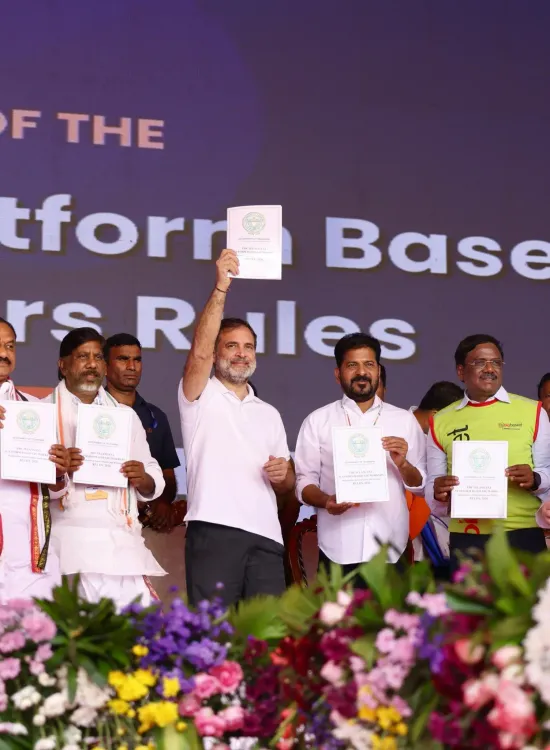
A promise made on a factory floor in 2023 became law on Saturday, 14 November 2026 — and Congress leader Rahul Gandhi made sure the country knew exactly how the dots connected. Posting on X, the Leader of the Opposition in Lok Sabha declared that Telangana's Congress government had fulfilled a pledge he personally made to gig workers three years ago, converting their demands into legally enforceable rights.
The 2023 promise and what it unlocked
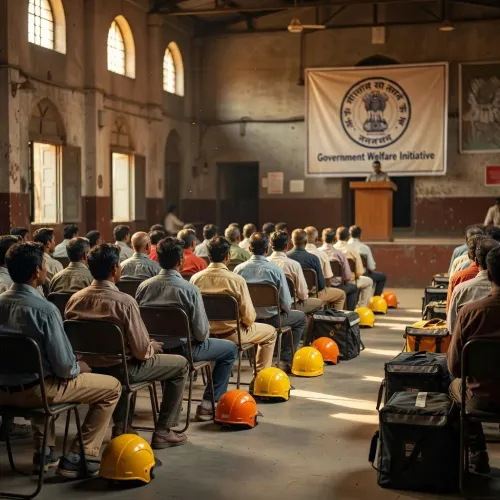
Gandhi recalled a long, detailed meeting with Telangana's gig workers in 2023, where delivery riders, cab drivers and platform workers laid out their anxieties — unpredictable income, zero safety net, no ownership of their own earnings data. 'A promise was made — your demands will be met, you will get security,' he wrote in Hindi. That conversation, he said, is what drove the legislation now on the books.
The package announced is substantial. It includes ₹5 lakh accident insurance, ₹10 lakh health insurance, a 1% of earnings contribution toward pension, the right to one's own data and income records, and WiFi-enabled rest centres at multiple locations across the state. Gandhi's post is emphatic: these are not welfare schemes — they are kanooni adhikar (legal rights).
Where Telangana fits in India's gig-worker policy map
India's platform economy employs tens of millions — from hyperlocal delivery executives to ride-hailing drivers — almost entirely without the protections that salaried workers take for granted. The central Code on Social Security, 2020 was the first national framework to formally recognise gig and platform workers, but implementation has been patchy and state-driven.
Several states have since moved independently. Rajasthan under a previous Congress government was among the first to table dedicated gig-worker legislation. Telangana's move, if the benefits described carry full legislative backing, would place it among the more comprehensive state-level efforts — combining insurance, pension linkage, data rights and physical infrastructure in a single framework.
The political contrast Gandhi is drawing
Gandhi did not let the announcement stand without a sharp political edge. He contrasted what he called Congress's prajalu sarkar — a people's government — against what he labelled the BJP-RSS's doralu vichaar, a Telugu phrase connoting a 'lords' or 'masters' mindset. His argument: one ideology wants to keep labour dependent; the other legislates dignity into the employment relationship.
The framing is deliberate. With Telangana serving as Congress's most prominent state-level showcase since the party's 2023 assembly election victory there, every welfare delivery becomes an exhibit in a larger national argument about governance — one Gandhi is clearly building toward the next electoral cycle.
Gig workers in Telangana waited three years for a meeting-room conversation to translate into a statute. If the rollout matches the announcement, millions of platform workers across India will be watching — and so will every state government still sitting on the fence.
Point of View
And this gig-worker announcement is a calculated exhibit in that project. By anchoring the policy to a personal 2023 promise, Gandhi is constructing a narrative of accountability that is rare in Indian politics — a leader who names a commitment and returns with receipts. The move also enters a live national debate: the central Code on Social Security 2020 recognised gig workers but left states to act, creating a patchwork; Telangana's package, if fully implemented, could set a benchmark that pressures other state governments. The sharply worded BJP-RSS contrast signals that Congress intends to make platform-worker rights a differentiating issue in the next electoral cycle, particularly in urban and semi-urban constituencies where gig employment is concentrated.
NationPress
14 Nov 2026
Frequently Asked Questions
What rights has Telangana given to gig workers in 2026?
According to Rahul Gandhi's announcement, Telangana has enacted legal rights for gig workers including ₹5 lakh accident insurance, ₹10 lakh health insurance, a pension contribution of 1% of earnings, the right to their own data and income records, and WiFi-enabled rest centres across the state.
When did Rahul Gandhi first meet Telangana gig workers?
Rahul Gandhi met Telangana gig workers in 2023, where they discussed their demands for security, insurance and better working conditions. He made a promise at that meeting to fulfil their demands.
Is there a central law for gig workers in India?
Yes. The Code on Social Security, 2020 is the first central legislation to formally recognise gig and platform workers in India, but implementation has largely been left to individual states, resulting in varying levels of protection across the country.
Which party governs Telangana and since when?
The Indian National Congress has governed Telangana since winning the state assembly elections in December 2023, defeating the Bharat Rashtra Samithi which had been in power for a decade.
How does Telangana's gig worker law compare to other Indian states?
Several Indian states have introduced welfare provisions for platform workers, but a comprehensive package combining accident insurance, health insurance, pension linkage, data rights and physical rest infrastructure in a single legal framework is among the more extensive state-level efforts seen in India so far.