CM Rio highlights Nagaland Drone School skilling youth
Synopsis
Nagaland Chief Minister Neiphiu Rio on June 25, 2026, highlighted the Drone School and Centre of Excellence under NGISRSC, which provides certified training in drone technology and digital skills to equip state youth with employment-ready capabilities aligned with national Digital India and Skill India frameworks.
Key Takeaways
CM Neiphiu Rio spotlighted the Drone School and Centre of Excellence under NGISRSC on June 25, 2026 .
The facility offers certified training, specialised programmes, and practical learning in drone technology and emerging digital fields.
The NGISRSC is a Nagaland state government body focused on geospatial technology and digital capacity building.
The initiative aligns with national frameworks including India's Drone Rules (2021) and the Skill India Mission (2015) .
Primary beneficiaries are Nagaland youth seeking certified, employment-ready skills in a growing national drone sector.
Potential future linkages to PM Gati Shakti and SVAMITVA drone survey programmes could expand trainee placement opportunities.
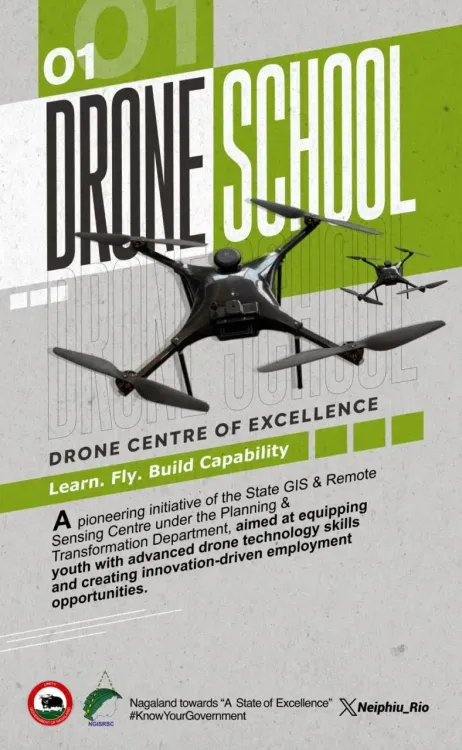
Nagaland Chief Minister Neiphiu Rio on Thursday, June 25, 2026, spotlighted the Drone School and Centre of Excellence operating under the Nagaland GIS and Remote Sensing Centre (NGISRSC), calling it a key vehicle for equipping state youth with skills in drone technology and emerging digital fields.
Context
In his post on X, CM Rio stated that the facility offers 'certified training, specialised programmes, and practical learning' aimed at driving innovation and expanding opportunities for young people in Nagaland. The post was part of the #KnowYourGovernment campaign, which the state government uses to publicise ongoing schemes and institutional initiatives to citizens.
The NGISRSC is a state government body responsible for geospatial technology applications and capacity building in emerging digital tools across Nagaland. The Drone School and Centre of Excellence functions as a dedicated training arm under this body, offering courses in drone operation, data analytics, and related digital disciplines.
Policy Backdrop
The initiative sits within a well-established national policy framework. The Government of India notified the Drone Rules in 2021, creating a regulatory and promotional architecture for drone usage across sectors including agriculture, infrastructure mapping, and disaster response, while explicitly encouraging certified training programmes.
The Skill India Mission, launched in 2015, provided an earlier structural foundation by targeting vocational training in emerging technologies — including geospatial and digital tools — to address youth unemployment. Nagaland's Drone School aligns directly with both frameworks, translating central policy into a state-level, practical institution.
Northeastern states have increasingly adopted such centres to close digital infrastructure gaps and align with Digital India goals. Drone technology has become central to national programmes covering land surveys, precision agriculture, and connectivity mapping in frontier and hilly regions where traditional methods are logistically difficult.
Stakeholders and Impact
The primary beneficiaries are Nagaland's youth — particularly those seeking certified, employment-ready skills in a state where traditional job markets remain limited. Certified drone operators are in growing demand nationally, with opportunities spanning government survey projects, private agriculture firms, infrastructure companies, and emergency services.
The NGISRSC's dual role — as both a geospatial services body and a training provider — positions the centre to link trainees directly to applied projects within the state government's own operations, offering a practical pipeline from classroom to deployment. The emphasis on 'practical learning' highlighted by CM Rio reflects a deliberate shift away from purely theoretical certification models.
What's Next
Observers will watch for state budget allocations or institutional partnership announcements that could signal plans to scale the Drone School and Centre of Excellence beyond its current capacity. Potential linkages to national programmes — such as drone-based land surveys under PM Gati Shakti or the SVAMITVA scheme for property mapping — could significantly expand both funding and placement opportunities for trainees.
As drone technology becomes embedded in India's infrastructure and agricultural economy, state-level centres like this one in Nagaland will increasingly serve as the workforce pipeline for a sector that the central government has identified as a strategic priority. The sustainability and scale of such institutions will depend on continued policy support and private sector engagement.
Point of View
And the long-running Skill India effort to reduce youth unemployment through certified vocational training. For a landlocked, hilly state like Nagaland, drone technology carries particular strategic weight — it is one of the few digital sectors where geography is an advantage rather than a barrier, given demand for aerial surveying and mapping in difficult terrain. Whether the state follows this visibility exercise with concrete budget commitments or national-scheme linkages will determine whether the centre scales or remains a modest pilot.
NationPress
25 Jun 2026
Frequently Asked Questions
What is the Drone School and Centre of Excellence in Nagaland?
The Drone School and Centre of Excellence is a training facility under the Nagaland GIS and Remote Sensing Centre (NGISRSC) that offers certified courses and practical programmes in drone operation, data analytics, and related digital skills targeted at Nagaland youth.
How does Nagaland's Drone School connect to national policy?
The centre aligns with India's Drone Rules notified in 2021, which promote certified drone training, and with the Skill India Mission launched in 2015 to provide vocational training in emerging technologies to reduce youth unemployment.
Who benefits from the Nagaland Drone School?
The primary beneficiaries are Nagaland's youth seeking certified, employment-ready skills in drone technology, with potential job opportunities in government survey projects, agriculture, infrastructure, and emergency services nationally.
What did CM Neiphiu Rio say about the Drone School?
CM Rio stated that the Drone School equips youth with skills in drone technology and emerging digital fields through 'certified training, specialised programmes, and practical learning' aimed at driving innovation and expanding opportunities.