CM Rio: Human Capital Is Nagaland's Greatest Strength

Synopsis
Nagaland Chief Minister Neiphiu Rio on June 11, 2026, reaffirmed that human capital is the state's greatest strength, pointing to Lighthouse School Complexes, CoE-Industry 4.0, NSEDM and the Nagaland Super League as the government's core investments in education, skills, innovation and sports for a future-ready generation.
Key Takeaways
Chief Minister Neiphiu Rio publicly identified human capital as Nagaland's greatest strength in a post on June 11, 2026 .
The Lighthouse School Complexes programme aims to upgrade infrastructure, teacher training and learning outcomes at model schools across the state.
The Nagaland Super League is used as a vehicle to promote youth participation in organised sport, particularly football, at the district level.
State skill development efforts operate under the National Skill Development Mission framework, complemented by the locally-driven NSEDM .
Nagaland's approach aligns school education reforms with the National Education Policy 2020 to restructure curriculum and assessment.
Progress on the Lighthouse School Complexes rollout and fresh budget allocations for these programmes are the key developments to watch next.
Nagaland Chief Minister Neiphiu Rio on Thursday, June 11, 2026, reaffirmed the state government's commitment to building a future-ready generation, citing a cluster of ongoing initiatives spanning education, skills, innovation, and sports as the pillars of the state's human capital strategy.
Context
Responding to a mention on X, Chief Minister Rio stated: 'Human capital remains Nagaland's greatest strength. Through initiatives such as Lighthouse School Complexes, the CoE - Industry 4.0, NSEDM and the Nagaland Super League, we are investing in education, skills, innovation and sports to create a future-ready generation.' The statement, while brief, signals the government's framing of youth development as the central plank of its governance agenda.
Nagaland, a northeastern Indian state with special constitutional protections under Article 371A, has a large and growing youth population. Out-migration and unemployment have historically been pressing concerns, making human capital investment a political as well as an economic priority for successive state administrations.
Policy Backdrop
The Lighthouse School Complexes programme is a Nagaland government initiative designed to create model schools that upgrade physical infrastructure, strengthen teacher training, and improve learning outcomes at select locations across the state. The effort is broadly aligned with the National Education Policy 2020, which the state government has adopted to restructure curriculum design and assessment frameworks.
Skill development efforts in the state have operated within the National Skill Development Mission framework since the mid-2010s. The Nagaland Super League, primarily a football-oriented competition, serves as a platform to channel youth energy into organised sport and district-level participation, mirroring the objectives of the centrally-sponsored Khelo India programme at the state level.
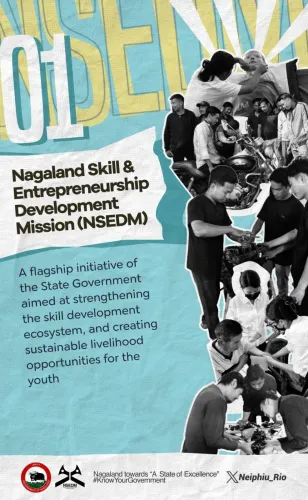
The CoE - Industry 4.0 and the NSEDM (Nagaland Skill and Entrepreneurship Development Mission) are also cited by the Chief Minister as active components of this integrated strategy, though their detailed operational status and outcomes are still being documented by the state government.
Stakeholders and Impact
The primary beneficiaries of these programmes are school students and youth across Nagaland's districts, particularly in areas with limited access to quality education and vocational training. By combining school-level reform with skill-building and sports, the state aims to reduce the economic pressure that pushes young Nagas to seek opportunities outside the state.
Northeastern states as a group have increasingly adopted multi-pronged human capital strategies that integrate central scheme funding with locally-tailored institutions. Nagaland's model — linking school infrastructure, industry-oriented training, and competitive sport — reflects this broader regional pattern while addressing the state's unique geographic and demographic constraints.
What's Next
Observers will watch the upcoming state budget for progress reports on the Lighthouse School Complexes rollout and for fresh allocations toward the skill and innovation programmes cited by the Chief Minister. The latest season of the Nagaland Super League will also be a practical test of the government's claim that sports investment is translating into measurable youth participation at the district level. Sustained funding and transparent outcome reporting will determine whether these initiatives move beyond policy statements into durable change for the state's young population.
Point of View
Not natural resources or central transfers, as the defining asset of a small northeastern state. By naming four distinct programmes in a single post, the Chief Minister signals that the administration wants these initiatives seen as a coherent system rather than isolated schemes. This framing is politically useful ahead of budget season, as it sets the terms on which the government expects to be evaluated. The broader arc here is Nagaland's attempt to shift from a welfare-dependent development model to one driven by skilled, locally-retained youth — a transition that will take years and consistent funding to validate.
NationPress
29 Jul 2026
Frequently Asked Questions
What are the Lighthouse School Complexes in Nagaland?
Lighthouse School Complexes are a Nagaland government initiative to create model schools that upgrade physical infrastructure, strengthen teacher training and improve learning outcomes at select locations, aligned with the National Education Policy 2020.
What is the Nagaland Super League?
The Nagaland Super League is a state-level sports competition, primarily focused on football, designed to promote youth participation and district-level sporting activity across Nagaland.
What is NSEDM in Nagaland?
NSEDM stands for the Nagaland Skill and Entrepreneurship Development Mission, a state-level programme aimed at building vocational skills and entrepreneurship among Nagaland's youth, operating within the broader National Skill Development Mission framework.
What did Nagaland CM Neiphiu Rio say about human capital?
On June 11, 2026, Chief Minister Neiphiu Rio stated that human capital remains Nagaland's greatest strength and cited Lighthouse School Complexes, CoE-Industry 4.0, NSEDM and the Nagaland Super League as the government's key investments in education, skills, innovation and sports.
How is Nagaland aligning with the National Education Policy 2020?
The Nagaland government has adopted the National Education Policy 2020 to restructure curriculum design and assessment frameworks in state schools, with the Lighthouse School Complexes programme serving as a flagship vehicle for this reform.