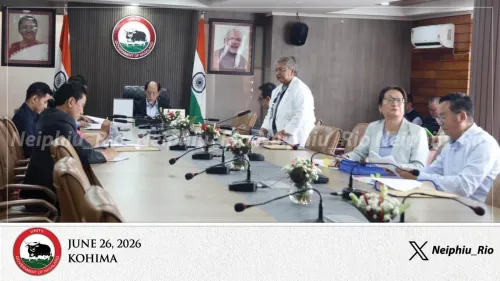
CM Rio urges Centre for IIT, AIIMS, upgraded medical institute in Nagaland
Synopsis
Nagaland Chief Minister Neiphiu Rio has publicly stated that the state has requested the Government of India to establish an IIT and a Greenfield AIIMS in Nagaland and to strengthen the Nagaland Institute of Medical Sciences and Research, citing critical gaps in higher education and tertiary healthcare.
Key Takeaways
Nagaland has formally requested the Government of India to establish an IIT and a Greenfield AIIMS in the state.
The state has also sought central support to strengthen the Nagaland Institute of Medical Sciences and Research (NIMSR) .
The request aims to address gaps in both higher education and tertiary healthcare services in Nagaland.
Nagaland holds special category status , making it eligible for enhanced central funding for such infrastructure.
The proposal fits a broader pattern of northeastern states seeking premier central institutions to curb outward migration for education and medical care.
Approval would depend on future Union Budget allocations and decisions by the Ministry of Education and Ministry of Health .
Nagaland Chief Minister Neiphiu Rio on Thursday, June 11, 2026, publicly disclosed that the state government has formally requested the Government of India to establish an Indian Institute of Technology (IIT) and a Greenfield All India Institute of Medical Sciences (AIIMS) in Nagaland, alongside strengthening the existing Nagaland Institute of Medical Sciences and Research (NIMSR) to close critical gaps in higher education and tertiary healthcare.
Context
Rio's post, shared on his official X account, states that Nagaland has 'requested the support of the GoI for the establishment of an IIT, a Greenfield AIIMS, and strengthening of the Nagaland Institute of Medical Sciences and Research to address gaps in higher education and tertiary healthcare services in the State.' The disclosure signals an active state-centre negotiation on flagship institutional infrastructure rather than a routine appeal.
Nagaland is a special category state in the northeastern region, bordering Myanmar, with a predominantly tribal population. Its geographic remoteness and limited institutional base have historically pushed students and patients to seek quality education and advanced medical care outside the state, often to cities in mainland India.
Policy Backdrop
The central government has expanded the AIIMS network under the Pradhan Mantri Swasthya Suraksha Yojana, with new campuses approved in multiple states since the early 2000s to improve equitable access to tertiary healthcare. Similarly, the IIT network was enlarged significantly after 2008, with new campuses opened across underserved regions to widen technical education access.
Northeastern states have received targeted central support for education and health infrastructure under successive five-year plans and special category provisions. However, the region remains underrepresented in the network of premier central institutions compared to other parts of the country, making Nagaland's request consistent with a long-standing regional demand.
The Nagaland Institute of Medical Sciences and Research was established to expand local medical education and specialised healthcare capacity, but its current scale falls short of meeting the state's tertiary care needs, according to the state government's own framing in Rio's post.
Stakeholders and Impact
The primary beneficiaries of a new IIT would be students from Nagaland and the wider northeastern region who currently travel to other states for engineering and technology education, incurring significant costs and contributing to outward migration of skilled youth. A Greenfield AIIMS would address the absence of a national-standard tertiary care hospital in the state, reducing the burden on patients who must travel to cities such as Guwahati or Vellore for specialised treatment.
Strengthening NIMSR would have a more immediate impact on local medical education capacity and the supply of trained healthcare professionals within the state. Together, the three proposals represent a comprehensive push to anchor high-quality public institutions in Nagaland rather than rely on out-of-state alternatives.
What's Next
The formal outcome of Nagaland's request will depend on allocations in upcoming Union Budgets and announcements from the Ministry of Education and the Ministry of Health and Family Welfare. The proposal may also surface in deliberations of the North Eastern Council or the NITI Aayog, both of which play roles in regional development planning.
If approved, a Greenfield AIIMS for Nagaland would mark a significant milestone for the state's healthcare infrastructure and would follow the pattern of central institutions being extended to states that have long advocated for equitable access to premier public services.
Point of View
AIIMS, and NIMSR upgradation into a single articulated demand, the state government is framing its ask as a comprehensive equity argument rather than a piecemeal plea, which is harder for the Centre to defer without political cost. The timing also fits a broader pattern in which northeastern chief ministers use public platforms to pressure New Delhi ahead of budget cycles and council meetings. Whether the Centre responds will be a test of how seriously it treats special category states' claims to flagship infrastructure in the current political dispensation.
NationPress
25 Oct 2026
Frequently Asked Questions
Has Nagaland requested an IIT from the central government?
Yes. Chief Minister Neiphiu Rio confirmed on June 11, 2026 that Nagaland has formally requested the Government of India to establish an IIT in the state to address gaps in higher education.
Is there an AIIMS in Nagaland?
No. Nagaland does not currently have an AIIMS. The state government has requested the Centre to establish a Greenfield AIIMS to provide tertiary healthcare services within the state.
What is the Nagaland Institute of Medical Sciences and Research?
The Nagaland Institute of Medical Sciences and Research (NIMSR) is a state medical institution aimed at expanding local medical education and specialised healthcare capacity. The state has requested central support to strengthen it further.
Why do northeastern states lack IITs and AIIMS?
Historically, premier central institutions were concentrated in larger states. While the Centre has expanded both IIT and AIIMS networks since the 2000s, the northeastern region remains underrepresented, prompting repeated requests from state governments including Nagaland.
What will happen next with Nagaland's request for IIT and AIIMS?
The request will be considered through Union Budget allocations and decisions by the Ministry of Education and Ministry of Health. It may also be taken up in North Eastern Council or NITI Aayog deliberations.