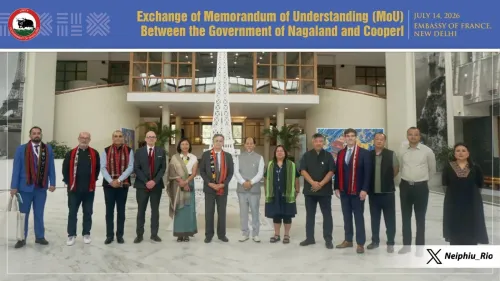
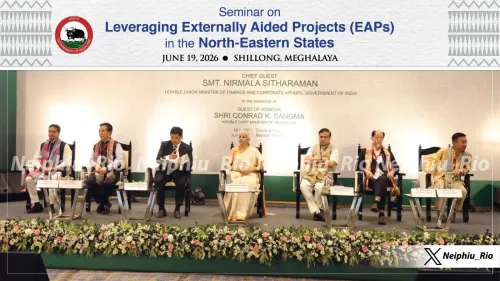
CM Rio Acknowledges MDB Partners' Role in Nagaland's Development
Synopsis
Nagaland Chief Minister Neiphiu Rio on 19 June 2026 publicly acknowledged the World Bank, ADB, JICA, KfW, NDB and other multilateral development banks for contributions that go beyond financing, citing technical expertise, institutional strengthening, innovation and global best practices as key value additions to the state's development agenda.
Key Takeaways
CM Neiphiu Rio on 19 June 2026 acknowledged six multilateral development partners: World Bank, ADB, JICA, KfW, NDB , and other MDBs.
The statement emphasises that MDB contributions extend beyond financing to include technical expertise, institutional strengthening, innovation, and global best practices .
Nagaland's engagement with multilateral lenders is part of a broader Northeast India development strategy dating to the 2000s .
Partners span institutions from Japan (JICA) , Germany (KfW) , the BRICS bloc (NDB) , and global multilateral bodies, reflecting a diversified international financing base.
The acknowledgement signals Nagaland's intent to position itself as a credible sub-national partner for future MDB project pipelines.
Nagaland Chief Minister Neiphiu Rio on Friday, 19 June 2026, acknowledged the contributions of the state's multilateral development partners, highlighting that their role extends well beyond financing to encompass technical expertise, institutional strengthening, innovation, and global best practices.
Context
In a post on X, CM Rio named six key partners — the World Bank, Asian Development Bank (ADB), Japan International Cooperation Agency (JICA), KfW, New Development Bank (NDB), and other Multilateral Development Banks (MDBs) — as central to Nagaland's development architecture. The acknowledgement underscores the state's active engagement with international financing institutions at a time when northeastern states are receiving heightened attention from both the central government and global lenders.
The Chief Minister's statement reflects a deliberate effort to place on record the non-financial value these institutions bring — an often-understated dimension of MDB partnerships that includes project design standards, environmental and social safeguards, and knowledge transfer.
Policy Backdrop
India's engagement with multilateral lenders in the Northeast Region has deepened steadily since the 2000s, with the World Bank and ADB financing infrastructure and institutional development projects under successive central plans. For states like Nagaland, which face unique geographic and connectivity challenges, MDB partnerships have historically served as a bridge between limited state fiscal capacity and large-scale infrastructure ambitions.
The New Development Bank, established by BRICS nations, adds a newer multilateral dimension to this mix, while JICA and KfW bring bilateral development finance from Japan and Germany respectively. Together, these institutions represent a diversified portfolio of international support that goes beyond any single lending relationship.
India's broader strategy has long been to leverage MDB platforms not just for capital but for the adoption of global standards in project execution, monitoring, and governance — a model that state governments are increasingly internalising.
Stakeholders and Impact
The primary beneficiaries of MDB-backed projects in Nagaland are local communities, particularly in areas where public infrastructure — roads, water supply, health facilities, and institutional capacity — remains underdeveloped relative to the national average. State government departments act as implementing agencies, gaining institutional knowledge and process discipline through MDB-mandated frameworks.
For the multilateral institutions themselves, Nagaland represents a sub-national engagement model where lending is paired with hands-on technical assistance, making the state a testing ground for adaptive development approaches in challenging terrains. CM Rio's public acknowledgement also signals to potential future partners that the state values and recognises the full spectrum of MDB contributions.
What's Next
Observers will watch for concrete follow-through in Nagaland's annual budget allocations and in central government review meetings with MDBs, where new financing agreements or project expansions may be announced. The Chief Minister's statement could also precede formal engagement events or bilateral reviews with one or more of the named partners.
As northeastern states compete for a larger share of MDB-assisted projects, Nagaland's proactive acknowledgement of its development partners positions the state as a willing and credible collaborator — a signal that may carry weight in future project pipeline discussions.
Point of View
Accountable sub-national partner. By explicitly naming the non-financial contributions of MDBs, Rio is reinforcing a governance narrative that prioritises institutional capacity alongside capital, a posture that aligns with the central government's broader push to make northeastern states more MDB-ready. The move also reflects a wider pattern among northeastern chief ministers of using social media to build credibility with international stakeholders, supplementing formal diplomatic channels. If followed by concrete project announcements or budget commitments, this statement could mark the opening of a more structured phase of multilateral engagement for Nagaland.
NationPress
19 Sept 2026
Frequently Asked Questions
Which development banks did Nagaland CM Neiphiu Rio acknowledge?
CM Neiphiu Rio acknowledged the World Bank, Asian Development Bank, JICA, KfW, New Development Bank, and other Multilateral Development Banks for their contributions to Nagaland's development.
What is the role of the World Bank in Nagaland?
The World Bank provides loans, technical assistance, and institutional support for development projects in Nagaland and the broader Northeast Region, partnering with both the central and state governments.
What does JICA do in India's Northeast?
JICA, Japan's bilateral aid agency, delivers technical expertise, training, and infrastructure support in partner regions including northeastern states of India.
What is the New Development Bank and why does it matter for Nagaland?
The New Development Bank, established by BRICS nations, finances infrastructure and sustainable development in emerging economies including India, offering Nagaland an additional multilateral financing avenue alongside traditional lenders.
Why is multilateral development bank support important for Nagaland?
Nagaland faces geographic and connectivity challenges that limit its fiscal capacity; MDB partnerships bridge this gap by providing not just capital but global standards in project design, safeguards, and monitoring.