CM Sai Accuses Previous Govt of DMF Corruption in Assembly
Synopsis
Chhattisgarh CM Vishnu Deo Sai, responding to an opposition no-confidence motion on 18 July 2026, accused the previous Congress government of extracting 40 per cent commission from the District Mineral Foundation, a welfare fund for mining-affected communities created under PM Modi's tenure.
Key Takeaways
CM Vishnu Deo Sai addressed the Chhattisgarh Legislative Assembly on 18 July 2026 in response to an opposition no-confidence motion.
He alleged that the previous government took 40 per cent commission from the District Mineral Foundation (DMF) fund.
The DMF was established under the MMDR Amendment Act, 2015 to direct mining revenues toward displaced and pollution-affected communities.
Chhattisgarh is a major mineral-producing state, making DMF governance a high-stakes political and welfare issue.
The BJP administration has framed its tenure since December 2023 as a corrective to alleged leakages under the prior Congress regime.
Scrutiny of DMF utilisation records and possible audit or inquiry proceedings are expected to follow the assembly exchange.
Chhattisgarh Chief Minister Vishnu Deo Sai launched a sharp attack on the previous Congress government on Saturday, 18 July 2026, accusing it of siphoning commissions from the District Mineral Foundation (DMF) — a welfare fund meant for communities displaced and polluted by mining operations — while responding to an opposition no-confidence motion on the floor of the Chhattisgarh Legislative Assembly.
Context
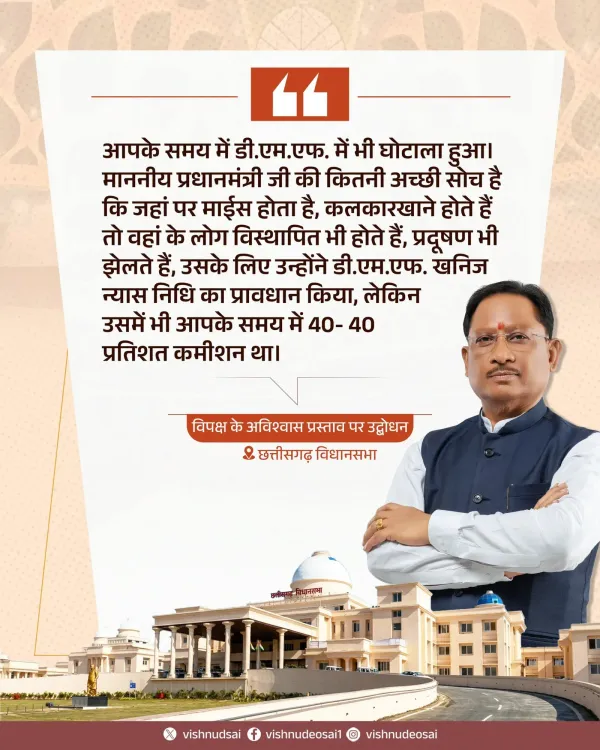
Addressing the assembly, CM Sai invoked Prime Minister Narendra Modi's vision behind the DMF framework, saying — 'aapke samay mein DMF mein bhi ghotala hua' [there was a scam in DMF during your time] — and alleged that the previous dispensation extracted 40 per cent commission from the fund. He framed the allegation as a betrayal of communities who already bear the twin burdens of displacement and pollution caused by mines and factories in their vicinity.
The no-confidence motion brought by the opposition provided the occasion for the Chief Minister to go on the offensive, turning a procedural challenge into a platform for governance accountability claims.
Policy Backdrop
The District Mineral Foundation was created as a statutory trust under the Mines and Minerals (Development and Regulation) Amendment Act, 2015, mandating that a portion of mining revenues be channelled into welfare, rehabilitation, and pollution mitigation for communities in affected districts. The provision was a signature initiative of the Modi government at the Centre, designed to ensure that mineral-rich regions and their residents receive a direct share of the wealth extracted from their land.
Chhattisgarh is one of India's most significant mineral-producing states, with substantial coal, iron ore, and bauxite deposits. The management of DMF funds has remained a contested political issue across successive state governments, with debates centring on utilisation rates, beneficiary targeting, and administrative transparency.
Stakeholders and Impact
The communities most directly affected by DMF governance are mining-affected populations — displaced families, tribal communities, and residents in pollution-prone zones across districts such as Korba, Raigarh, and Surguja. Funds under DMF are meant to finance drinking water, healthcare, education, and livelihood support in these areas.
If the commission allegations are substantiated through audit or legal proceedings, it would represent a significant diversion of welfare resources away from some of Chhattisgarh's most vulnerable populations. The BJP administration has positioned itself as a corrective force against such leakages since assuming power in December 2023.
What's Next
The assembly exchange is likely to intensify scrutiny of DMF utilisation records from the previous Congress tenure. Observers will watch for any formal audit referral, inquiry commission, or legislative committee probe into the alleged irregularities. At the national level, any proposed amendments to the MMDR Act or state-level DMF rules in upcoming sessions could further reshape how these funds are governed and monitored across mineral-rich states.
Point of View
Making welfare fund misuse politically toxic. By anchoring the allegation to PM Modi's original intent behind the DMF framework, Sai simultaneously defends the Centre's policy record and localises blame on the previous state government. Whether the allegations translate into formal investigations will determine if this remains campaign rhetoric or becomes a substantive governance accountability moment.
NationPress
18 Jul 2026
Frequently Asked Questions
What is the District Mineral Foundation (DMF) in India?
The District Mineral Foundation is a statutory trust mandated under the Mines and Minerals (Development and Regulation) Amendment Act, 2015, requiring mining companies to contribute a share of revenues into a fund for the welfare, rehabilitation, and pollution relief of communities affected by mining in that district.
What did Chhattisgarh CM Vishnu Deo Sai say about DMF in the assembly?
CM Sai alleged that during the previous Congress government's tenure, officials extracted 40 per cent commission from the District Mineral Foundation fund, diverting welfare money meant for displaced and pollution-affected mining communities.
What is a no-confidence motion in a state assembly?
A no-confidence motion is a formal legislative procedure through which the opposition moves to withdraw its confidence in the ruling government; if it passes by a majority, the government must resign. CM Sai was responding to such a motion filed by the Chhattisgarh opposition.
Why is DMF important for Chhattisgarh?
Chhattisgarh is one of India's largest mineral-producing states, with significant coal, iron ore, and bauxite reserves. DMF funds are meant to support tribal communities, displaced families, and residents in pollution-affected mining districts, making their proper utilisation a major welfare and political issue.
When did Vishnu Deo Sai become Chief Minister of Chhattisgarh?
Vishnu Deo Sai was sworn in as Chief Minister of Chhattisgarh in December 2023 after the BJP won the state assembly elections.