CM Sai Defends Mining-Forest Balance in Assembly
Synopsis
Responding to an opposition no-confidence motion in the Chhattisgarh Assembly on 18 July 2026, CM Vishnu Deo Sai cited data showing open-cast mines occupy just 0.29% of the state's 59.82 lakh hectare forest cover, defending his government's record on balancing mining with environmental protection.
Key Takeaways
CM Vishnu Deo Sai addressed a no-confidence motion in the Chhattisgarh Legislative Assembly on 18 July 2026 .
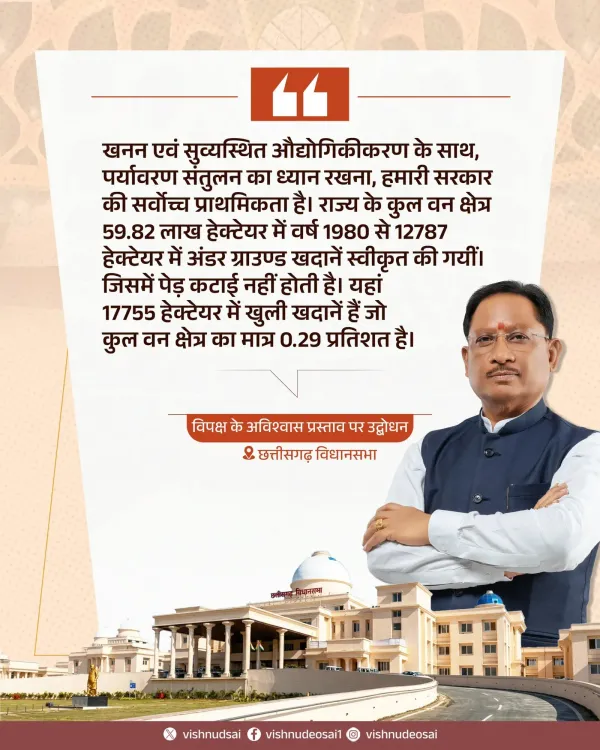
He stated that environmental balance alongside mining is his government's 'highest priority.' Of the state's total forest area of 59.82 lakh hectares , underground mines approved since 1980 cover 12,787 hectares — with no tree-felling involved.
Open-cast mines span 17,755 hectares , equal to just 0.29 per cent of total forest cover.
All mining approvals are governed by the Forest (Conservation) Act, 1980 , which mandates central clearance for forest land diversion.
The debate has direct implications for tribal forest dwellers and mining lease holders across the mineral-rich state.
Chhattisgarh Chief Minister Vishnu Deo Sai on Saturday, 18 July 2026, told the Chhattisgarh Legislative Assembly that balancing mining and industrialisation with environmental protection is his government's highest priority, making the statement while responding to an opposition no-confidence motion.
Context
Addressing the legislature during the no-confidence debate, CM Sai cited specific figures to counter opposition criticism on environmental grounds. He stated that out of the state's total forest area of 59.82 lakh hectares, only 12,787 hectares have been approved for underground mines since 1980 — operations that, he emphasised, do not require tree-felling. Open-cast mines cover an additional 17,755 hectares, amounting to just 0.29 per cent of the total forest cover.
In his own words, 'खनन एवं सुव्यस्थित औद्योगिकीकरण के साथ, पर्यावरण संतुलन का ध्यान रखना, हमारी सरकार की सर्वोच्च प्राथमिकता है' — ('Maintaining environmental balance alongside mining and organised industrialisation is the highest priority of our government.')
Policy Backdrop
The figures cited by CM Sai are anchored to the Forest (Conservation) Act, 1980, the central legislation that brought all diversion of forest land for non-forest purposes — including mining — under mandatory government clearance. Every underground and open-cast lease referenced in his address would have required approval under this framework.
Chhattisgarh, carved out as a separate state in 2000, holds some of India's largest reserves of coal, iron ore, and bauxite, much of it beneath dense forest tracts. The state's successive mineral policies have required compensatory afforestation alongside extraction approvals. National Sustainable Mining guidelines, issued in 2015-16, further promoted underground methods precisely to limit surface forest loss in mineral-bearing states like Chhattisgarh.
Stakeholders and Impact
The debate directly concerns tribal forest dwellers, whose livelihoods and customary rights are intertwined with the forests overlying mineral deposits. Mining lease holders and industrial investors also have a stake in the regulatory clarity that government statistics on forest diversion are intended to signal.
The opposition's no-confidence motion appears designed to force the BJP administration to account publicly for its environmental record — a recurring pressure point in mineral-rich states. By anchoring his defence to the low percentage of forest diversion (0.29 per cent for open-cast mines), CM Sai sought to reframe the debate around compliance rather than impact.
What's Next
The outcome of the no-confidence motion will determine the immediate political fallout for the Sai government, which has held power since December 2023. Beyond the vote, the monsoon session of the Chhattisgarh Legislative Assembly is expected to see further scrutiny of pending mining proposals and the state's compensatory afforestation targets. How the government reconciles expanding underground mining with its stated environmental commitments will remain a central question heading into the next budget cycle.
Point of View
1980 is deliberate, tying state-level decisions to a central legal framework and diffusing sole accountability. For the BJP, holding this line is strategically important ahead of any future assembly polls, given that tribal constituencies in forested belts have historically been swing voters. The no-confidence motion, even if it fails, has succeeded in extracting a data-point-heavy public commitment from the Chief Minister that civil society and the opposition can benchmark against future mining clearances.
NationPress
17 Oct 2026
Frequently Asked Questions
What did CM Vishnu Deo Sai say about mining and forests in the Chhattisgarh Assembly?
CM Sai said that maintaining environmental balance alongside mining and industrialisation is his government's highest priority, and cited data showing open-cast mines cover only 0.29 per cent of the state's total forest area of 59.82 lakh hectares.
What is the total forest area of Chhattisgarh?
According to CM Sai's statement in the assembly on 18 July 2026, Chhattisgarh's total forest area is 59.82 lakh hectares.
Why was a no-confidence motion moved against the Chhattisgarh government?
The opposition moved a no-confidence motion against the Vishnu Deo Sai-led BJP government in the Chhattisgarh Assembly; the Chief Minister used his address to defend the government's environmental record on mining approvals.
What is the Forest Conservation Act 1980 and how does it relate to Chhattisgarh mining?
The Forest (Conservation) Act, 1980 is a central law requiring mandatory government clearance before any forest land can be diverted for non-forest uses such as mining; all underground and open-cast mine approvals cited by CM Sai fall under this framework.
How much forest land in Chhattisgarh is used for underground mines?
According to CM Sai's assembly address, 12,787 hectares of forest land have been approved for underground mines since 1980 — operations that do not involve tree-felling.