CM Sai Announces 5 New Govt Medical Colleges, 250 MBBS Seats for Chhattisgarh
Synopsis
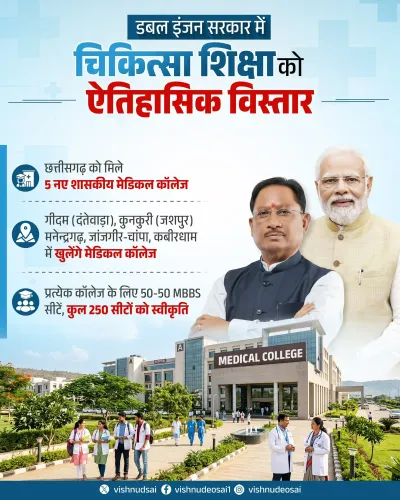
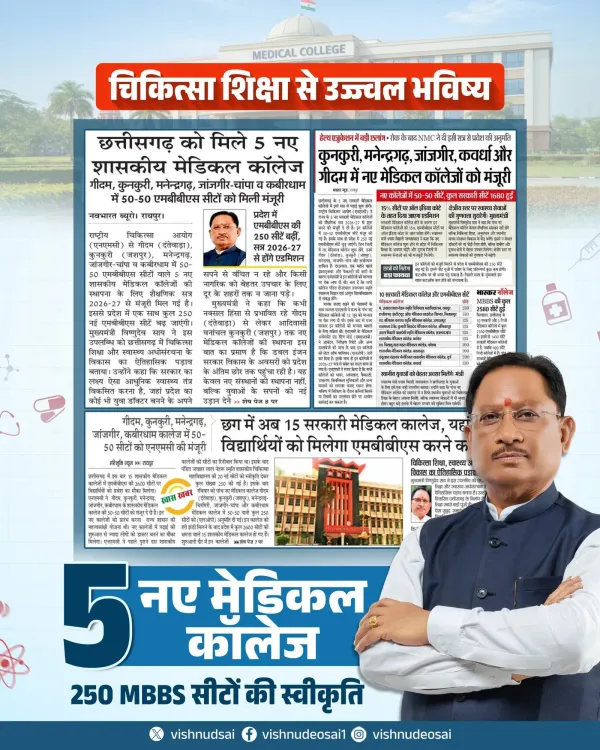
Chhattisgarh Chief Minister Vishnu Deo Sai announced approval of five new government medical colleges and 250 additional MBBS seats on 14 July 2026, citing the BJP's double engine governance model as the driver of the state's accelerating medical education expansion.
Key Takeaways
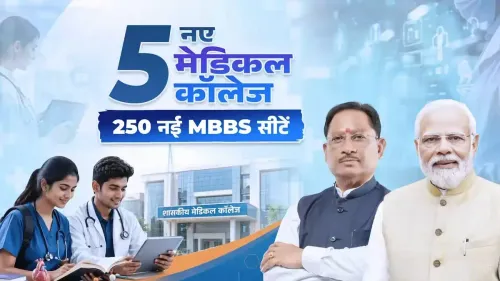
5 new government medical colleges have been approved for Chhattisgarh , as announced by CM Vishnu Deo Sai on 14 July 2026 .
250 new MBBS seats will be added to the state's medical education capacity alongside the new colleges.
CM Sai attributed the approvals to the BJP's 'double engine' model of coordinated central-state governance.
The expansion aims to address Chhattisgarh's historically limited medical education infrastructure and doctor shortages in rural areas.
The new colleges must clear National Medical Commission (NMC) inspections and accreditation before admitting students.
The move aligns with a national push since 2014 to more than double India's MBBS seat count through new government colleges in under-served states.
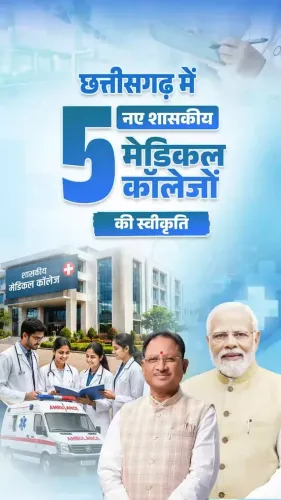
Chhattisgarh Chief Minister Vishnu Deo Sai on Tuesday, 14 July 2026 announced the approval of five new government medical colleges and 250 additional MBBS seats for the state, calling the expansion a cornerstone of a stronger public health system. The announcement, made via a post on X, positions the move as a milestone under the BJP's 'double engine' governance model, reflecting coordinated action between the state and the Union government.
In his post, CM Sai wrote: 'चिकित्सा शिक्षा का सशक्त विस्तार ही सुदृढ़ स्वास्थ्य व्यवस्था की आधारशिला है' ['A robust expansion of medical education is the foundation of a strong health system']. He added that Chhattisgarh is 'continuously advancing towards new heights in the field of medical education' under the double engine government, and that the approvals will also 'give new strength to future healthcare services.'
Context
Chhattisgarh has historically had limited medical education infrastructure relative to its population and geographic spread. Since Chief Minister Sai took office in December 2023 following the BJP's assembly election victory, the state government has signalled medical education as a priority sector. The latest approvals, if implemented as announced, would meaningfully expand the state's capacity to train doctors closer to home.
The addition of 250 MBBS seats spread across five institutions would reduce pressure on aspirants who currently compete for a small pool of government seats or must seek admission in other states. It also addresses a long-standing concern about the uneven geographic distribution of medical colleges in central India.
Policy Backdrop
The announcement fits within a broader national push, active since 2014, to more than double India's MBBS seat count by approving new government medical colleges in under-served states. The Pradhan Mantri Swasthya Suraksha Yojana (PMSSY), launched in 2006 and expanded in multiple phases, has been a key vehicle for sanctioning such colleges, with central funding channelled to states including Chhattisgarh.
BJP-ruled states have routinely framed such health-education projects as proof of the 'double engine' model — where a party in power at both the state and Union levels can align funding, policy clearances, and implementation timelines more efficiently. CM Sai's post explicitly invokes this framing, describing the approvals as a product of that coordinated governance.
Stakeholders and Impact
Medical aspirants from Chhattisgarh stand to be the most immediate beneficiaries, gaining access to more government MBBS seats — which carry subsidised fees — without relocating to other states. Rural communities across the state could also benefit in the medium term as a larger cohort of locally trained doctors enters the public health system.
State health services, which face chronic shortages of physicians in interior districts, are expected to gain from the expanded pipeline of graduates. The National Medical Commission (NMC) will need to inspect and accredit each of the five proposed colleges before they can admit students, making regulatory timelines a key variable in how quickly these benefits materialise.
What's Next
The practical milestones ahead include NMC inspections, land acquisition, infrastructure construction, and the recruitment of qualified faculty — each of which has historically been a bottleneck for new medical colleges across India. Funding allocations for the colleges may also feature in the state's next budget cycle.
If the colleges clear regulatory hurdles on schedule, Chhattisgarh could see its first cohorts of students enrolling within the next two to three academic years, gradually shifting the state's doctor-population ratio closer to national targets and reducing dependence on medical education hubs in other states.
Point of View
Who took office only in late 2023, approvals of this scale help establish a visible development record ahead of the next electoral cycle. The invocation of the 'double engine' model is deliberate — it frames central funding and state execution as a unified BJP achievement rather than separable contributions. The real test, however, will be implementation speed: new medical colleges in India have frequently faced multi-year delays in NMC accreditation, faculty recruitment, and infrastructure completion, meaning the political announcement and the ground reality can diverge significantly.
NationPress
14 Jul 2026
Frequently Asked Questions
How many new medical colleges has Chhattisgarh approved in 2026?
Chief Minister Vishnu Deo Sai announced approval of 5 new government medical colleges for Chhattisgarh on 14 July 2026 , along with 250 new MBBS seats .
What is the double engine government model CM Sai mentioned?
The 'double engine' model refers to the BJP's framework of coordinated governance where the same party controls both the state government and the Union government, enabling faster alignment of funding, policy approvals, and implementation for projects like new medical colleges.
How many MBBS seats will Chhattisgarh gain from the new colleges?
The approval covers 250 new MBBS seats across the five proposed government medical colleges, according to CM Sai's announcement.
When will the new medical colleges in Chhattisgarh start admitting students?
No specific start date has been announced. The colleges must first clear inspections and accreditation by the National Medical Commission (NMC) , after which land, infrastructure, and faculty must be in place — a process that typically spans multiple years.
What central scheme funds new government medical colleges in states like Chhattisgarh?
The Pradhan Mantri Swasthya Suraksha Yojana (PMSSY) , launched in 2006 and expanded in several phases, has been a primary mechanism through which the Union government has sanctioned and funded new government medical colleges in under-served states including Chhattisgarh.