CM Sai Announces Major Reforms to Chhattisgarh's Property Registration System
Synopsis
Chhattisgarh Chief Minister Vishnu Deo Sai on 27 June 2026 announced wide-ranging reforms to the state's property registration system, leveraging modern technology to make the process simpler, transparent, and time-bound — part of the BJP government's broader good-governance agenda since December 2023.
Key Takeaways
CM Vishnu Deo Sai announced comprehensive reforms to Chhattisgarh's property registration system on 27 June 2026 .
The reforms aim to make the registry process simpler, more secure, transparent, and citizen-friendly through modern technology and innovation.
The initiative builds on the National Land Records Modernization Programme (NLRMP) launched in 2008 and the Digital India programme of 2015 .
States such as Maharashtra , Karnataka , and Madhya Pradesh have already implemented similar digital registration reforms.
Key metrics to watch include rollout timelines for the new portal, changes in average processing days, and citizen grievance data from the stamps and registration department.
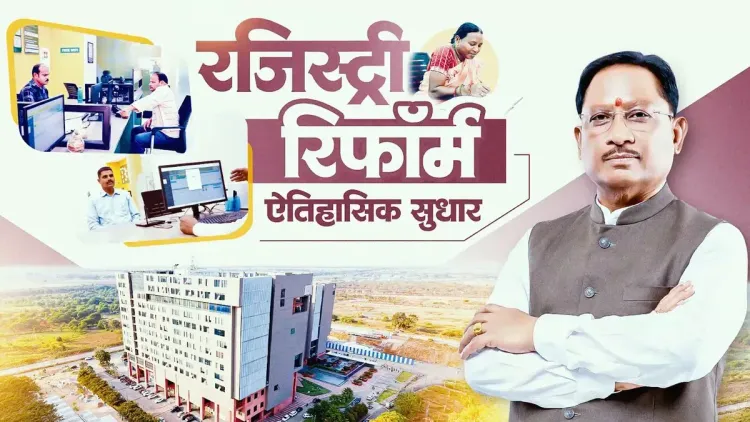
Chhattisgarh Chief Minister Vishnu Deo Sai on Saturday, 27 June 2026 announced sweeping reforms to the state's property registration system, pledging to make the process simpler, more secure, transparent, and citizen-friendly through the adoption of modern technology and innovation.
Context
In a post on X, Chief Minister Sai stated: 'नागरिकों को सरकारी सेवाएं सरल, पारदर्शी और समयबद्ध तरीके से उपलब्ध कराना ही सुशासन की पहचान है' — 'Providing government services to citizens in a simple, transparent, and time-bound manner is the hallmark of good governance.' He added that the goal is for every citizen to receive better services, save time, and develop stronger trust in the administration. The announcement signals that the BJP government in Chhattisgarh, which came to power in December 2023, is moving to overhaul the stamps and registration department as a visible governance deliverable.
Policy Backdrop
Property registration reform in India has a long lineage. The National Land Records Modernization Programme (NLRMP), launched in 2008, set out to computerise land records and sub-registrar offices across all states. The broader Digital India programme, launched in 2015, further accelerated efforts to digitise citizen-facing government services and reduce processing delays.
Several states — including Maharashtra, Karnataka, and Madhya Pradesh — have already introduced online registration portals, e-stamping, and biometric authentication at sub-registrar offices. Chhattisgarh's announced reforms place the state on a similar trajectory, aiming to close the gap with these early movers and cut opportunities for rent-seeking in property transactions.
Stakeholders and Impact
The primary beneficiaries are Chhattisgarh's property owners and ordinary citizens who interact with the registration system for transactions such as land sales, lease deeds, and mortgage registrations. Reducing paperwork and wait times at sub-registrar offices has direct economic value, particularly for rural and tribal communities in the state who may have limited means to navigate bureaucratic delays.
Transparency upgrades — such as digitised records and online status tracking — also reduce the scope for unofficial payments that have historically plagued registration offices across India. For the BJP government, visible improvements in a high-contact public service carry political weight ahead of future electoral cycles.
What's Next
The specific technological tools and timelines for the reformed registration portal are yet to be detailed publicly by the state government. Observers will watch for concrete rollout dates from the Chhattisgarh Stamps and Registration Department, measurable changes in average processing times, and citizen grievance data that can independently verify the reform's on-ground impact. How quickly the state translates this policy intent into operational change will determine whether the initiative becomes a replicable model for other BJP-governed states.
Point of View
Digitising a process that directly affects property-owning households serves both a governance and a political purpose. The reform also aligns with the central party's 'good governance' brand, allowing the state unit to claim credit for a national-level agenda. Whether the initiative produces measurable outcomes or remains aspirational will hinge on implementation quality and the speed at which the state's bureaucracy adapts.
NationPress
27 Jun 2026
Frequently Asked Questions
What reforms has Chhattisgarh CM Vishnu Deo Sai announced for property registration?
CM Vishnu Deo Sai announced on 27 June 2026 that Chhattisgarh's registration system is being overhauled using modern technology to make property registration simpler, more secure, transparent, and time-bound for citizens.
How will Chhattisgarh's new registration system benefit citizens?
Citizens stand to benefit from reduced paperwork, faster processing times, online status tracking, and lower scope for unofficial payments at sub-registrar offices under the reformed system.
What is the National Land Records Modernization Programme?
The National Land Records Modernization Programme (NLRMP), launched in 2008, is a central government initiative to computerise land records and registration offices across Indian states.
Which states have already digitised their property registration process?
Maharashtra, Karnataka, and Madhya Pradesh are among the states that have already introduced online registration portals, e-stamping, and biometric authentication at sub-registrar offices.
When did Vishnu Deo Sai become Chief Minister of Chhattisgarh?
Vishnu Deo Sai was sworn in as Chief Minister of Chhattisgarh in December 2023 after the BJP won the state assembly elections.