CM Sai Cabinet Clears VB-G Ram Ji Yojana, 125-Day Rural Jobs Plan
Synopsis
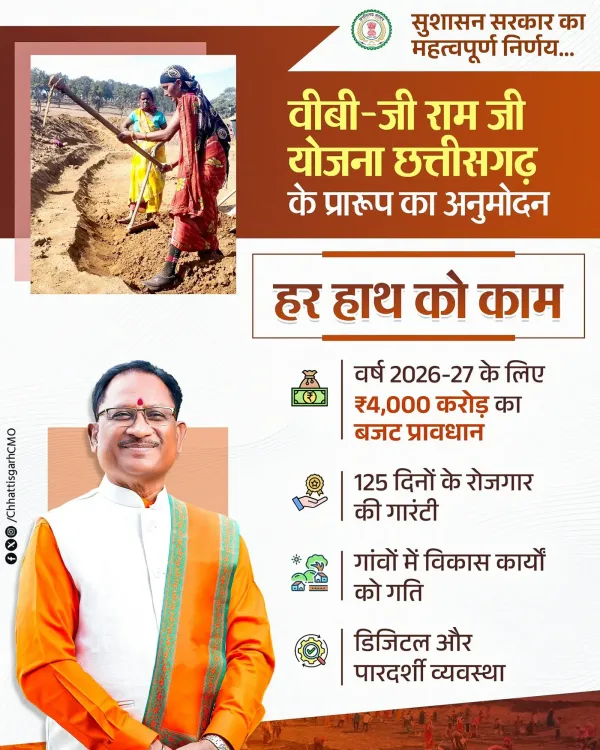
The Chhattisgarh cabinet under Chief Minister Vishnu Dev Sai has approved the draft framework of the VB-G Ram Ji Yojana, promising 125 days of guaranteed rural employment backed by a ₹4,000 crore budget, with a focus on water conservation and village self-reliance.
Key Takeaways
The Vishnu Dev Sai cabinet approved the draft framework of the VB-G Ram Ji Yojana Chhattisgarh on 24 June 2026 .
The scheme guarantees 125 days of wage employment to eligible rural households — 25 days more than the central MGNREGA entitlement of 100 days.
A budget provision of ₹4,000 crore has been earmarked for the initiative.
The scheme prioritises water conservation, rural development, and livelihood creation as its core activity pillars.
The stated goal is to make villages self-reliant (Atmanirbhar) and prosperous , aligning with the national Atmanirbhar Bharat framework.
Formal scheme guidelines, beneficiary registration and MGNREGA integration details are yet to be released.
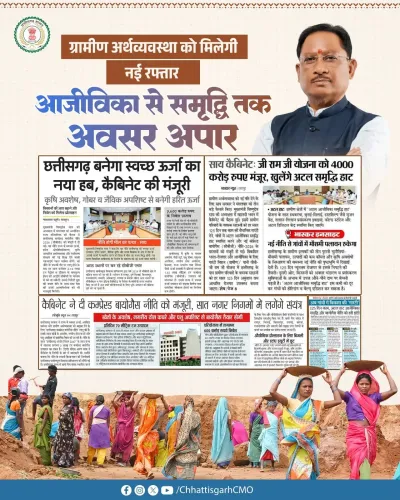
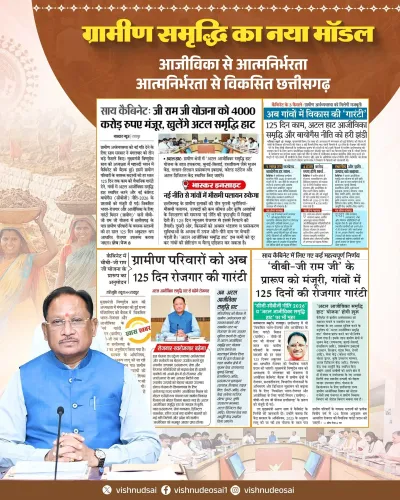
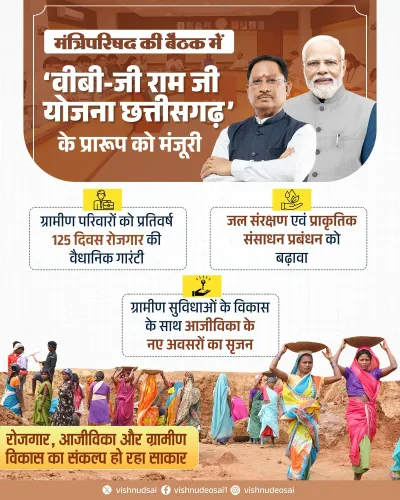
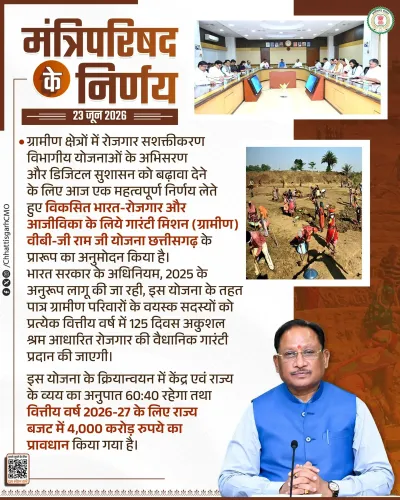
The Chief Minister's Office of Chhattisgarh announced on Wednesday, 24 June 2026 that the Vishnu Dev Sai cabinet has approved the draft framework of the VB-G Ram Ji Yojana Chhattisgarh, a state-sponsored rural employment scheme guaranteeing 125 days of wage work to eligible rural households across the state.
The post, shared by the official CMO handle, states: 'विष्णुदेव सरकार द्वारा कैबिनेट बैठक में वीबी-जी राम जी योजना छत्तीसगढ़ के प्रारूप का अनुमोदन किया गया' — ('The Vishnu Dev government approved the draft of the VB-G Ram Ji Yojana Chhattisgarh in a cabinet meeting'). The scheme carries a budget provision of ₹4,000 crore and is designed to reinforce water conservation, rural development, and livelihood creation, with the stated goal of making villages self-reliant and prosperous.
Context
Chhattisgarh is a central Indian state with a predominantly rural and tribal population that depends heavily on agriculture, forests, and seasonal labour. Seasonal unemployment in rural belts has long been a structural challenge, with many households relying on central employment guarantee programmes to bridge lean agricultural months. The new scheme directly addresses this gap by extending the employment guarantee beyond the national floor.
Policy Backdrop
India's Mahatma Gandhi National Rural Employment Guarantee Act (MGNREGA), enacted in 2005, provides up to 100 days of guaranteed wage employment per year to rural households. The VB-G Ram Ji Yojana proposes to top this up to 125 days, adding 25 additional days of state-funded employment — a model several Indian states have explored to address demand that outpaces MGNREGA's central allocation. The scheme's focus on water conservation works also aligns with a broader national push under the Atmanirbhar Bharat initiative since 2020, which promotes village-level self-reliance through natural resource management and local infrastructure creation.
Chief Minister Vishnu Dev Sai, who was sworn in December 2023 after leading the BJP to victory in the state assembly elections, has positioned rural welfare and good governance as central planks of his administration. The cabinet approval of this scheme's draft framework marks a significant policy move in that direction.
Stakeholders and Impact
The primary beneficiaries are eligible rural households in Chhattisgarh — particularly agricultural labourers and marginal farmers who face income gaps between cropping seasons. Water conservation works planned under the scheme are expected to generate community assets such as check dams, ponds, and watershed structures that benefit farming communities beyond the employment period itself. With a ₹4,000 crore budget provision, the scheme represents one of the larger state-level rural livelihood investments in recent years for Chhattisgarh.
Rural development agencies, gram panchayats, and self-help groups are likely to serve as implementation channels, though formal operational guidelines are yet to be published. The scheme's integration mechanism with the existing MGNREGA framework will be a key detail to watch as the programme moves from cabinet approval to rollout.
What's Next
The cabinet has approved only the draft framework at this stage; detailed scheme guidelines, beneficiary registration processes, and fund-release timelines are expected to follow in the coming months. Employment generation data and fund utilisation will be closely tracked by the state assembly's rural development committees and by civil society organisations working in Chhattisgarh's tribal and agrarian belts. If implemented at scale, the VB-G Ram Ji Yojana could set a precedent for other BJP-governed states considering supplementary rural employment guarantees above the MGNREGA baseline.
Point of View
While anchoring works in water conservation, is a politically astute move in a state where tribal and agrarian constituencies are decisive. The ₹4,000 crore budget provision is substantial, but the scheme's real test will lie in implementation fidelity — whether beneficiary registration is timely, works are productive, and funds are not diverted. If it delivers, Chhattisgarh could emerge as a reference model for BJP-governed states seeking to supplement central rural welfare architecture with state-funded layers.
NationPress
24 Jun 2026
Frequently Asked Questions
What is the VB-G Ram Ji Yojana in Chhattisgarh?
The VB-G Ram Ji Yojana is a state-level rural employment scheme approved in draft by the Chhattisgarh cabinet on 24 June 2026. It guarantees 125 days of wage employment to eligible rural households, with a focus on water conservation and rural development, backed by a ₹4,000 crore budget.
How is VB-G Ram Ji Yojana different from MGNREGA?
MGNREGA, the central government scheme enacted in 2005, provides up to 100 days of guaranteed rural employment per year. The VB-G Ram Ji Yojana extends this to 125 days through additional state funding, and places a specific emphasis on water conservation works and village self-reliance.
What is the budget for VB-G Ram Ji Yojana Chhattisgarh?
The Chhattisgarh government has earmarked a budget provision of ₹4,000 crore for the VB-G Ram Ji Yojana as part of the cabinet-approved draft framework.
Who will benefit from the VB-G Ram Ji Yojana?
Eligible rural households in Chhattisgarh — particularly agricultural labourers and marginal farmers — are the primary beneficiaries. The scheme aims to provide income support during lean agricultural seasons and generate community assets through water conservation works.
When will VB-G Ram Ji Yojana be implemented?
The cabinet has approved the draft framework as of 24 June 2026. Detailed operational guidelines, beneficiary registration processes, and rollout timelines are expected to be announced in the coming months.